
Non-FictionSelf-HelpRemote Work
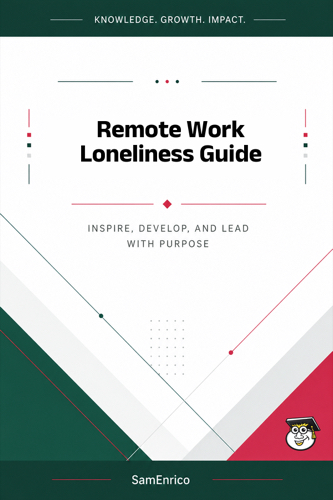
Remote Work Loneliness Guide eBook
Combat isolation while working from home using vir
Combat isolation while working from home using virtual and local connection strategies.
Formats
Free sample
Chapter 1: The 3 PM Wall--–- The dream of remote work is real: no commute, flexible hours, working in comfortable clothes, making your own coffee. But nobody warns you about 3 PM. That specific hour when the afternoon light shifts, the Slack notifications slow to a trickle, and you realize you haven't spoken a single word aloud in forty-eight hours. Not a meaningful word. Not a "good morning." Not even a frustrated curse at a printer, because you don't have a printer.
You have silence. And that silence has weight.This is not a metaphor. The silence of remote work is a physical presence in your home. It sits in the empty chair across from your desk. It lingers in the kitchen where no one eats lunch with you.
It climbs into bed with you at night, whispering that you spent another day as a ghost in your own life. You worked. You were productive. You maybe even had a "great day" by every metric your company uses to measure performance. And yet you feel hollow.You are not broken.
You are not weak. You are not secretly antisocial or ungrateful for the privilege of working from home. You are experiencing a structural mismatch between how your brain evolved to connect and how your workday is now structured. The loneliness you feel is not a personal failure. It is a failure of strategy.
And strategy can be fixed.This book exists because the current conversation about remote work loneliness is stuck in one of two unhelpful places. Either it tells you to "just join a gym" or "just call a friend" – as if loneliness were a simple lack of effort. Or it pathologizes remote work itself, suggesting that the only cure is returning to an office, as if fluorescent lights and open floor plans ever solved anyone's existential isolation. Both perspectives miss the point entirely.The truth is more nuanced and more actionable: loneliness in remote work is not about the absence of people. It is about the absence of micro-interactions – the tiny, almost invisible social moments that your nervous system evolved to expect.
You can be surrounded by family at home and still feel crushingly lonely because your work identity is invisible to them. You can have a hundred Slack contacts and still feel unseen because those digital connections lack the biological signals your brain craves.The Great Unspoken Let me tell you something that almost no one admits about remote work: you can succeed at every objective measure of your job and still feel like you're failing at being human.I have interviewed hundreds of remote workers over the past three years. Software engineers who ship code on time every sprint but cry in their cars during lunch breaks – except they don't have cars because they don't commute, so they cry in their bathrooms instead. Marketing directors who run flawless campaigns but cannot remember the last time a coworker asked them how their weekend was. Customer support managers who resolve every ticket and hit every KPI but have started talking to their houseplants just to hear a human voice – even their own.These are not outliers.
These are the norm. And almost all of them share the same secret shame: they believe they are the only ones feeling this way.They are wrong.A 2023 study from the American Psychological Association found that remote workers report loneliness at nearly twice the rate of in-office workers, even when they work on highly collaborative teams. Another study from the University of Exeter showed that the single strongest predictor of burnout in remote environments is not workload – it is perceived social disconnection. You can be drowning in tasks and still feel fine if you feel seen. You can have a reasonable workload and fall apart if you feel invisible.The pandemic-era shift to remote work was framed as a temporary crisis measure.
But for millions of workers, it has become permanent. According to Gallup, as of 2024, approximately 35 percent of U.S. employees with jobs that can be done remotely are working exclusively from home, with another 45 percent working in hybrid arrangements. That is tens of millions of people who have structurally changed how they work – but who have not structurally changed how they connect.We built the technology for remote work. We built the VPNs and the Slack channels and the Zoom licenses.
We built the project management software and the time tracking tools. We optimized for productivity until productivity became a religion. But we forgot to build the social infrastructure. We assumed that connection would happen naturally, the way it did in offices. We assumed that friendship would emerge from shared digital space the way it emerged from shared physical space.That assumption was wrong.The Watercooler Lie There is a myth about remote work that goes like this: the only thing you lost was the watercooler.
If only you could replicate those casual chats – the "hey, how was your weekend" moments – everything would be fine.This myth is dangerous because it is half true. Yes, the watercooler moments mattered. But reducing the loss to just the watercooler ignores the entire ecosystem of micro-interactions that sustained your nervous system without you ever noticing.Let me define what I mean by micro-interactions. These are not conversations. They are not meetings.
They are not planned social events. They are the tiny, spontaneous, often nonverbal moments of shared human presence that happen dozens or hundreds of times a day in a physical workplace:The nod of acknowledgment when you pass a coworker in the hallway The shared eye-roll during a tedious presentation that says "we're in this together"The spontaneous "you look tired, everything okay?" from someone who noticed because they saw your face The unconscious mirroring of body language that signals safety and belonging The ambient awareness of other people working nearby – the sound of typing, the clearing of throats, the crinkle of a snack wrapper The brief moment of standing side by side at the coffee machine, saying nothing, but existing together The laugh you overhear from three desks away that makes you smile without knowing why Each of these moments, by itself, is trivial. You would never miss any single one. But their cumulative absence is devastating.The Polyvagal Perspective To understand why micro-interactions matter so much, we need to briefly visit the biology of safety. I will keep this accessible because the science matters – but I also know that you are here for practical help, not a textbook.The human nervous system, as described by Dr.
Stephen Porges in his polyvagal theory, is constantly scanning our environment for cues of safety or threat. This happens below conscious awareness. You are not deciding to feel safe or threatened; your nervous system is calculating it automatically based on thousands of tiny signals.In an office environment, those safety cues are abundant. You see faces. You hear voices.
You smell coffee and the weird microwave popcorn that someone always burns. Your peripheral vision registers movement. Your ears register background chatter. All of this adds up to a constant, low-grade signal that says: you are part of a tribe. you are not alone.
if something goes wrong, someone will notice.In a remote work environment, those safety cues vanish almost entirely. Your home office…
This is the end of the free sample. Get the eBook to keep going. Buy now
About this book
Details
- Author
- Dennison Karon
- Publisher
- SamEnrico
- Language
- English
- Genre
- Non-Fiction, Self-Help, Remote Work
- Released
- 2026-06-11
- Pages (approx.)
- 133
- Available as
- eBook, Audiobook

Read better in the ZLOADR app
Your eBooks on your phone or tablet. Sign in with your SamEnrico account and start reading.
More by Dennison Karon
 Zumba Latin Rhythms DecoderDennison Karon$11.99
 Phobia Complete Treatment GuideDennison Karon$11.99
 Gaming Community Harassment CasesDennison Karon$11.99
 Antwerp Diamond Heist Locked Vault MysteryDennison Karon$11.99
 Into the Arctic Abyss: The Forgotten Pioneers of Ice Cave DivingDennison Karon$11.99
 The Velvet Noose: How a Nurse’s Hands Became WeaponsDennison Karon$11.99
 How to Start a Senior Care Service BusinessDennison Karon$11.99
 Understanding Double CortexDennison Karon$17.99
 Subcontractor UnionizationDennison Karon$12.99
 AI Sales Chatbot GuideDennison Karon$12.99
 CAD OperatorDennison Karon$11.99
You may also like
 Hong Kong Handover 1997Dunn Johnnie$11.99
 Zumba For Postnatal Recovery CourseNeal Christian$11.99
 Zumba for BeginnersLadner Nikia$11.99
 YouTube Comment Mining GuideHumes Pandora$12.99
 Worry Box MeditationCarlin Rudy$11.99
 Workplace Stress MeditationNguyen Lynn$11.99
 Workplace Stress and Sleep RepairHawley Ivory$11.99
 Workplace Perfectionism CureDelaney Jeffry$11.99
 Workplace Injustice Anger GuideWallen Isabelle$11.99
 Work Addiction and Burnout LinkGreenwood Ester$11.99
 Women in Yoga and WellnessBeattie Galina$11.99
 Women in Stand Up ComedyChun Evangeline$11.99