
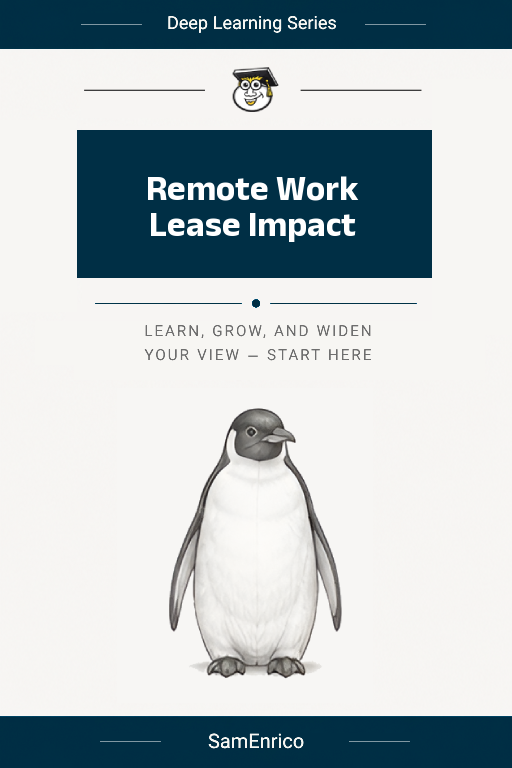
Non-FictionAnnual CheckupRemote WorkHybrid
Remote Work Lease Impact eBook
Adjust commercial leases for remote and hybrid wor
Adjust commercial leases for remote and hybrid work including reduced square footage and flexible terms.
Formats
Free sample
Chapter 1: The $1.75M Lie--–- Every morning, millions of CFOs, founders, and facilities directors walk into offices they no longer need. They swipe badges, ride elevators, and settle into desks that will remain empty for two-thirds of the week. Then they pay rent on those empty desks as if nothing has changed.The lie is not malicious. No landlord invented it. No broker conspired to deceive.
The lie is embedded in a single, unexamined metric that has governed commercial real estate for over a century: cost per square foot ($/SF). It is the oxygen of every lease negotiation, the anchor of every budget, and the reason most companies are quietly burning millions of dollars on space they do not use.This chapter dismantles that metric. It replaces it with three numbers that actually matter for hybrid work. And it introduces a decision framework that will change how you evaluate every lease—whether you are renewing next month or have five years remaining on a dinosaur of a contract.The Metric That Is Lying to You Cost per square foot is seductive because it is simple. A landlord offers 50,000 square feet at 50persquarefoot.Themathisclean:50 per square foot.
The math is clean: 50persquarefoot.Themathisclean:2.5 million per year. Compare that to another building at $45 per square foot, and the decision seems obvious.But here is what $/SF assumes: that every square foot is equally valuable, that you will use every square foot you pay for, and that density is the only variable that matters. In the hybrid era, none of these assumptions hold.Consider a concrete example. Company A signs a lease for 50,000 square feet at 50/SF,paying50/SF, paying 50/SF,paying2.5 million annually. Pre-pandemic, they filled those desks with 250 employees five days a week.
Today, their hybrid policy requires two days in the office. Peak attendance (typically Tuesday) reaches 160 people. The remaining 90 desks are never used. The meeting rooms sit empty three days a week. The breakroom, the phone booths, the corridors—all paid for 100% of the time but utilized perhaps 30% of the time.That company is not paying 50persquarefoot.Theyarepayinganeffectiverateofroughly50 per square foot.
They are paying an effective rate of roughly 50persquarefoot.Theyarepayinganeffectiverateofroughly167 per utilized square foot. And that is the lie. $/SF rewards density but punishes flexibility. The less you use your space, the more expensive each unit of actual occupancy becomes.The author and economist Tyler Cowen has noted that the biggest inefficiencies in modern business are not about production costs but about fixed assets that no longer fit the operating model. Office space is the largest fixed asset for most white-collar companies after payroll.
And it is the most mismatched.The Three Metrics That Actually Matter To escape the $/SF trap, you must replace it with three metrics that reflect real usage, real cost, and real outcomes.Metric 1: Cost per Employee (Real Estate Only)This is the simplest and most revealing number. Take your total annual rent plus operating expenses (CAM, taxes, insurance). Divide by your total headcount—not your peak headcount, not your desk count, but every employee whose work could theoretically be done in the office.Formula:Cost per Employee = (Annual Base Rent + Operating Expenses) / Total Headcount Why this metric matters: It forces you to see real estate as a per-person overhead line, not a square footage abstraction. If your cost per employee exceeds 8,000–8,000–8,000–10,000 (typical for major metros), you are in the danger zone. If it exceeds $15,000, you are subsidizing space you do not need.Example from the field: A 500-person marketing agency in Chicago was paying 4.2millionannuallyfor70,000squarefeet.Theircostperemployeewas4.2 million annually for 70,000 square feet.
Their cost per employee was 4.2millionannuallyfor70,000squarefeet.Theircostperemployeewas8,400. After a hybrid utilization audit (see Chapter 2), they discovered peak attendance of 180 people. They downsized to 35,000 square feet at 60/SF(60/SF (60/SF(2.1 million). New cost per employee: $4,200. They cut their real estate overhead in half while actually improving the office experience for those who showed up.Metric 2: Peak Utilization Rate This is the number that will make you angry.
And you should be angry, because most companies have never calculated it.Peak utilization rate is the maximum simultaneous occupancy of your office (on your busiest day of the week) divided by your total capacity. Capacity means the number of people you could theoretically seat if every desk and every meeting room was filled.Formula:Peak Utilization Rate = (Highest Single-Day Badge Swipes or Desk Bookings) / (Total Desks + Meeting Room Capacity)Target clarification (critical for this edition): The design target for physical space is 70–80% peak utilization. This prevents crowding on busy days while avoiding waste. However, if your actual peak utilization falls below 50%, you should not be in a fixed lease at all—you need a usage-based model (see Chapter 6). These are two different decisions: first, design your space for 70–80% of your expected peak attendance; second, if that expected peak is below 50% of your employee count, switch lease structures entirely.Why this metric matters: Most hybrid companies have peak utilization between 30% and 60%.
That means they are paying for 100% of their space but using less than two-thirds of it even on the busiest day. On quiet days, utilization can drop below 20%.Real-world data from a 2024 survey of 500 companies by the Workplace Intelligence Forum showed that the average peak utilization rate for companies with mandated 2–3 day hybrid policies was 54%. Companies with no mandate averaged 31%. Companies with a 4-day mandate averaged 78%. The implication is clear: your utilization rate is a direct function of your attendance policy, and your lease should reflect that policy—not the other way around.Metric 3: Outcome-Based Space Allocation This is the most advanced and most powerful metric.
It asks a question that almost no lease negotiation considers: What business outcomes does this space enable?Traditional space allocation is headcount-driven. You have 200 employees, so you need 200 desks (plus meeting rooms, plus break areas). Outcome-based allocation flips the logic. You start with the activities that require physical presence—collaborative projects, client meetings, hands-on training, confidential conversations—and you size space to those activities, not to bodies.Example: A software company with 300 engineers realized that their only in-person activities were weekly sprint planning (2 hours, 20 people), monthly all-hands (3 hours, all 300), and occasional client whiteboarding sessions (2–6 people). They downsized from 60,000 square feet to 12,000 square feet with four large collaboration suites, one town hall space, and no assigned desks.
Their cost per employee dropped from 9,000to9,000 to 9,000to1,800. Their engineering velocity actually increased because they stopped wasting time commuting for solo work that could be done at home.How to calculate outcome-based allocation:List every activity that your team currently does in the office.Mark each activity as “must be in-person” (e.g., hands-on equipment), “better in-person” (e.g., brainstorming), or “indifferent” (e.g., email, coding, reports).For “must” and “better” activities, estimate the maximum simultaneous participants.Size your space to that number, plus 20% buffer for variance.Everything else can be remote or asynchronous.This method typically reduces required square footage by 40–70% compared to headcount-based allocation.The Keep, Shrink, Convert, Exit Matrix Once you have calculated your three metrics—cost per employee, peak utilization rate, and outcome-based allocation—you need a decision framework for each lease. The Keep, Shrink, Convert, Exit matrix is that framework.Decision Conditions Actions Keep Peak utilization >70%; cost per employee $15,000; outcome-based allocation suggests completely different space…
This is the end of the free sample. Get the eBook to keep going. Buy now
About this book
Details
- Author
- Galarza Neoma
- Publisher
- SamEnrico
- Language
- English
- Genre
- Non-Fiction, Annual Checkup, Remote Work, Hybrid
- Released
- 2026-06-01
- Pages (approx.)
- 125
- Available as
- eBook, Audiobook

Read better in the ZLOADR app
Your eBooks on your phone or tablet. Sign in with your SamEnrico account and start reading.
More by Galarza Neoma
 Async QA and Testing GuideGalarza Neoma$11.99
 TM Daily Practice RoutineGalarza Neoma$11.99
 Meth Recovery Legal Issue GuideGalarza Neoma$11.99
 Counseling with MAT GuideGalarza Neoma$11.99
 Side Hustle Comparison CureGalarza Neoma$11.99
 The Velvet Underground: Exploding the Art of RockGalarza Neoma$11.99
 The Forgotten Broadcast: The Day the BBC VanishedGalarza Neoma$11.99
 Chat Support Free GuideGalarza Neoma$12.99
 Understanding Cote–adamopoulos–pantelakis SyndromeGalarza Neoma$17.99
 Cue SportsGalarza Neoma$11.99
 How to Start a Prepared Meat Dishes Business (Beginners Guide)Galarza Neoma$11.99
You may also like
 Hong Kong Handover 1997Dunn Johnnie$11.99
 Zumba For Postnatal Recovery CourseNeal Christian$11.99
 Zumba for BeginnersLadner Nikia$11.99
 YouTube Comment Mining GuideHumes Pandora$12.99
 Worry Box MeditationCarlin Rudy$11.99
 Workplace Stress MeditationNguyen Lynn$11.99
 Workplace Stress and Sleep RepairHawley Ivory$11.99
 Workplace Perfectionism CureDelaney Jeffry$11.99
 Workplace Injustice Anger GuideWallen Isabelle$11.99
 Work Addiction and Burnout LinkGreenwood Ester$11.99
 Women in Yoga and WellnessBeattie Galina$11.99
 Women in Stand Up ComedyChun Evangeline$11.99