
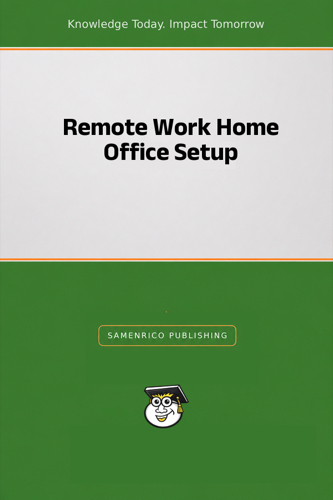
Non-FictionSelf-HelpErgonomics
Remote Work Home Office Setup eBook
Create an ergonomic space that supports sustained
Create an ergonomic space that supports sustained focus and health.
Formats
Free sample
Chapter 1: The Second Office--–- On a Tuesday morning in March, a senior software engineer named Priya sat down at her kitchen table with a laptop, a mug of coffee, and the sincere belief that she was about to have the most productive day of her career. She had just received approval for permanent remote work. Her company had sent a stipend for a new chair and a second monitor. She had cleared her calendar of meetings. She was ready.By 2:00 PM, she had accomplished almost nothing.Not because she was lazy.
Not because she lacked skill. Not because she was distracted by social media or household chores. Priya was a focused, disciplined professional who had delivered complex code under crushing deadlines for a decade. But on that Tuesday morning, something strange happened every time she tried to engage with a difficult debugging task. Her brain would begin the work, then—without her permission—drift toward the pile of mail at the end of the table.
Then to the dishes in the sink. Then to the half-remembered argument she had with her partner the night before. Then back to the mail. Then to a sudden, urgent need to reorganize her spice drawer.She told herself to focus. She tried harder.
She failed. And then she began to feel something worse than distraction: shame.Priya's experience is not a failure of character. It is a predictable, well-documented neurological response to a specific environmental condition—one that almost every remote worker unknowingly creates for themselves. The kitchen table, the spare bedroom, the corner of the living room: these are not neutral spaces. They are loaded with psychological meaning, visual obligations, and neural triggers that actively work against sustained focus.
And until you understand how your domestic environment shapes your brain, no amount of willpower, productivity apps, or expensive office furniture will save you.This chapter is not about buying a better chair or painting your wall blue. It is about understanding the hidden biology of your workspace—the three neurological traps that every home office hides, the unifying framework that explains why your brain behaves differently at home than in an office, and the single most important shift in perspective that will transform how you think about remote work. By the end of this chapter, you will see your home office not as a backdrop for work but as an active tool that shapes your neurology. And you will have a clear, actionable roadmap for turning that tool to your advantage.The Great Misunderstanding: Willpower Is Not the Answer Before we dive into the neuroscience, we must confront a myth that has caused immeasurable suffering among remote workers: the belief that focus is a moral virtue.This myth runs deep. When you cannot concentrate, the culture tells you that you are lazy, distractible, or insufficiently disciplined.
Productivity gurus sell you systems to "hack" your attention. Managers suggest you "just try harder." And when those interventions fail, you are left with a quiet, corrosive sense of personal failure.The truth is that sustained focus is not primarily a function of willpower. It is a function of environment.Consider an experiment from cognitive psychology. Researchers asked two groups of people to perform a demanding attention task. One group sat in a clean, organized room.
The other sat in a messy, cluttered room. The second group made significantly more errors, reported higher levels of stress, and gave up faster—even though they were told to ignore the clutter and focus solely on the task. Their willpower had not changed. Their environment had.This is the great misunderstanding of remote work. We treat our home offices as neutral containers—mere backdrops against which we either succeed or fail based on our inner resources.
But your environment is not neutral. It is constantly, silently, shaping your cognitive performance. Every object you see, every sound you hear, every scent you smell is being processed by your brain, either supporting your focus or eroding it.The goal of this book is to help you become the architect of that environment rather than its victim. And that transformation begins with understanding the three neurological traps that make home offices so uniquely challenging.Trap One: The Default Mode Network Deep within your brain, tucked between the two hemispheres, lies a network of interconnected regions known as the Default Mode Network, or DMN. Neuroscientists discovered the DMN accidentally in the 1990s while using brain scanners to study attention.
They noticed that certain brain regions consistently activated when subjects were doing nothing—resting, daydreaming, letting their minds wander. When subjects engaged in focused tasks, those regions went quiet. When the tasks ended, they lit up again.The DMN is your brain's neutral gear. It is the network that activates when you are not actively engaged in goal-directed behavior. And its primary functions are deeply unhelpful for work: autobiographical memory retrieval (remembering the past), mental time travel (imagining future scenarios), social cognition (worrying about what others think), and self-referential thought (the endless internal monologue about who you are and how you are being perceived).In other words, the DMN is the neural substrate of daydreaming, rumination, and distraction.Here is what most people do not understand: the DMN does not activate randomly.
It is triggered by environmental cues. Specifically, the DMN activates when you are in environments that your brain has learned to associate with rest, relaxation, or safety. Your living room couch. Your bedroom. Your kitchen table where you eat dinner.
Your brain has spent years building associations between these spaces and the DMN. When you sit down at your kitchen table to work, your brain receives conflicting signals. The conscious part of your brain says, "This is work." The ancient, automatic part of your brain says, "This is where I eat, rest, and scroll through my phone."The DMN wins that conflict every time. Not because you are weak, but because the environmental cue is more powerful than the conscious intention.This is why a curtain or a room divider can be more effective for focus than a $500 productivity course. A physical barrier changes the environmental cue.
When you cannot see the couch, your brain is less likely to activate the DMN. When you turn your desk to face a blank wall instead of the television, you deprive the DMN of its trigger. Visual separation is not aesthetic preference; it is neurological necessity.Trap Two: Cognitive Load Theory Every object in your peripheral vision makes a bid for your attention.This is not a metaphor. It is a measurable phenomenon. When your eyes register an object—a coffee mug, a stack of papers, a phone charger—your brain automatically processes it.
It identifies the object. It checks whether the object is relevant to your current goal. It assesses whether the object requires action. And then, if the object is irrelevant, your brain must actively suppress the urge to attend to it.All of this happens in milliseconds. And it happens for every single object in your field of view.Cognitive Load Theory, developed by educational psychologist John Sweller in the 1980s, describes the limited capacity of working memory.
Your brain can hold only a small amount of information at any given moment—roughly four to seven chunks. Everything else…
This is the end of the free sample. Get the eBook to keep going. Buy now
About this book
Details
- Author
- Bryson Mikaela
- Publisher
- SamEnrico
- Language
- English
- Genre
- Non-Fiction, Self-Help, Ergonomics
- Released
- 2026-06-10
- Pages (approx.)
- 151
- Available as
- eBook, Audiobook

Read better in the ZLOADR app
Your eBooks on your phone or tablet. Sign in with your SamEnrico account and start reading.
More by Bryson Mikaela
 Community Choir DirectorBryson Mikaela$11.99
 The Foster Care BackpackBryson Mikaela$11.99
 Major Depressive Disorder Suicide Prevention GuideBryson Mikaela$11.99
 Scented Candle Lead WicksBryson Mikaela$11.99
 Red Mafia HistoryBryson Mikaela$11.99
 Middle Passage Women CaptivesBryson Mikaela$11.99
 Success Without Burnout for CodersBryson Mikaela$11.99
 The Marble Dreamer: Canova and the Birth of NeoclassicismBryson Mikaela$11.99
 The Battle of Tabatonga: The Last Stand of the Ngoni Warriors (1895)Bryson Mikaela$11.99
 Service Providers Guide to Office Support ServicesBryson Mikaela$11.99
 How to Produce Water TablesBryson Mikaela$11.99
 A Collector's Handbook to the Mg F MagnaBryson Mikaela$11.99
You may also like
 Hong Kong Handover 1997Dunn Johnnie$11.99
 Zumba For Postnatal Recovery CourseNeal Christian$11.99
 Zumba for BeginnersLadner Nikia$11.99
 YouTube Comment Mining GuideHumes Pandora$12.99
 Worry Box MeditationCarlin Rudy$11.99
 Workplace Stress MeditationNguyen Lynn$11.99
 Workplace Stress and Sleep RepairHawley Ivory$11.99
 Workplace Perfectionism CureDelaney Jeffry$11.99
 Workplace Injustice Anger GuideWallen Isabelle$11.99
 Work Addiction and Burnout LinkGreenwood Ester$11.99
 Women in Yoga and WellnessBeattie Galina$11.99
 Women in Stand Up ComedyChun Evangeline$11.99