
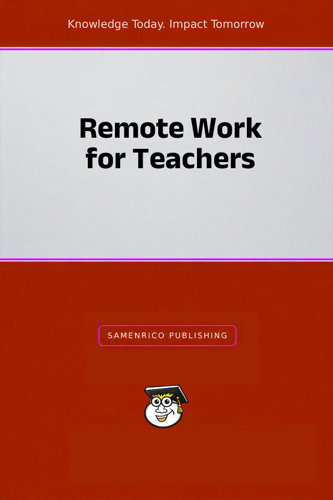
Remote Work for Teachers eBook
Plans lessons and virtual classes efficiently.
Plans lessons and virtual classes efficiently.
Formats
Free sample
Chapter 1: The Digital Atelier...--–- Maria had been a teacher for fourteen years. She knew how to manage a classroom of thirty-two restless seventh graders, how to read the room without saying a word, how to redirect off-task behavior with a glance. But on a Tuesday morning in October, sitting in her converted dining nook with a laptop perched on a stack of cookbooks, she whispered to her reflection in the dark Zoom screen: "I don't know what I'm doing anymore."Her students were there—at least, their names were. Sixteen black squares with white initials. One camera on, showing the ceiling fan of a student who had long since left the room.
She had spent three hours the night before building a beautiful Google Slides presentation with embedded videos and clever transitions. She had linked it in the chat. She had asked a question. Silence. Then a single chat message: "lol wut."Maria closed her laptop and cried for ten minutes.
Then she opened it again and answered thirty-seven parent emails.This is not a story about a bad teacher. This is a story about a good teacher who was set up to fail because no one ever taught her that remote teaching is not in-person teaching on a screen. It is a fundamentally different medium, with different rhythms, different tools, and different rules. And without understanding those rules, even the most dedicated educator will drown.This chapter is about building the foundation that Maria never had. Before you plan a single lesson, before you record a single video, before you send a single email, you need to construct the environment, the mindset, and the systems that will make efficiency possible.
Think of it as building your digital atelier—a workshop where creativity and productivity can flourish because the space itself does not fight against you.The Myth of the 24/7 Classroom When Maria moved her classroom to her dining nook, she made an invisible but devastating error: she stopped clocking out.In a physical school, there are natural boundaries. The bell rings. The students leave. You close your classroom door, walk to your car, and drive home. Even if you bring grading with you, the place of work is distinct from the place of rest.
But when your workplace is also your living room, your kitchen table, your bedroom dresser repurposed as a standing desk—the boundaries dissolve.Here is what teachers report when they first move to remote work without a system:Answering emails at 11 PM because the notification popped up while watching Netflix Grading assignments at 6 AM because the laptop was already open from the night before Feeling guilty for not working on Sunday because "the LMS is right there"Losing track of which day it is because every day looks the same on a screen This is not a failure of willpower. It is a failure of architecture. You cannot out-discipline a poorly designed environment any more than you can out-swim a rip current. The solution is not to try harder. The solution is to redesign the space so that working late becomes physically inconvenient.Step One: Physical Boundaries (Even in a Small Space)Let us be honest about your living situation.
Not everyone has a spare bedroom that can become a dedicated office. Some of you are reading this from a studio apartment, a shared kitchen table, or a corner of a bedroom. That is fine. Physical boundaries do not require square footage; they require intention.The Dedicated Surface If you do nothing else from this chapter, do this: designate one flat surface that is only for teaching. Not for eating breakfast.
Not for paying bills. Not for your child's Lego projects. That surface—whether a desk, a table, or a repurposed ironing board—is your classroom. When you are there, you are working. When you leave it, you are not.For teachers in very tight spaces, the solution can be a folding table that comes out at 8 AM and goes away at 4 PM.
The act of setting up and taking down becomes your commute. It forces a ritual. It forces a boundary.The Visual Barrier Human brains are terrible at abstract boundaries but excellent at visual ones. If you cannot close a door, create a visual barrier. A room divider.
A curtain. A large piece of cardboard leaned against a bookshelf. Even a bedsheet hung from a tension rod. The goal is not privacy; it is a signal to your brain that the space behind this barrier is different from the space in front of it.The "No Work" Zone Conversely, designate areas where work is forbidden. Your bed.
The couch where you watch television. The chair where you drink your morning coffee. These are sacred rest zones. Do not open your laptop there. Do not answer emails there.
If you must think about a lesson plan, use a notebook—not a screen. This trains your brain to associate certain physical locations with rest, which is essential for preventing burnout.Step Two: The Shutdown Ritual (Your Digital Commute Home)In a physical school, you have a commute. Even a short drive or walk serves a psychological function: it transitions you from "teacher mode" to "home mode." Remote teachers lose this transition. The result is a feeling of always being half-at-work, half-at-home, fully exhausted.The solution is a shutdown ritual—a deliberate sequence of actions that you perform at the end of each workday to signal to your brain that teaching is done.Here is a sample shutdown ritual, tested by hundreds of remote teachers:1. Close all tabs (all of them).Every browser tab, every document, every email draft.
Close them. Do not leave anything open for tomorrow. If you are afraid you will forget something, use a "parking lot" document—a single text file where you dump tomorrow's to-do items before closing it.2. Log out of your LMS and email.This is non-negotiable. Logging out means you cannot receive notifications.
It means checking email requires an extra step—a step you will only take during work hours.3. Clear your desk surface.Return everything to its designated place. Pens in a cup. Notebooks in a drawer. Laptop closed and, if possible, put away.
The visual emptiness of a clean desk signals completion.4. Change your clothes.If you wore "work clothes" (even just a nicer shirt for Zoom), change into "home clothes." This physical shift reinforces the mental shift.5. Say a closing phrase out loud.This sounds silly, and it works. Say "School's out" or "Done for the day" or "I am off the clock." Speaking the words aloud activates different neural pathways than just thinking them. It works.6.
Walk away.Leave the room. Do not come back until tomorrow.The entire ritual takes less than five minutes. It is the single highest-leverage habit in this chapter. Teachers who adopt a shutdown ritual report feeling 40% less anxious in the evenings and sleeping significantly better.Step Three: Time-Blocking for the Remote Teacher Most teachers plan their days by task: "grade papers," "plan lesson," "reply to emails." This is a recipe for disaster because it ignores the most precious resource: focused attention.The Pomodoro Method (Adapted for Teachers)The classic Pomodoro…
This is the end of the free sample. Get the eBook to keep going. Buy now
About this book
Details
- Author
- Leonard Deborah
- Publisher
- SamEnrico
- Language
- English
- Genre
- Non-Fiction, Self-Help, Education
- Released
- 2026-06-06
- Pages (approx.)
- 141
- Available as
- eBook, Audiobook

Read better in the ZLOADR app
Your eBooks on your phone or tablet. Sign in with your SamEnrico account and start reading.
More by Leonard Deborah
 Design Thinking for WebsitesLeonard Deborah$11.99
 Respiratory Support in DetoxLeonard Deborah$11.99
 Restless Leg Syndrome CalmLeonard Deborah$11.99
 Empathy in ConflictLeonard Deborah$11.99
 DBT Phone Coaching GuideLeonard Deborah$11.99
 Weight Loss Plateau HandbookLeonard Deborah$11.99
 Infant Back BlowsLeonard Deborah$11.99
 Love in the Shadows: The Wartime Letters of Lerner & LoeweLeonard Deborah$11.99
 Black Tornado: The Secret War for the FalklandsLeonard Deborah$11.99
 Ultimate Handbook Guide to Feicheng : (China) Travel GuideLeonard Deborah$11.99
 Food and Culture GuideLeonard Deborah$12.99
 ARIPO Banjul Protocol on MarksLeonard Deborah$12.99
You may also like
 Hong Kong Handover 1997Dunn Johnnie$11.99
 Zumba For Postnatal Recovery CourseNeal Christian$11.99
 Zumba for BeginnersLadner Nikia$11.99
 YouTube Comment Mining GuideHumes Pandora$12.99
 Worry Box MeditationCarlin Rudy$11.99
 Workplace Stress MeditationNguyen Lynn$11.99
 Workplace Stress and Sleep RepairHawley Ivory$11.99
 Workplace Perfectionism CureDelaney Jeffry$11.99
 Workplace Injustice Anger GuideWallen Isabelle$11.99
 Work Addiction and Burnout LinkGreenwood Ester$11.99
 Women in Yoga and WellnessBeattie Galina$11.99
 Women in Stand Up ComedyChun Evangeline$11.99