
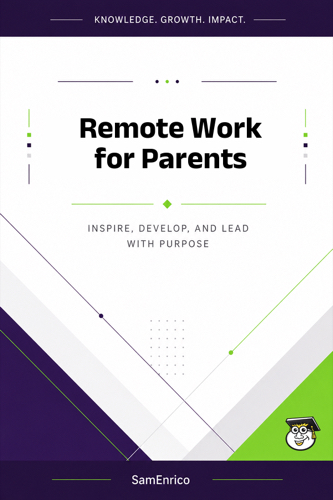
Remote Work for Parents eBook
Schedules work around child care and naps.
Schedules work around child care and naps.
Formats
Free sample
Chapter 1: The Jagged Path--The first time it happened, I cried in the closet.Not because my baby was in danger. Not because I had lost my job. But because I had done everything right—or so I believed. I had scheduled my calls for exactly 10:00 AM, believing with religious certainty that the 9:30 AM nap would last ninety minutes. I had prepped the bottle, darkened the room, and tiptoed out like a spy leaving a war zone.
At 9:47 AM, just as I was unmuting for a client presentation, the monitor lit up with a sound I had learned to dread: the wail of a child who had slept exactly seventeen minutes. My carefully constructed day collapsed like a wet sandcastle. I spent the next hour holding a crying baby with one hand and typing apologies with the other, feeling like a fraud in both roles.That night, I scrolled through parenting forums looking for someone who had solved this. Instead, I found thousands of parents describing the exact same closet. We were all trying to fit our families into a schedule designed for people without small humans.
And we were all failing, not because we lacked discipline, but because we were playing a game whose rules were written for a different reality.This chapter exists to give you permission to stop playing that game.The Great Lie of the 9-to-5 Nursery Let me name the assumption that is quietly destroying your sanity: If I just schedule my work neatly into my child's nap times, I can function like a childless employee. This is not a small miscalculation. It is the foundational error upon which most remote parenting advice is built. It assumes that babies and toddlers operate on predictable, trainable schedules. It assumes that a forty-hour workweek can be compressed into two-hour nap windows without friction.
And it assumes that you, an exhausted parent running on coffee and guilt, can somehow perform deep cognitive work the moment your child's eyes close.Every single one of these assumptions is false.The data from organizational psychology is clear: traditional productivity metrics—hours logged, uninterrupted blocks, continuous availability—were designed for factories and offices, not nurseries. In their groundbreaking work Four Thousand Weeks, Oliver Burkeman argues that the modern obsession with "optimizing" time is a trap. We cannot control time. We can only control our attention within it. When you add a child to the equation, the illusion of control shatters completely.
A baby's sleep cycle does not care about your 2:00 PM deadline. A toddler's separation anxiety does not respect your "focus block." The corporate clock is a human invention. The child's rhythm is a biological reality. When the two collide, biology wins every time.The research backs this up. A 2022 study published in the Journal of Business and Psychology found that remote parents who attempted to maintain strict 9-to-5 schedules experienced 47% higher burnout rates than those who adopted flexible, outcomes-based schedules.
The reason is simple: the cognitive cost of switching between "parent mode" and "worker mode" is exhausting. Every time your child wakes early, you don't just lose work time. You lose the emotional energy required to refocus. Over a week, those micro-fractures add up to a full day of lost productivity—not because you are lazy, but because you are human.The parents I interviewed for this book described the same pattern. A graphic designer named Mara told me she spent her daughter's first year trying to force a schedule.
"I had color-coded blocks," she said. "I had alarms. I had a whiteboard. And every single day, by 3:00 PM, I was either sobbing or screaming. The schedule wasn't helping me.
It was torturing me." Mara eventually abandoned the color-coded blocks and built something entirely different. She stopped asking "What should I be doing at 2:00 PM?" and started asking "What can I accomplish between now and the next interruption?"That question changed everything.Introducing the Jagged Schedule The Jagged Schedule is not a template. It is a mindset. It begins with a single radical acceptance: no two days look alike. Tuesday might gift you a ninety-minute nap.
Wednesday might give you three twenty-minute naps and a teething meltdown. Thursday might offer nothing but contact naps while you answer emails on your phone. The Jagged Schedule does not fight this chaos. It maps it.Think of it this way: a traditional schedule is a straight line. You plan to work from 9 to 11, then parent from 11 to 1, then work from 1 to 3.
But a child's day is not a straight line. It is a jagged line with spikes of intensity and sudden drops into quiet. The Jagged Schedule aligns your work with the shape of your actual day, not the shape of your ideal day.This means letting go of three toxic beliefs that remote parenting culture has sold you:Myth 1: "I should be able to work during every nap." No. Some naps are for recovery. Some naps are for eating a hot meal.
Some naps are for staring at the wall and remembering that you are a person, not a productivity machine. The parents who thrive are the ones who know which naps to sacrifice to rest.Myth 2: "If I had better discipline, I could make this work." Discipline is not the issue. The issue is that you are trying to impose a rigid structure on an unpredictable system. You would not blame a sailor for failing to make a boat go straight in a hurricane. Stop blaming yourself for failing to make your schedule hold in the chaos of early childhood.Myth 3: "Other parents have figured this out.
Why can't I?" The parents who appear to have figured it out are either lying, have full-time childcare, or have abandoned their own well-being. The ones who are actually succeeding have simply stopped pretending that predictability exists. They have built systems for chaos, not castles in the air.The Jagged Schedule replaces these myths with three new principles:Principle 1: Map reality before you design your day. You cannot fix what you do not see. Most parents operate on a fictional version of their time—what they wish they could do, not what they actually do.
The first step is an honest audit of your actual free minutes.Principle 2: Identify your unexpected windows. These are the moments you did not plan but that consistently appear: the twenty minutes after a bottle when the baby is drowsy and calm, the forty-five minutes of independent play after breakfast, the ten-minute window while the toddler is mesmerized by a new toy. These windows are not failures of scheduling. They are opportunities hiding in plain sight.Principle 3: Design for flexibility, not precision. A good schedule bends.
It has multiple entry points. It does not assume that your 10:00 AM block will happen. It asks: "If the nap ends early, what is my backup plan?" The parents who survive remote work are not the ones with perfect schedules. They are the ones with good enough systems that survive imperfection.The Weekly Chaos Audit Before you can build a Jagged Schedule, you need data. Not the data you wish you had.
The real, messy, frustrating data of your actual week.The Weekly Chaos Audit is a fifteen-minute Sunday exercise that will become…
This is the end of the free sample. Get the eBook to keep going. Buy now
About this book
Details
- Author
- Swain Vicenta
- Publisher
- SamEnrico
- Language
- English
- Genre
- Non-Fiction, Self-Help, Parenting
- Released
- 2026-06-06
- Pages (approx.)
- 140
- Available as
- eBook, Audiobook

Read better in the ZLOADR app
Your eBooks on your phone or tablet. Sign in with your SamEnrico account and start reading.
More by Swain Vicenta
 Family Role in Medicated DetoxSwain Vicenta$11.99
 Overthinking Stopping SleepSwain Vicenta$11.99
 Systems Thinking IntegrationSwain Vicenta$11.99
 Creative Conflict ResolutionSwain Vicenta$11.99
 Peninsular War GuideSwain Vicenta$11.99
 Blue Zone Family ChecklistSwain Vicenta$11.99
 Validating Joy GuideSwain Vicenta$11.99
 The Quantum Pioneers: Black Geniuses Who Shaped the UniverseSwain Vicenta$11.99
 The Poisoned Chalice: The Sisters Who Defied a Killer DoctorSwain Vicenta$11.99
 Service Providers Guide to Pediatric Allergy & ImmunologySwain Vicenta$11.99
 How to Start a Pile Knitted Fabric Business (Beginners Guide)Swain Vicenta$11.99
 How to Produce ICE Maker AccessoriesSwain Vicenta$11.99
You may also like
 Hong Kong Handover 1997Dunn Johnnie$11.99
 Zumba For Postnatal Recovery CourseNeal Christian$11.99
 Zumba for BeginnersLadner Nikia$11.99
 YouTube Comment Mining GuideHumes Pandora$12.99
 Worry Box MeditationCarlin Rudy$11.99
 Workplace Stress MeditationNguyen Lynn$11.99
 Workplace Stress and Sleep RepairHawley Ivory$11.99
 Workplace Perfectionism CureDelaney Jeffry$11.99
 Workplace Injustice Anger GuideWallen Isabelle$11.99
 Work Addiction and Burnout LinkGreenwood Ester$11.99
 Women in Yoga and WellnessBeattie Galina$11.99
 Women in Stand Up ComedyChun Evangeline$11.99