
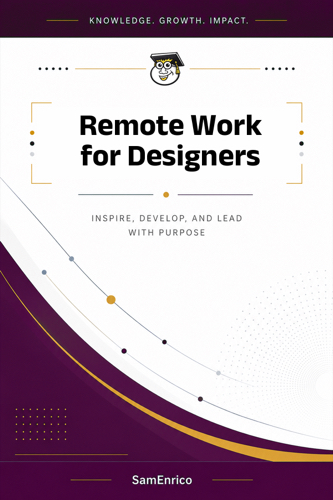
Remote Work for Designers eBook
Schedules creative sprints and client revisions.
by Mims Miquel
Schedules creative sprints and client revisions.
Formats
Free sample
Chapter 1: The Sprint Lie--The email arrived at 4:47 PM on a Friday. The subject line read: “Sprint went off the rails – can we debrief?”It was from Sarah, a product lead at a mid-sized fintech company. Three weeks earlier, she had been enthusiastic about running a “Google Ventures-style design sprint” with her fully remote team of seven designers, product managers, and engineers. She had read Jake Knapp’s book. She had watched the You Tube videos.
She had blocked off five days on everyone’s calendar, created the Miro boards, and told her CEO that they would have a tested prototype by Friday afternoon.Thursday afternoon, the sprint collapsed.Not with a dramatic explosion, but with a slow, quiet suffocation. The Monday mapping session had gone okay—four hours of Zoom, people talking over each other, a few participants clearly checking email on their second monitors. Tuesday’s sketching day was supposed to be “asynchronous,” but half the team misunderstood the instructions and showed up to an empty Zoom link anyway. Wednesday’s decision-making session turned into a two-hour debate between two senior designers while everyone else muted their mics and scrolled Twitter. By Thursday, when they were supposed to be prototyping, the team was exhausted, the client was confused, and no one could remember which Figma file was the “source of truth.”Sarah wrote in her email: “I don’t understand.
We followed the method exactly. What went wrong?”The answer is painful but simple: The design sprint was never designed for remote work.This chapter is that answer, unpacked. It is the post-mortem of every remote sprint that has failed, the diagnosis of why the most beloved design methodology of the past decade breaks when you remove the room, and the introduction of an alternative rhythm that actually works for distributed teams. If you have ever tried to run a five-day sprint over Zoom and felt like you were pushing a boulder uphill, this chapter is your permission slip to stop forcing it.The Three Hidden Pillars of the In-Person Sprint The Google Ventures design sprint, as documented in the 2016 bestseller Sprint, is a brilliant piece of methodology. It compresses months of work into five days.
It forces decisions. It produces tested prototypes. It has launched hundreds of successful products.But here is what the book does not tell you: The method depends on three invisible pillars that do not exist in remote work.Pillar One: Incidental Communication In a physical sprint room, communication happens constantly and effortlessly. You arrive in the morning and overhear the product manager talking to the engineer about a technical constraint. You walk to the whiteboard and see a designer’s sticky note that sparks a new idea.
You grab coffee with the user researcher and realize you misunderstood the customer problem. You eat lunch together and a casual comment unblocks a decision that was stuck for two hours.None of this happens on Zoom.On a video call, communication is scheduled, framed, and performed. You speak when it is your turn. You wait for someone to stop talking. You hesitate to interrupt because the social cost feels higher through a screen.
The incidental hallway conversation—the single most productive form of collaboration in the original sprint model—simply disappears. Research from Microsoft’s Human Factors Lab found that remote teams have 40 percent fewer “spontaneous interactions” than co-located teams. That is not a minor difference. That is the difference between a sprint that flows and a sprint that stalls.Pillar Two: Shared Physical Context In a physical sprint room, the work is everywhere. Sticky notes cover the walls.
Sketches are taped to windows. The problem statement is written on a whiteboard in large marker. The user journey map spans two walls. When you turn your head, you see the work. When you stand up to stretch, you see the work.
When you glance away from your computer to think, you see the work.This matters more than most designers realize. Shared physical context creates what cognitive scientists call “ambient awareness”—the low-grade, continuous sensing of what everyone is working on and what decisions have been made. You do not need to ask “What did we decide about the login flow?” because the sticky note is right there, in orange, at eye level. You do not need to re-explain the user persona because her face is taped to the door.On a remote sprint, the work lives in tabs. Figma is open in one tab.
Miro is open in another. The brief is in Notion. The chat log is in Slack. The client feedback is in email. Every time you need to reference something, you click away, lose context, and spend mental energy reorienting yourself.
Studies on “context switching” show that each tab switch costs an average of 23 seconds of cognitive recovery. Over a five-day sprint with seven participants, that adds up to hours of lost productivity.Pillar Three: Natural Time Constraints In a physical sprint, time is visible and enforced in ways that remote work cannot replicate. Lunch arrives at noon; the team stops working together. The building closes at 6 PM; everyone packs up. The facilitator says “we have ten minutes left in this exercise” and points to a physical timer on the table.
These constraints are not arbitrary—they create productive pressure. Parkinson’s Law states that work expands to fill the time available. The sprint compresses time intentionally to force decisions.On a remote sprint, time is amorphous. The 10 AM session runs to 10:45 because someone was late joining. The 2 PM breakout is supposed to be 60 minutes but stretches to 90 because no one wants to be the person who says “we need to stop.” The day bleeds into evening because everyone is already at their desk anyway.
Time zones turn “five days” into seven or eight calendar days as handoffs wait for morning in London and evening in San Francisco.I have watched remote sprints lose an entire day to time zone math alone. A designer in Australia finishes their sketching at 5 PM local time. They upload to Figma and tag the New York-based product manager. The product manager sees the notification at 7 AM their time, reviews for an hour, and leaves comments. The Australian designer wakes up to those comments at 6 PM their time—a full 24-hour cycle for what would have been a five-minute conversation in a physical room.Why Video Calls Make Everything Worse The most common response to these problems is: “We’ll just use Zoom more intensively.”This is the wrong answer.Video conferencing tools are optimized for presentation, not collaboration.
Look at the interface. The speaker is large. The content being shared is smaller. The chat is a sidebar. The dominant visual is a grid of faces waiting for their turn to speak.
This is a lecture hall, not a workshop.When you ask a team to collaborate on a complex design problem over video, you are asking them to perform a kind of cognitive gymnastics that humans are not built for. You must watch the speaker, read the shared screen, monitor the chat for questions, track your own thoughts, and manage your facial expressions to signal engagement—all…
This is the end of the free sample. Get the eBook to keep going. Buy now
About this book
Details
- Author
- Mims Miquel
- Publisher
- SamEnrico
- Language
- English
- Genre
- Non-Fiction, Self-Help, Design
- Released
- 2026-06-06
- Pages (approx.)
- 145
- Available as
- eBook, Audiobook

Read better in the ZLOADR app
Your eBooks on your phone or tablet. Sign in with your SamEnrico account and start reading.
More by Mims Miquel
 Willing Hands TechniqueMims Miquel$11.99
 Autism Sleep RoutineMims Miquel$11.99
 Design Thinking for RoadmapsMims Miquel$11.99
 Teresa of Ávila Interior Castle GuideMims Miquel$11.99
 Validating Failure FeelingsMims Miquel$11.99
 NVC for Teenagers GuideMims Miquel$11.99
 Elizabeth Virgin Queen MythMims Miquel$11.99
 The Silent Crusade: How a 12th-Century Nun Outsmarted the ChurchMims Miquel$11.99
 The Empress and the Iron Cage: Japan's First Solitary Confinement CaseMims Miquel$11.99
 A Collector's Handbook to the Hillman Minx Phase IMims Miquel$11.99
 ARIPO Well Known Marks ProtectionMims Miquel$12.99
 Master's Degree ComparisonMims Miquel$12.99
You may also like
 Hong Kong Handover 1997Dunn Johnnie$11.99
 Zumba For Postnatal Recovery CourseNeal Christian$11.99
 Zumba for BeginnersLadner Nikia$11.99
 YouTube Comment Mining GuideHumes Pandora$12.99
 Worry Box MeditationCarlin Rudy$11.99
 Workplace Stress MeditationNguyen Lynn$11.99
 Workplace Stress and Sleep RepairHawley Ivory$11.99
 Workplace Perfectionism CureDelaney Jeffry$11.99
 Workplace Injustice Anger GuideWallen Isabelle$11.99
 Work Addiction and Burnout LinkGreenwood Ester$11.99
 Women in Yoga and WellnessBeattie Galina$11.99
 Women in Stand Up ComedyChun Evangeline$11.99