
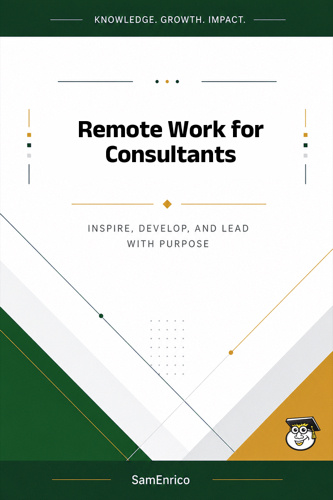
Non-FictionSelf-HelpConsulting
Remote Work for Consultants eBook
Manages client calls and deliverables from home.
Manages client calls and deliverables from home.
Formats
Free sample
Chapter 1: The Corporation of One--–- The day I stopped calling myself a freelancer and started calling myself the CEO of a one-person firm, my fees tripled in six months. The work I delivered did not change. My expertise did not suddenly double. My laptop was the same. My spare bedroom office was the same.
The only thing that changed was my identity—and that changed everything.I had been like most remote consultants: desperate to prove I was working. I answered emails at 11 PM. I billed by the hour and felt guilty about every bathroom break. I called myself a "freelancer" because that felt humble, and humble felt safe. Then a client referred to me as "their freelancer" in a group email, and something cracked inside me.
Freelancers are interchangeable. Freelancers are cheap. Freelancers get paid last.That night, I incorporated. Not just legally—I filed the paperwork, yes—but psychologically. I printed a fake stock certificate with my name on it and taped it above my monitor.
I started referring to my "Shareholder Value" (my health, my happiness, my time with my family) and my "Stock Price" (my reputation and my minimum fee). I told myself: you are not working from home. You are a B2B services corporation with a headcount of one. Your home office is not a makeshift compromise. It is your corporate headquarters.This chapter is about making that same shift.
Because until you see yourself as a business rather than a worker, no amount of Zoom etiquette or value-based pricing or fancy tech stacks will save you. You will remain an employee without a boss—which is the worst of both worlds.The Employee Mindset Trap Let me describe the employee mindset because you probably have it, and you probably do not know you have it.The employee mindset says: someone is watching. Even when you work from home, even when you set your own hours, a part of your brain believes there is a manager somewhere who will judge you for starting at 9:07 instead of 9:00. The employee mindset apologizes for taking lunch. It feels guilty about picking up a child from school.
It bills in six-minute increments because that is what the Big Four firms do, and the Big Four firms must know something you do not.The employee mindset also conflates effort with value. It believes that working sixty hours deserves more money than working forty hours, regardless of outcomes. This is why freelancers burn out: they sell time, and time is finite. You cannot work eighty hours every week without destroying your body and your relationships. But you can deliver enormous value in twenty hours if you solve the right problem for the right client.Here is the dirty secret that the employee mindset hides from you: no client cares how hard you worked.
They care whether their problem got solved. They care whether revenue went up or costs went down or risk was mitigated. The number of hours you stared at your screen is irrelevant to them. It is only relevant to you, in your employee mindset, as a proxy for legitimacy.I once had a client ask me how many hours a project would take. I said, "I do not know, and you should not care." He looked shocked.
I said, "Would you rather I spend two hundred hours and deliver a mediocre solution, or twenty hours and deliver a brilliant one?" He chose the brilliant one. I billed him $40,000 for those twenty hours—an effective rate of $2,000 per hour. He paid happily because his problem was solved.That is the difference between the employee mindset and the CEO mindset. The employee sells time. The CEO sells outcomes.Your Two Bottom Lines: Shareholder Value and Stock Price Every public corporation has two fundamental metrics: shareholder value (the return to investors) and stock price (the market's perception of future performance).
As a Corporation of One, you have the same two metrics. They are intimately connected, and you must grow both simultaneously.Shareholder Value Your shareholder is you. Not your family, not your future self, not your retirement account—although those are all downstream beneficiaries. Your shareholder is the person living in your body right now. Shareholder value means: your physical health, your mental well-being, your relationships, your sleep, your joy, your sense of purpose, and your freedom from financial anxiety.Most consultants neglect shareholder value entirely.
They grind. They take calls at 10 PM. They skip workouts to finish slide decks. They tell themselves that "someday" they will take a vacation. This is like a corporation paying out all its profits as executive bonuses while letting the factory crumble.
Eventually, the factory stops working. Eventually, you burn out or get sick or get divorced or just become so miserable that the money stops mattering.The Corporation of One protects shareholder value aggressively. That means:You establish a minimum acceptable fee that makes the work worthwhile (we will calculate this in a moment).You decline projects that would require unsustainable hours, even if the fee is high.You schedule rest, exercise, and family time as non-negotiable line items in your week.You treat your own health as a capital asset, not an optional luxury.Stock Price Your stock price is your market reputation and your fee rate. It is what the market believes you are worth. Unlike shareholder value, which is private and subjective, stock price is public and quantifiable.
It is the number you put on proposals. It is the way existing clients describe you to potential clients. It is the gap between "we should hire that consultant" and "we cannot afford not to hire that consultant."Stock price is not about self-esteem. It is about evidence. Your stock price rises when you deliver measurable outcomes, when you speak with authority, when you say no to cheap work, and when you position yourself as a peer to executives rather than a vendor to middle managers.Here is the crucial insight: shareholder value and stock price are not in conflict.
They reinforce each other. When you are well-rested and happy, you make better decisions, you communicate more clearly, and clients trust you more—which raises your stock price. When your stock price is high, you can work fewer hours for more money, which raises your shareholder value. The two metrics spiral upward together.The opposite is also true. If you grind yourself into exhaustion, your work quality suffers, your confidence erodes, and your stock price drops.
Then you take even more hours to make the same money, grinding yourself further. That is the death spiral of the employee mindset.Calculating Your Minimum Viable Annual Revenue Now we get to the numbers. This section replaces the traditional "break-even rate" calculation because break-even rates are hourly thinking, and we are not in the business of selling hours. Instead, you will calculate your Minimum Viable Annual Revenue (MVAR).MVAR is the total annual income you need to:Cover all your business expenses Cover all your personal living expenses Fund your health insurance Fund your retirement contributions Leave a margin for taxes Leave a margin for unexpected costs Notice that MVAR is an annual number, not an hourly…
This is the end of the free sample. Get the eBook to keep going. Buy now
About this book
Details
- Author
- Bermudez Maren
- Publisher
- SamEnrico
- Language
- English
- Genre
- Non-Fiction, Self-Help, Consulting
- Released
- 2026-06-06
- Pages (approx.)
- 153
- Available as
- eBook, Audiobook

Read better in the ZLOADR app
Your eBooks on your phone or tablet. Sign in with your SamEnrico account and start reading.
More by Bermudez Maren
 Teen Bedtime RelaxationBermudez Maren$11.99
 Priority Overload SolutionsBermudez Maren$11.99
 Blind Patient Withdrawal SupportBermudez Maren$11.99
 DBT for PTSD SymptomsBermudez Maren$11.99
 NEAT Non Exercise ActivityBermudez Maren$11.99
 Empathy Journal GuideBermudez Maren$11.99
 Catherine Power ConsolidationBermudez Maren$11.99
 Whispers of the Vanished: The Last Echoes of the AnasaziBermudez Maren$11.99
 Anansi’s Grail: The Spider’s Cunning QuestBermudez Maren$11.99
 A Collector's Handbook to the Hillman Minx (1932-33)Bermudez Maren$11.99
 How to Start a Nuclear Fuel Plant Business (Beginners Guide)Bermudez Maren$11.99
 Madrid Protocol China Extension GuideBermudez Maren$12.99
You may also like
 Hong Kong Handover 1997Dunn Johnnie$11.99
 Zumba For Postnatal Recovery CourseNeal Christian$11.99
 Zumba for BeginnersLadner Nikia$11.99
 YouTube Comment Mining GuideHumes Pandora$12.99
 Worry Box MeditationCarlin Rudy$11.99
 Workplace Stress MeditationNguyen Lynn$11.99
 Workplace Stress and Sleep RepairHawley Ivory$11.99
 Workplace Perfectionism CureDelaney Jeffry$11.99
 Workplace Injustice Anger GuideWallen Isabelle$11.99
 Work Addiction and Burnout LinkGreenwood Ester$11.99
 Women in Yoga and WellnessBeattie Galina$11.99
 Women in Stand Up ComedyChun Evangeline$11.99