
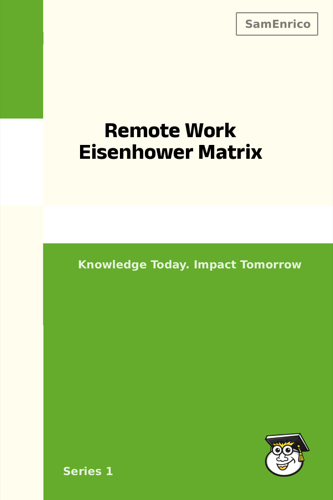
Remote Work Eisenhower Matrix eBook
Categorizes tasks by urgency and importance.
by Krauss Carey
Categorizes tasks by urgency and importance.
Formats
Free sample
Chapter 1: The Invisible Crisis--–- The first sign that something was wrong came not from a burnout, but from a spreadsheet.Sarah, a senior marketing manager who had been working remotely for eighteen months, opened her time-tracking app on a Tuesday morning expecting to see a normal week. What she found instead stopped her cold. She had worked 63 hours the previous week—far more than her contracted 40—yet when she scanned her completed tasks, she could not identify a single strategic accomplishment. She had answered 247 Slack messages, attended 14 video calls, and moved 38 emails from "Inbox" to "Archived." But the product launch she was supposed to be leading? She had spent exactly 45 minutes on it.Sarah is not real, but her crisis is.
She represents millions of remote workers who have discovered a disturbing paradox: they are working more hours than ever before, feeling more exhausted than ever before, yet accomplishing less of what actually matters. This is the invisible crisis of remote work—a silent epidemic that no one is talking about because everyone is too busy responding to notifications to notice.The Great Disappearance of Cues Let us begin with a simple question: How did you know what was important when you worked in an office?If you think about it, the physical workplace was a constant broadcast of prioritization signals. When your manager walked past your desk and paused, that was a cue. When a colleague knocked on your door frame, that was a cue. When the conference room filled with people for a last-minute meeting, that was a cue.
When everyone else started packing up at 5:30 PM, that was a cue to wrap up your own day.You did not have to think about these signals. They were ambient—like background music that told you when to speed up, when to slow down, when to collaborate, and when to go home.Remote work has not just changed where you sit. It has removed the entire operating system of environmental cues that your brain evolved to rely upon. And in that vacuum, something strange and deeply unproductive happens.The Two Pathologies of a Cue-Less World Without the natural boundaries and signals of an office, remote workers tend to fall into one of two pathological patterns. There is very little healthy middle ground.Pathology One: The Burnout Spiral The first group becomes invisible in the opposite direction: they never stop working.Consider the physics of an office.
At 6:00 PM, the lights begin to dim automatically. The cleaning staff arrives. Your coworkers put on jackets and leave. These are not subtle hints—they are forceful environmental commands that say, "The workday is over."Remotely, there are no such commands. Your laptop looks exactly the same at 10:00 PM as it did at 10:00 AM.
Slack still pings. Emails still arrive. And because you are already at home, the boundary between "working" and "not working" dissolves into nothing.The result is a population of remote workers who answer messages at midnight, join calls during what used to be their commute, and feel a persistent low-level guilt whenever they step away from their screens. They are physically present with their families but mentally still checking notifications. They take fewer vacation days and when they do take them, they check email "just in case."Here is the cruel irony: these workers are putting in more hours, but their productivity is not increasing.
In fact, it is declining. A study of remote workers found that those who worked more than 50 hours per week were actually less productive than those who worked 40, because the extra hours were spent on low-value reactive work, not strategic thinking. They were burning out on busyness.Pathology Two: The Invisibility Trap The second group falls into the opposite problem. Without a manager physically present, they struggle to self-initiate. They wait for emails rather than pursuing proactive work.
They appear "green" on Slack for nine hours but accomplish little of substance.This is not laziness. It is a lack of structure. In an office, the environment itself creates a gentle pressure to begin work. The sound of keyboards clicking, the murmur of conversations, the simple fact of being in a professional space—these cues tell your brain, "It is time to produce."Remotely, those cues are gone. Your kitchen table, your home office, your couch—these spaces were previously associated with rest and personal life.
Your brain does not automatically reclassify them as "work zones" just because you opened a laptop. Without deliberate effort, many remote workers drift into a reactive mode: they answer what comes to them but never reach for what matters most.The invisibility trap is particularly dangerous because it is invisible to the worker themselves. They feel busy. They are typing and clicking. But when they look back at their week, they cannot point to a single significant output.The Bestseller Clues: Busyness versus Business These two pathologies are not new.
What is new is how remote work amplifies them. The foundational insights from the most successful productivity books of the past two decades have all pointed toward the same distinction—a distinction that remote work makes either devastating or liberating, depending on whether you understand it.In *The 4-Hour Workweek*, Tim Ferriss introduced a distinction that should be tattooed on every remote worker's forearm: the difference between busyness and business.Busyness is activity that looks like work but produces no meaningful results. It is rearranging files, answering non-urgent emails immediately, attending meetings that could have been emails, and perfecting details that no one will notice. Busyness feels productive because it involves movement. But movement is not progress.Business is activity that directly produces results.
It is the one task that moves a project forward, the conversation that unblocks a decision, the thirty minutes of focused work that replaces three hours of scattered effort.In an office, busyness is somewhat constrained by environmental cues. You cannot spend three hours reorganizing your desk without someone noticing. Remotely, however, busyness thrives because activity is more visible than output. A remote worker who spends four hours carefully tagging documents in a shared drive looks busy—their Slack status is green, they are clicking and typing, they appear productive. A remote worker who spends two hours staring out a window thinking through a strategic problem looks idle.
The first worker is committing busyness. The second is doing business. But remote work rewards the appearance of activity over the reality of results.Then there is the second foundational insight, from Gary Keller's The One Thing: the concept of attention residue.Every time you switch from one task to another—from an email to a spreadsheet to a Slack message—you do not fully leave the first task behind. A piece of your attention remains attached to it, like a sticky residue that contaminates your next activity. Keller's research found that after ten task switches, your cognitive capacity is reduced by nearly half.
You are present but not productive.In an office, task switching is costly but somewhat limited. You have to physically move, turn around, or walk to another room. Remotely, task switching is frictionless and therefore endless. A single Slack notification costs you nothing…
This is the end of the free sample. Get the eBook to keep going. Buy now
About this book
Details
- Author
- Krauss Carey
- Publisher
- SamEnrico
- Language
- English
- Genre
- Non-Fiction, Self-Help, Prioritization
- Released
- 2026-06-09
- Pages (approx.)
- 121
- Available as
- eBook, Audiobook

Read better in the ZLOADR app
Your eBooks on your phone or tablet. Sign in with your SamEnrico account and start reading.
More by Krauss Carey
 Night Stalker Fan Mail CollectionKrauss Carey$11.99
 Email Sign Off GuideKrauss Carey$11.99
 The Ten Minute Full Body StretchKrauss Carey$11.99
 Franchising Your Local Brand Across Borders Ecommerce IntegrationKrauss Carey$11.99
 Rise from the Ashes: The Unbreakable Will of Simon BilesKrauss Carey$11.99
 Burke and Wills: The Dead Heart of AustraliaKrauss Carey$11.99
 How to Become a Checkroom AttendantKrauss Carey$11.99
 Understanding Cutis Marmorata Telangiectatica CongenitaKrauss Carey$17.99
 Energy Efficiency Tax DeductionKrauss Carey$12.99
 Social Media Strategy One PageKrauss Carey$12.99
 Azure Ad IAM Solution IntegratorKrauss Carey$11.99
You may also like
 The Remote Task Prioritization GuideGaddis Micaela$11.99
 The Eisenhower Block MatrixLedford Tanja$11.99
 Goal Prioritization MatrixSheets Cordell$11.99
 The Trigger Hierarchy MethodOsgood Cole$11.99
 The Remote Work Power ListCabral Bernita$11.99
 The Anger Budget WorkbookRollins Sherell$11.99
 Remote Worker Task PrioritizationTrinidad Cristobal$11.99
 The Remote Work Daily ThreeHoneycutt Bobbie$11.99
 Remote Worker Priority MatrixReece Fran$11.99
 Remote Dot Voting GuidePerrin Terese$11.99
 Priority Task First RuleNunn Rocky$11.99
 Collaborative Idea Shedding GuideMaxey Solange$11.99