
Non-FictionSelf-HelpCore HoursFlexibility
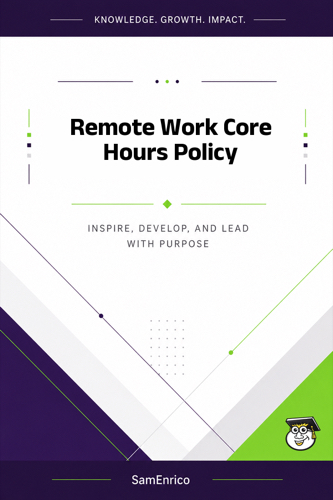
Remote Work Core Hours Policy Audiobook
Define overlapping hours for collaboration and fle
Define overlapping hours for collaboration and flexible hours for deep work.
Formats
Free sample
Chapter 1: The Performance Trap--–- Sarah had been online for eleven hours. Her Slack status flickered between “active” and “away” only when she walked the seven steps from her desk to the kitchen and back. She had replied to forty-three messages, attended six meetings, and sent nineteen emails. At 9:00 PM, her manager sent a public praise message in the general channel: “Look at Sarah grinding it out. This is dedication.” Three months later, Sarah resigned.
She was not burned out in the dramatic sense—no breakdown, no tearful exit interview. She simply admitted something that her manager never saw coming: “I haven’t done anything meaningful in two months. I just got really good at looking busy.”This is not an outlier story. It is the quiet epidemic of modern knowledge work.We have built an entire workplace culture around the measurement of presence rather than the production of value. The 9-to-5 schedule, invented for factory workers who pulled levers and stacked boxes, has been clumsily strapped to knowledge workers who write code, design systems, and solve abstract problems.
And it is failing. Spectacularly. But the failure is invisible because the metrics we use are precisely the wrong ones. We count hours online. We measure response times.
We reward the people who are always there, always replying, always visible. We call it dedication. Sarah calls it a trap.The Invention of a Myth The eight-hour workday did not emerge from science. It did not come from a study on human cognition or an optimization of creative output. It came from the Industrial Revolution, specifically from Welsh industrialist Robert Owen, who coined the slogan “Eight hours labour, eight hours recreation, eight hours rest.” In 1866, the International Workingmen’s Association adopted the eight-hour day as a demand.
The Ford Motor Company implemented it in 1914, not because it was optimal for productivity but because it reduced turnover and allowed for shift work in factories.Here is what no one tells you: that schedule was designed for repetitive, linear, physical labor. On an assembly line, hour eight looks exactly like hour two. The task is identical. The required cognitive load is constant. Fatigue matters, but the work does not become more complex or more abstract as the day progresses.Knowledge work is the opposite.When you are writing a strategy document, debugging a codebase, designing a user interface, or synthesizing customer feedback, hour eight is not…
This is the end of the free sample. Get the Audiobook to keep going. Buy now
About this book
Details
- Author
- Pagan Melissia
- Publisher
- SamEnrico
- Language
- English
- Genre
- Non-Fiction, Self-Help, Core Hours, Flexibility
- Released
- 2026-06-09
- Pages (approx.)
- 136
- Available as
- eBook, Audiobook

Listen in the VoxFlicks app
Audiobooks and audio dramas wherever you go. Sign in with your SamEnrico account and press play.
More by Pagan Melissia
 Financial Stress Mindfulness WorkbookPagan Melissia$11.99
 The Filter Literacy GuidePagan Melissia$11.99
 Gambling Addiction for GriefPagan Melissia$11.99
 Orthotic Brace FittingPagan Melissia$11.99
 Learn to Play the TimplePagan Melissia$11.99
 Technical Documentation ChecklistPagan Melissia$12.99
 How to Start a Blackplate Business (Beginners Guide)Pagan Melissia$11.99
You may also like
 Hong Kong Handover 1997Dunn Johnnie$11.99
 Zumba For Postnatal Recovery CourseNeal Christian$11.99
 Zumba for BeginnersLadner Nikia$11.99
 YouTube Comment Mining GuideHumes Pandora$12.99
 Worry Box MeditationCarlin Rudy$11.99
 Workplace Stress MeditationNguyen Lynn$11.99
 Workplace Stress and Sleep RepairHawley Ivory$11.99
 Workplace Perfectionism CureDelaney Jeffry$11.99
 Workplace Injustice Anger GuideWallen Isabelle$11.99
 Work Addiction and Burnout LinkGreenwood Ester$11.99
 Women in Yoga and WellnessBeattie Galina$11.99
 Women in Stand Up ComedyChun Evangeline$11.99