
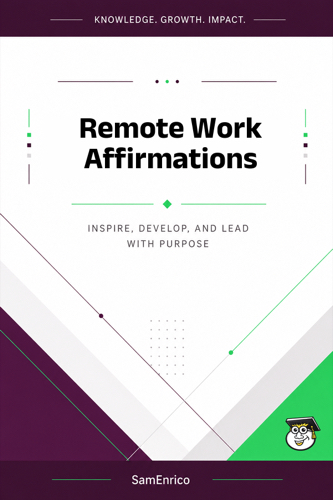
Remote Work Affirmations eBook
undefined
by Segura Lina
undefined
Formats
Free sample
Chapter 1: The Guilt Taxonomy--–- You are reading this book because you feel guilty. Not the sharp, specific guilt of having done something wrong—you did not steal from your employer or lie on your timesheet. You feel a low, humming, atmospheric guilt that follows you from your bedroom to your desk to your kitchen to your couch. It whispers at 10am when you take a five-minute break to throw in laundry. It hisses at 2pm when the afternoon slump hits and you stare out the window for sixty seconds longer than you should.
It shouts at 5pm when you close your laptop and the house is quiet and you think: Should I do one more thing? Just one more email?You cannot name this guilt. That is the problem.When you cannot name a feeling, you cannot disarm it. You can only endure it, or worse, try to outrun it by working harder, longer, more frantically. You tell yourself that if you just send that one extra message, if you just stay online until 7pm, if you just prove that you are not slacking—then the guilt will stop.
It never does. Because the guilt is not coming from your behavior. It is coming from a mismatch between your ancient, office-trained brain and your new, remote-working life.This chapter is going to give you a map. You are going to learn the four distinct types of remote work guilt, how to recognize each one in real time, and why guilt is actually a signal—not a verdict. By the end of this chapter, you will stop asking "Why do I feel so weird about working from home?" and start asking "Which guilt is speaking right now, and what does it actually need?"That shift—from mystery to taxonomy—is the difference between drowning in guilt and using it as data.The Unspoken Epidemic of Remote Guilt Let us name what most remote work books ignore.
You are not struggling with productivity. You are not struggling with time management. You are not struggling with software, hardware, or Wi-Fi signal strength. You are struggling with a feeling that has no place to land and therefore attaches to everything.A 2023 study from the National Bureau of Economic Research found that remote workers reported significantly higher levels of guilt than their in-office counterparts, even when their objective productivity was identical or higher. The researchers called it the "visibility penalty"—the sense that because no one can see you working, you must not be working hard enough.
But guilt showed up in other ways too. Workers felt guilty about taking breaks, about setting boundaries with family, about enjoying the time they saved from commuting, about logging off at a reasonable hour.The study concluded with a frustrating observation: remote workers are not actually doing anything wrong. They are just doing it in the wrong emotional container. Their brains are still running office software on a home operating system.Think of it this way. For decades, your brain learned a set of unconscious rules about what "work" looks like.
Work happens in a building. Work happens between 9am and 5pm. Work involves seeing other people work. Work involves a commute that separates "work you" from "home you." These rules were never written down, but they were deeply encoded in your nervous system. They were the water you swam in.Now the water is gone.
You are working from home, often alone, often without a clear start or end time, often without the visual cues that used to tell your brain "you are being productive." Your brain does not know what to do with this freedom. So it defaults to anxiety. And anxiety, when you cannot locate its source, feels like guilt.But here is the truth that will set you free: your guilt is not a single thing. It is four different things wearing the same mask. Once you learn to see the mask for what it is, you can stop fighting a shadow and start addressing the actual source.The Four Faces of Remote Guilt After studying hundreds of remote workers across industries, analyzing the most successful remote work literature, and synthesizing decades of research on workplace psychology, I have identified four distinct types of remote work guilt.
Every single guilty feeling you have experienced since working from home falls into one of these four categories. None of them are your fault. All of them have a solution.Type 1: Visibility Guilt – "If They Can't See Me, They Won't Value Me"This is the most common form of remote guilt, and the one that keeps people chained to their desks long after their work is done. Visibility guilt whispers: "Your manager doesn't know what you're doing right now. Therefore, they assume you're doing nothing.
Therefore, you are in danger of being fired, passed over, or forgotten."Visibility guilt is a holdover from the office era, where physical presence was a proxy for productivity. In many offices, the employees who stayed late were seen as harder workers, even if they spent those extra hours scrolling social media. The employees who arrived early were seen as more dedicated, even if they spent the first hour making coffee and chatting. Visibility was not the same as output, but it felt the same to managers.Your brain learned this equation: Presence = Safety. Now that you are remote, presence is invisible.
Your brain panics. It floods you with cortisol and tells you to do something—anything—to be seen. So you send unnecessary emails. You over-share in Slack. You stay online after hours.
You feel guilty the moment you step away from your keyboard.The truth: Presence is not productivity. Your manager does not want to see you; they want results. Visibility guilt is a lie your brain tells you to protect you from an old threat (the corner office boss who judged by sight). That threat does not exist anymore. You can thank your brain for trying to protect you, and then ignore the alarm.The solution: You will find the complete solution to visibility guilt in Chapter 7, where we build the Daily Three-Sentence Update—a simple, predictable system for proving your value through results, not presence.
For now, just learn to recognize visibility guilt when it appears. The phrase is: "I feel guilty because I am not being seen."Type 2: Boundary Guilt – "I'm Being Selfish by Protecting My Focus"Boundary guilt is the second most common form, and it often masquerades as politeness. You are on a roll with a deep work task. Your phone buzzes. Your partner knocks on the door.
Your child wants a snack. Your roommate asks a question. You want to say "Not now," but the guilt rises immediately: "You're being rude. You're being selfish. You're prioritizing your work over your relationships."Boundary guilt is the voice that tells you that setting a limit makes you a bad person.
It confuses protection with rejection. A closed door feels like a slammed door. A silenced phone feels like a ignored friend. An away message feels like abandonment.This guilt is particularly vicious because it works both directions. When you are working, you feel guilty for not…
This is the end of the free sample. Get the eBook to keep going. Buy now
About this book
Details
- Author
- Segura Lina
- Publisher
- SamEnrico
- Language
- English
- Genre
- Non-Fiction, Self-Help / Affirmations
- Released
- 2026-06-08
- Pages (approx.)
- 131
- Available as
- eBook, Audiobook

Read better in the ZLOADR app
Your eBooks on your phone or tablet. Sign in with your SamEnrico account and start reading.
More by Segura Lina
 Atomic Habits For Letting GoSegura Lina$11.99
 The Workplace Self Respect PrimerSegura Lina$11.99
 Dating First Date NonverbalSegura Lina$11.99
 Mobile Game Gacha AddictionSegura Lina$11.99
 Wound Care Documentation LogSegura Lina$11.99
 Journey Method Locations GuideSegura Lina$11.99
 Alpha 2 Delta LigandsSegura Lina$11.99
 The Lost Queens of the Medieval Games: How Women Fought for Their Place in SportSegura Lina$11.99
 How to Produce Musical ToysSegura Lina$11.99
 How to Produce 100% Nylon YarnSegura Lina$11.99
 China to Ghana Shipping Times GuideSegura Lina$12.99
 Brackets and Ellipses CitationSegura Lina$12.99
You may also like
 Interruption AffirmationsBrunner Alysa$11.99
 Habit AffirmationsSanderson Belkis$11.99
 Goal Setting AffirmationsAviles Pattie$11.99
 Spending Affirmations GuideBrandt Zelda$11.99
 Divorce Affirmations AudioMccarter Gianna$11.99
 Child Loss AffirmationsYu Tori$11.99
 Pain AffirmationsHoff Connie$11.99
 Anticipatory Grief AffirmationsKirby Catarina$11.99
 Job Loss AffirmationsHarden Ayesha$11.99
 Gratitude AffirmationsLenz Amira$11.99
 Financial Stress Audio AffirmationsYarbrough Flor$11.99
 Anger Affirmations for CouplesLockwood Lynwood$11.99