
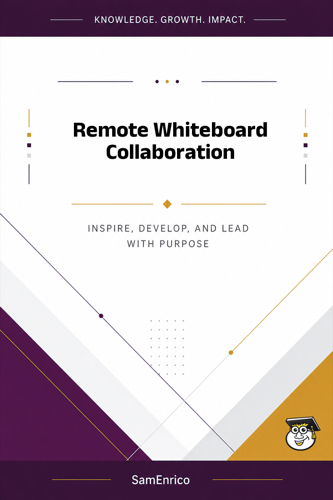
Non-FictionSelf-HelpVisual Collaboration
Remote Whiteboard Collaboration Audiobook
Use Miro, Mural, or Jamboard for visual brainstorm
Use Miro, Mural, or Jamboard for visual brainstorming and planning.
Formats
Free sample
Chapter 1: The Slide Deception--–- The email arrived at 9:47 AM on a Tuesday. "Team, please review the Q3 strategy deck before our 2 PM meeting. 47 slides. We'll move fast." Alex closed their laptop, stared at the ceiling, and felt the familiar weight settle behind their sternum. It wasn't dread, exactly.
It was something worse: resignation. Another hour of their life would vanish into the void of bullet points, unmuted microphones, and the quiet desperation of watching colleagues pretend to read slides they had already forgotten.This book exists because that feeling is not a personal failing. It is a systemic failure of the tools we have been trained to trust. The slide deck, for all its historical utility in boardrooms and lecture halls, is actively damaging remote collaboration. And the first step toward mastering remote whiteboard collaboration is admitting that the problem is not your team, your attention span, or your meeting culture.
The problem is the container itself.For the past decade, remote teams have been trying to fit the fluid, messy, beautiful work of human collaboration into a format designed for one thing: linear, presenter-driven information delivery. The slide deck assumes a single speaker, a captive audience, and a sequence that cannot be rewound, reorganized, or rewritten in real time. But remote work has shattered those assumptions. When your team is spread across six time zones, when half the participants are muted to protect their children's background noise, when the shared context is reduced to a grid of tiny faces, the slide deck becomes not just inefficient but actively counterproductive.This chapter dismantles the default corporate meeting culture of slide decks and linear documents. It argues that the remote brain suffers from what cognitive psychologists call "cognitive load"—the inability to hold complex relationships in memory when information is presented sequentially.
It introduces the neuroscience of visual thinking, specifically how mind maps and graphic organizers activate both hemispheres of the brain, improving recall by over thirty percent. And it presents the foundational shift that separates high-performing remote teams from struggling ones: the move from passive recording to active visual sense-making.By the end of this chapter, you will understand why your slide-based meetings are failing, why visual collaboration is not a "nice to have" but a neurological necessity, and how one fintech startup transformed its weekly planning from a ninety-minute slog into a sixty-minute brainstorming session that generated over two…
This is the end of the free sample. Get the Audiobook to keep going. Buy now
About this book
Details
- Author
- Larsen Celena
- Publisher
- SamEnrico
- Language
- English
- Genre
- Non-Fiction, Self-Help, Visual Collaboration
- Released
- 2026-06-09
- Pages (approx.)
- 129
- Available as
- eBook, Audiobook

Listen in the VoxFlicks app
Audiobooks and audio dramas wherever you go. Sign in with your SamEnrico account and press play.
More by Larsen Celena
 Sex Addiction And Bipolar Disorder GuideLarsen Celena$11.99
 Dreams in Human Trafficking RecoveryLarsen Celena$11.99
 Life Purpose Discovery GuideLarsen Celena$11.99
 Dreams After Police BrutalityLarsen Celena$11.99
 The Fury of Krakatoa: When the Indian Ocean RoaredLarsen Celena$11.99
 The Asura's Curse: How a Forgotten God Shaped Hindu CosmologyLarsen Celena$11.99
 Front Store ManagerLarsen Celena$11.99
 How to Become a Key CutterLarsen Celena$11.99
 GPT Prompts For Faster Essay DraftingLarsen Celena$12.99
 Understanding HemangiopericytomaLarsen Celena$17.99
You may also like
 Hong Kong Handover 1997Dunn Johnnie$11.99
 Zumba For Postnatal Recovery CourseNeal Christian$11.99
 Zumba for BeginnersLadner Nikia$11.99
 YouTube Comment Mining GuideHumes Pandora$12.99
 Worry Box MeditationCarlin Rudy$11.99
 Workplace Stress MeditationNguyen Lynn$11.99
 Workplace Stress and Sleep RepairHawley Ivory$11.99
 Workplace Perfectionism CureDelaney Jeffry$11.99
 Workplace Injustice Anger GuideWallen Isabelle$11.99
 Work Addiction and Burnout LinkGreenwood Ester$11.99
 Women in Yoga and WellnessBeattie Galina$11.99
 Women in Stand Up ComedyChun Evangeline$11.99