
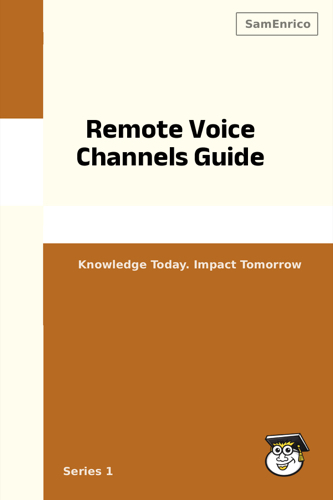
Non-FictionBusiness BriefVoice
Remote Voice Channels Guide eBook
Use voice messaging and walkie talkie apps for fas
by Varney Jolyn
Use voice messaging and walkie talkie apps for faster remote communication.
Formats
Free sample
Chapter 1: The Ping Paradox...--Imagine for a moment that you are a remote team leader named Sarah. It is 2:47 PM on a Tuesday. In the last ninety minutes, you have answered forty-seven Slack messages, attended a twelve-minute "quick sync" that ran to thirty-eight, and typed three paragraphs explaining a budget variance that could have been spoken in fifteen seconds. Your thumbs hurt. Your attention is shattered.
And you have just watched a colleague spend four messages and seven minutes clarifying what turned out to be a simple "yes."You are not alone. This is the daily reality of modern remote work.The problem is not that we have too few communication tools. The problem is that we have too many, and we are using them all for everything. We have stretched text chat—a medium designed for asynchronous, searchable, low-urgency exchange—into a real-time beast that demands instant replies. We have stretched email—a formal, archival medium—into a chat channel.
And we have stretched video calls, which require everyone to be present simultaneously, into spaces that could have been a three-sentence voice memo.The result is a paradox that I call the Ping Paradox: The more we communicate through text, the more exhausted we become, and the more we rely on real-time calls to compensate, which exhausts us further. Voice messaging and walkie-talkie apps sit in the perfect middle ground—faster than text, less intrusive than a call, more expressive than an email—yet most teams ignore them entirely. This book exists to fix that.In this chapter, we will dismantle the Ping Paradox piece by piece. We will look at the cognitive science of why typing wears you out more than speaking. We will examine the hidden costs of clarification loops.
We will diagnose whether your team suffers from Inbox Paralysis, Meeting Fatigue, or Context Switching Burnout. And by the end, you will understand why voice—not more text, not fewer meetings—is the single most underutilized lever for faster, saner remote communication.The Myth of the "Quick" Text Message Let us start with a simple experiment that you can run on yourself. Think of a moderately complex question you need to ask a colleague. Something like: "Can you review the Q3 budget by Friday and let me know if the marketing line item looks off?" Now, ask that question in two ways.First, type it out as a chat message. Notice what happens in your head.
You pause. You rephrase. You delete a word. You add a comma. You wonder if "looks off" is too vague.
You change it to "deviates from forecast." You delete that because it sounds stiff. You settle on "seems high compared to last quarter." This entire internal process takes perhaps twenty seconds. It feels like nothing. But your brain just performed a sequence of high-cognitive-load operations: planning, editing, perspective-taking, tone-checking, and future-proofing against misunderstanding.Now, speak the same question out loud as if you were leaving a voice message. Notice the difference.
The words come out in a natural flow. You might say: "Hey, could you look at the Q3 budget by Friday? The marketing number seems high compared to last quarter. Let me know if that jumps out at you." That took five seconds. Your brain did not edit itself mid-sentence.
You did not worry about punctuation. The tone was carried by your voice, not by careful word choice.This difference is not trivial. It is the difference between a medium that activates the prefrontal cortex—the part of your brain responsible for executive function, planning, and self-monitoring—and a medium that flows through the more primitive, faster, less effortful language centers. Speaking is natural. Typing is a skill.
And every time we default to text for anything beyond the simplest exchange, we are paying a cognitive tax that we barely notice but that accumulates across dozens of daily interactions.The research backs this up. A study cited in Andrew Brodsky's Ping (2025) found that professionals spend an average of 2.3 hours per day just managing chat threads—reading, triaging, responding, clarifying—and that nearly forty percent of that time is spent on messages that could have been replaced by a thirty-second voice memo. The same study found that switching from typing to speaking for a single moderately complex question reduced the time from question to resolution by an average of sixty-three percent.Let me repeat that: sixty-three percent.For a question that would take two minutes of back-and-forth over text, a thirty-second voice note plus a thirty-second voice reply resolves it in one minute. That is not a marginal improvement. That is a step function change in efficiency.But most teams do not use voice messaging because of a hidden belief that text is faster.
Text feels faster because we can type a sentence in a few seconds and hit send. But that is only the sending part. The full cycle—compose, send, read, interpret, clarify, reply—is almost always longer with text. We mistake the speed of transmission for the speed of communication. And that mistake is costing us hours every day.The Clarification Loop: Where Text Goes to Die There is a specific pattern of text-based communication that I want you to notice because once you see it, you will see it everywhere.
I call it the Clarification Loop.It starts innocently enough. Person A sends a text message: "Can you handle the Johnson report?" Person B replies: "Which parts?" Person A: "The financials." Person B: "All of them or just the summary?" Person A: "Just the summary but include the variance notes." Person B: "Okay, by when?" Person A: "Tomorrow end of day." Person B: "Got it."That exchange took seven messages and roughly two minutes of elapsed time. The same exchange as a voice memo would have taken fifteen seconds: "Hey, could you handle the Johnson report? Just the financials summary, but include the variance notes. Need it by tomorrow end of day.
Thanks." Person B replies with a ten-second voice memo: "Got it, will do."Here is what makes the Clarification Loop so insidious. Each individual text message feels fast. Typing "Which parts?" takes two seconds. But the loop—the back-and-forth, the waiting for replies, the context switching between other tasks—amplifies the time cost by a factor of three to five. Worse, each message in the loop interrupts both people.
Person A sends a message, switches back to another task, gets interrupted by the reply, switches back, sends another message, and so on. The cognitive cost of those context switches is often larger than the cost of the messages themselves.Research on task switching, first documented by Gloria Mark at the University of California, Irvine, shows that it takes an average of twenty-three minutes to fully return to a task after an interruption. Every chat message that requires a reply is a potential interruption. If you receive forty chat messages in a day that require some form of response, you are not "multitasking." You are fracturing your attention into forty fragments, and your brain is paying a switching cost each time.Voice messaging breaks the Clarification Loop in two ways. First, because voice messages are longer and more…
This is the end of the free sample. Get the eBook to keep going. Buy now
About this book
Details
- Author
- Varney Jolyn
- Publisher
- SamEnrico
- Language
- English
- Genre
- Non-Fiction, Business Brief, Voice
- Released
- 2026-06-09
- Pages (approx.)
- 139
- Available as
- eBook, Audiobook

Read better in the ZLOADR app
Your eBooks on your phone or tablet. Sign in with your SamEnrico account and start reading.
More by Varney Jolyn
 Self Esteem After Infidelity HandbookVarney Jolyn$11.99
 Memory Palace for Actors LinesVarney Jolyn$11.99
 Shift Work Workplace SafetyVarney Jolyn$11.99
 Timing Your Retirement MoveVarney Jolyn$11.99
 The Phantom Pain: How a Rare Brain Disorder Unlocked a Musical GeniusVarney Jolyn$11.99
 Frozen Whispers: The Lost Expedition of the *Aurora*Varney Jolyn$11.99
 Cross Cultural Mentoring TemplatesVarney Jolyn$12.99
 CV Writer Cold Email ScriptsVarney Jolyn$12.99
 Understanding Erythropoietic ProtoporphyriaVarney Jolyn$17.99
 Manager Silicon Design EngineeringVarney Jolyn$11.99Understanding Erythropoietic ProtoporphyriaVarney Jolyn$17.99
You may also like
 Hong Kong Handover 1997Dunn Johnnie$11.99
 Zumba For Postnatal Recovery CourseNeal Christian$11.99
 Zumba for BeginnersLadner Nikia$11.99
 YouTube Comment Mining GuideHumes Pandora$12.99
 Worry Box MeditationCarlin Rudy$11.99
 Workplace Stress MeditationNguyen Lynn$11.99
 Workplace Stress and Sleep RepairHawley Ivory$11.99
 Workplace Perfectionism CureDelaney Jeffry$11.99
 Workplace Injustice Anger GuideWallen Isabelle$11.99
 Work Addiction and Burnout LinkGreenwood Ester$11.99
 Women in Yoga and WellnessBeattie Galina$11.99
 Women in Stand Up ComedyChun Evangeline$11.99