
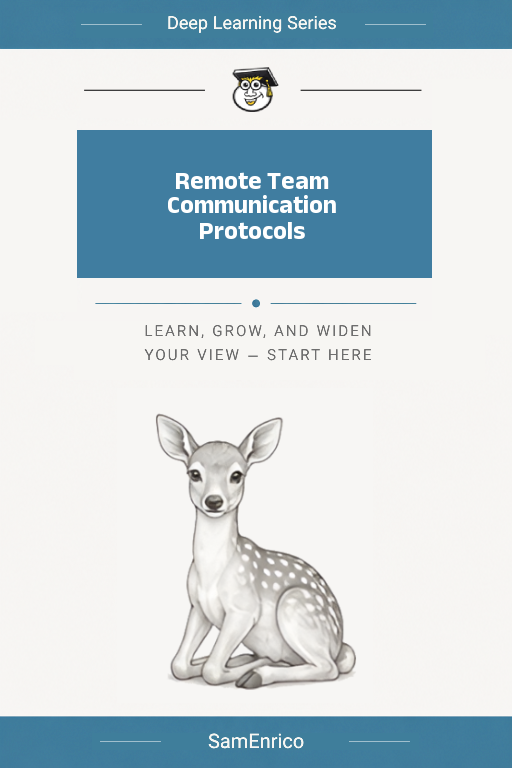
Non-FictionBusiness BriefCommunication
Remote Team Communication Protocols eBook
Establish async-first communication rules that res
Establish async-first communication rules that respect time zone differences and work styles in all three nations.
Formats
Free sample
Chapter 1: The 3 AM Slack--Maria had stopped checking her phone before bed. It was a defense mechanism, a small act of rebellion against a reality she could no longer control. But on this particular Tuesday night—or rather, Wednesday morning at 2:47 AM—her device buzzed against the nightstand with enough force to wake both her and her sleeping husband. The screen glowed with the familiar blue light of Slack. A direct message from Kenji in Tokyo."Hi Maria, sorry for the late hour.
Quick question about the Q3 forecast. The numbers from your team seem off by about 12%. Can you clarify? Need this for the 9 AM meeting with our CEO. Thanks!"Maria stared at the message for thirty seconds, her brain struggling to transition from REM sleep to cognitive function.
Twelve percent. She knew exactly which numbers Kenji was referencing. She had reviewed them three times before sending. The discrepancy wasn't an error—it was a difference in accounting methods between their São Paulo office and Tokyo's reporting standards. She had documented this in a footnote.
A footnote that Kenji had clearly not read.She typed a response at 2:48 AM. Then another at 2:52 AM. Then a third at 3:01 AM, this one including a screenshot of the footnote she had written five days earlier. By 3:15 AM, she was wide awake, her mind racing through the implications of the conversation, her body running on the wrong side of the circadian clock. She would get maybe three hours of sleep before her own 7 AM meetings began.This was not a crisis.
This was not a system outage or a client emergency or a compliance violation. This was a Tuesday.The Silent Epidemic No One Is Talking About Maria's story is not unusual. It is not exceptional. It is, in fact, so common across global teams that most leaders have stopped noticing it. The 3 AM Slack message has become as normalized as the morning coffee run, accepted as an inevitable cost of working across time zones.
But normalizing something does not make it harmless. The 3 AM Slack is a symptom of a much deeper pathology: the assumption that real-time communication is the default setting for all work, regardless of time zone, role, or human limitation.This book is called Remote Team Communication Protocols, but its subject is not really about communication at all. It is about power. Specifically, the power that one person's urgency has over another person's peace. The power that the "quick question" holds over sleep, over family dinners, over weekends, over the fragile boundary between work and life.
And the power that written protocols have to restore what has been taken.Over the past five years, the number of globally distributed teams has tripled. Organizations that once operated within a single time zone now span eight, twelve, or even sixteen hours of difference. The promise was seductive: follow the sun, hand off work, achieve 24-hour productivity loops, hire the best talent regardless of location. But the reality has been something else entirely. The reality has been burnout, turnover, resentment, and a quiet exodus of talented people who have decided that no salary is worth the 3 AM Slack.The problem is not time zones.
The problem is the tyranny of the synchronous clock—the unexamined assumption that all communication should happen in real time, and that anyone who is not immediately available is failing their team.The Follow-the-Sun Fallacy The phrase "follow the sun" entered the business lexicon alongside the rise of global software development in the 1990s. The idea was elegant: a team in India would write code during their day, hand it off to a team in the United States at the end of their shift, and that team would review it during their day, handing it back to India the following morning. In theory, work would progress around the clock, compressing timelines and accelerating delivery.In practice, something very different happened.The follow-the-sun model did not eliminate waiting. It simply relocated it from the task queue to the human nervous system. When Nation A's output arrived in Nation B's inbox at 9 AM, Nation B was expected to have it reviewed by 5 PM so Nation A could find it ready at their 9 AM.
This created a cascading pressure cascade. Any delay—a sick day, a server outage, a fifteen-minute overrun on a meeting—rippled across all three shifts, forcing someone, somewhere, to work late or start early to catch up.But the real damage was not logistical. It was psychological. The follow-the-sun model created what researchers at Stanford's Virtual Human Interaction Lab have called "asynchronous anxiety"—the persistent, low-grade stress of knowing that work was accumulating in a queue that you would have to address when you woke up. Even when team members were offline, they were not truly offline.
Their minds were already running through the backlog, anticipating the messages, mentally drafting responses before the alarm had even rung.A 2024 study published in the Journal of Applied Psychology followed 847 knowledge workers across seventeen global companies. The researchers found that team members who received more than fifteen Slack messages outside their working hours per week reported a 34 percent increase in self-reported depression symptoms, a 28 percent increase in anxiety, and a 41 percent increase in workplace cynicism. The study controlled for total hours worked, job role, and industry. The culprit was not overwork. The culprit was unpredictability.When team members could not predict when they would be interrupted—or by whom, or about what—their brains remained in a state of low-level alert.
The notification badge on Slack became a source of dread rather than a signal of collaboration. And the most common response was not to set boundaries but to check Slack more frequently, creating a self-reinforcing loop of availability anxiety.The Ping-Pong Pandemic There is a term for what Maria experienced, and it will appear throughout this book. It is called the ping-pong pandemic.Ping-pong is the back-and-forth of clarifying questions that should have been answered in the original message. It is the "What do you mean?" that follows a one-sentence email. It is the "Quick call?" that interrupts deep work to resolve a confusion that could have been prevented with thirty seconds of additional writing.
Ping-pong is not collaboration. Ping-pong is the tax that asynchronous teams pay for synchronous thinking.Consider the anatomy of a typical ping-pong exchange between Nation A and Nation B:Message 1 (Nation A, 2 PM): "Can you review the proposal?"Message 2 (Nation B, 10 AM next day): "Which proposal? There are three in the folder."Message 3 (Nation A, 3 PM): "The Q3 marketing proposal. The one we discussed last week."Message 4 (Nation B, 11 AM next day): "Last week's meeting? I was on vacation.
Can you share the link?"Message 5 (Nation A, 4 PM): "Sorry! Here it is: [link]. Need feedback by Friday."Message 6 (Nation B, 12 PM next day): "Friday? That's tomorrow. What kind of feedback?"This exchange, which spans three calendar days and consumes approximately eight minutes of active typing time, has cost both teams nearly seventy-two hours of calendar time.
The work itself has not progressed. The proposal sits unread. And both Maria and Kenji—or their equivalents in your organization—feel a low-grade frustration that they cannot quite articulate.The…
This is the end of the free sample. Get the eBook to keep going. Buy now
About this book
Details
- Author
- Saucedo Rosanna
- Publisher
- SamEnrico
- Language
- English
- Genre
- Non-Fiction, Business Brief, Communication
- Released
- 2026-05-29
- Pages (approx.)
- 141
- Available as
- eBook, Audiobook

Read better in the ZLOADR app
Your eBooks on your phone or tablet. Sign in with your SamEnrico account and start reading.
More by Saucedo Rosanna
 Child Star Sibling JealousySaucedo Rosanna$11.99
 Carnegie Hero FundSaucedo Rosanna$11.99
 Hybrid Work Energy GuideSaucedo Rosanna$11.99
 The Medical Error DisclosureSaucedo Rosanna$11.99
 GST Registration for Educational Institutions HandbookSaucedo Rosanna$11.99
 Upwork Client Communication GuideSaucedo Rosanna$11.99
 Career Transition Visualization GuideSaucedo Rosanna$11.99
 F35 Lightning PilotSaucedo Rosanna$11.99
 Citation Rules for Conference PresentationsSaucedo Rosanna$11.99
 The Last Telegram: How a WWII Codebreaker Outsmarted the NazisSaucedo Rosanna$11.99
 The Imperial Dreamers: Albrechtsburg and the Birth of Renaissance GermanySaucedo Rosanna$11.99
 The Browser Wars: How Microsoft Fought to Control the InternetSaucedo Rosanna$11.99
You may also like
 Hong Kong Handover 1997Dunn Johnnie$11.99
 Zumba For Postnatal Recovery CourseNeal Christian$11.99
 Zumba for BeginnersLadner Nikia$11.99
 YouTube Comment Mining GuideHumes Pandora$12.99
 Worry Box MeditationCarlin Rudy$11.99
 Workplace Stress MeditationNguyen Lynn$11.99
 Workplace Stress and Sleep RepairHawley Ivory$11.99
 Workplace Perfectionism CureDelaney Jeffry$11.99
 Workplace Injustice Anger GuideWallen Isabelle$11.99
 Work Addiction and Burnout LinkGreenwood Ester$11.99
 Women in Yoga and WellnessBeattie Galina$11.99
 Women in Stand Up ComedyChun Evangeline$11.99