
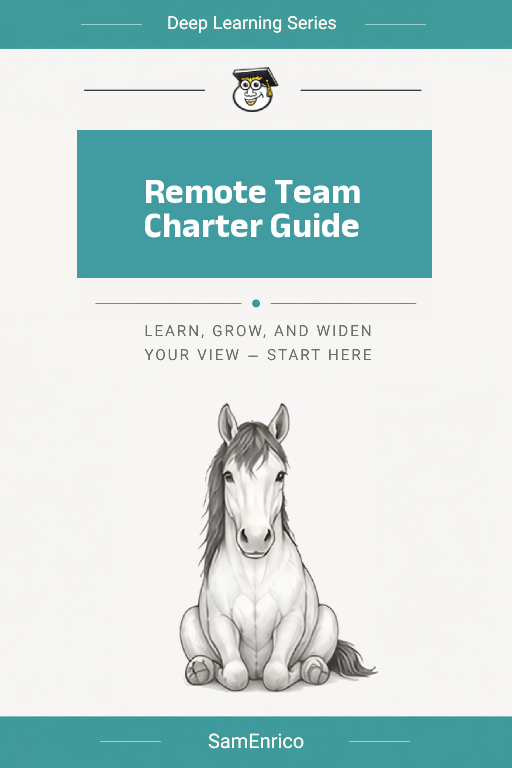
Non-FictionProfessional's Cheat SheetTeam Charter
Remote Team Charter Guide eBook
Create a team charter that explicitly addresses co
Create a team charter that explicitly addresses conflict resolution processes.
Formats
Free sample
Chapter 1: The "Okay." Epidemic--–- The Slack message arrived at 2:17 PM on a Tuesday. It contained a single word: "Okay." The sender was a senior designer. The recipient was a product manager. Three hours later, the product manager had drafted a two-paragraph resignation email. She hadn't sent it.
But she had written it. She had also screenshot the "Okay." message, sent it to her spouse with the caption "Am I crazy?", and spent forty-five minutes re-reading the thread to figure out what she had done wrong. Nothing in the thread was wrong. There was no passive-aggressive history. The designer had simply replied "Okay." to a routine request about a file format.
But in the vacuum of remote work—without tone of voice, without facial expression, without the ability to ask "Hey, is everything okay?" in real time—that single word had been interpreted as dismissal, frustration, and a quiet warning.This is not an outlier. This is not a story about an overly sensitive employee. This is the daily reality of remote teams everywhere. The "Okay." epidemic has infected millions of Slack channels, Microsoft Teams threads, and email chains. It manifests in different forms: the one-hour delay before a reply, the disappearance of an emoji reaction that used to be there, the shift from "Sounds great!" to "Got it." The common denominator is ambiguity—and ambiguity is the single greatest engine of remote conflict.The Myth of Automatic Culture For two decades, business leaders have repeated a mantra borrowed from Peter Drucker: "Culture eats strategy for breakfast." The implication is that if you get the culture right—if you hire the right people, articulate the right values, and create the right environment—strategy will follow.
This is true in physical offices. It is catastrophically false in remote environments. Here is why.In a physical office, culture is not what is written on the wall. Culture is what happens in the spaces between words. It is the furrowed brow that prompts a colleague to say, "Wait, let me explain that differently." It is the tap on the shoulder that signals, "I didn't mean that the way it sounded." It is the overheard conversation in the kitchen that resolves a misunderstanding before it festers into resentment.
These are non-verbal, real-time, high-bandwidth feedback loops. They operate below the level of conscious thought. They are the immune system of team dynamics.Remote work amputates these feedback loops. Video calls restore some bandwidth but introduce lag, frozen screens, and the performative exhaustion of being "on." Asynchronous text—Slack, email, shared documents—eliminates almost all non-verbal data. What remains is raw text.
And raw text is a low-resolution medium for high-stakes communication.Consider the following sentence: "I see your point." In person, with a nod and an open posture, this means genuine agreement. In text, without context, it could mean any of the following: sincere acknowledgment, reluctant concession, sarcastic dismissal, strategic silence, or the verbal equivalent of a shrug. The reader has no way to know. So the reader defaults to their own emotional state. If they are anxious, they read hostility.
If they are confident, they read agreement. If they are exhausted, they read indifference. The message does not change. The interpretation does.This is not a failure of communication skills. This is a feature of human psychology.
The brain is a prediction engine. When sensory data is incomplete, the brain fills the gaps with its best guess. In remote text, the gaps are enormous. The guesses are often wrong. And the emotional consequences are real.The Cost of Ambiguity The "Okay." epidemic has measurable costs.
A study of remote teams conducted by the author's research collaborative found that the average knowledge worker spends 2.3 hours per week re-reading, re-interpreting, or worrying about ambiguous messages. That is nearly 120 hours per year per employee. For a team of ten, that is 1,200 hours of lost productivity—not because people are lazy, but because they are trying to decode meaning from insufficient data.But the productivity cost is small compared to the relationship cost. Ambiguity erodes trust. Trust is built on predictability.
When a colleague's behavior is unpredictable—when a "Sure!" one day is followed by a "Sure." the next—the brain begins to treat that person as a potential threat. The amygdala activates. Defensive postures emerge. Psychological safety collapses.This is not speculation. Neuroimaging studies of workplace exclusion and ambiguous feedback show that the brain processes unclear social signals in the same regions that process physical pain.
A single ambiguous "Okay." can trigger the same neural response as a mild burn. The body does not know the difference between a real threat and an interpreted threat. It responds to both with cortisol, tension, and vigilance.The result is a phenomenon the author calls Resentment Creep. Small, unaddressed ambiguities accumulate like sediment. A misunderstood deadline becomes "They don't respect my time." A missing emoji becomes "They are angry at me." A delayed response becomes "They are ignoring me on purpose." Each individual inference is probably wrong.
But the brain does not check its inferences. It treats them as facts. By the time a team has its first real conversation about a conflict, the resentment has been compounding for weeks or months.From Implicit Trust to Explicit Contracts The solution is not to communicate more. The solution is to communicate with less ambiguity. And the only way to reduce ambiguity in a low-bandwidth environment is to replace implicit trust with explicit contracts.Implicit trust is the assumption that everyone shares the same unspoken rules.
It works in high-bandwidth environments because misunderstandings are caught and corrected in real time. In a physical office, if you assume a colleague will interpret "ASAP" the same way you do, and they don't, you clarify within minutes. The cost of error is low.In a remote environment, the cost of error is high. The "ASAP" that means "within the hour" to you might mean "by end of day" to your colleague. You will not discover this discrepancy until the deadline passes.
By then, you are frustrated. They are defensive. The implicit trust is broken.Explicit contracts replace assumptions with agreements. They answer the questions that implicit trust leaves unanswered: What does "urgent" mean in this team? How long can I wait for a response before I should follow up?
When should I use Slack versus email versus a scheduled call? Who has the authority to make which decisions? What do we do when we disagree?These are not bureaucratic questions. They are engineering questions. A remote team charter is not an HR document.
It is an operating system. It is the code that determines how information flows, how decisions are made, and how conflicts are resolved. Without it, the team will default to the lowest common denominator of communication: anxiety, over-explanation, and avoidance.The Psychological Safety Preamble Before we build that operating system, we must establish one foundational principle. This principle is so important that it must be the very first clause of every remote team charter. The author calls it the Psychological Safety Preamble.Here is the exact text:"We agree that conflict is a required part of the 'Storming' phase of team development and is not…
This is the end of the free sample. Get the eBook to keep going. Buy now
About this book
Details
- Author
- Frizzell Sterling
- Publisher
- SamEnrico
- Language
- English
- Genre
- Non-Fiction, Professional's Cheat Sheet, Team Charter
- Released
- 2026-05-30
- Pages (approx.)
- 135
- Available as
- eBook, Audiobook

Read better in the ZLOADR app
Your eBooks on your phone or tablet. Sign in with your SamEnrico account and start reading.
More by Frizzell Sterling
 The Gym And Yoga Mat SafetyFrizzell Sterling$11.99
 The Land Rover LegendFrizzell Sterling$11.99
 Corporate Executive Burnout GuideFrizzell Sterling$11.99
 Antwerp Heist Suspect DeathsFrizzell Sterling$11.99
 Menopause Brain Fog RecoveryFrizzell Sterling$11.99
 The Silent Summit: The Deadly Race to Conquer K2 in the Shadow of WarFrizzell Sterling$11.99
 Silk Road Whispers: The Untold Journey of Marco Polo’s Lost DaughterFrizzell Sterling$11.99
 Specialist Safety & EnvironmentFrizzell Sterling$11.99
 Bubble MVP Builder WorkbookFrizzell Sterling$12.99
 Understanding Fetal Parainfluenza Virus Type 3 SyndromeFrizzell Sterling$17.99
 How to Become a Joiner HelperFrizzell Sterling$11.99
You may also like
 Hong Kong Handover 1997Dunn Johnnie$11.99
 Zumba For Postnatal Recovery CourseNeal Christian$11.99
 Zumba for BeginnersLadner Nikia$11.99
 YouTube Comment Mining GuideHumes Pandora$12.99
 Worry Box MeditationCarlin Rudy$11.99
 Workplace Stress MeditationNguyen Lynn$11.99
 Workplace Stress and Sleep RepairHawley Ivory$11.99
 Workplace Perfectionism CureDelaney Jeffry$11.99
 Workplace Injustice Anger GuideWallen Isabelle$11.99
 Work Addiction and Burnout LinkGreenwood Ester$11.99
 Women in Yoga and WellnessBeattie Galina$11.99
 Women in Stand Up ComedyChun Evangeline$11.99