
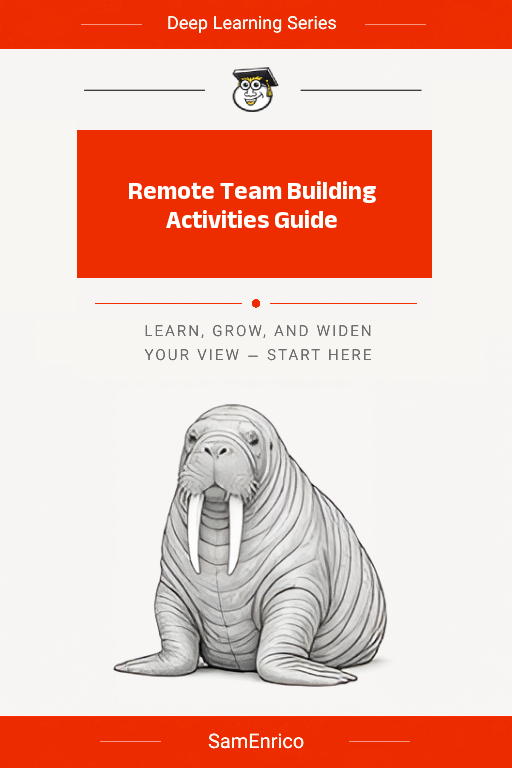
Non-FictionBusiness BriefTeam Building
Remote Team Building Activities Guide eBook
Plan virtual team building that respects cultural
Plan virtual team building that respects cultural differences across three countries.
Formats
Free sample
Chapter 1: The $400,000 Icebreaker--The email arrived at 9:47 AM on a Tuesday. Subject line: "Fun Friday – Team Building!" The body contained a cheerful invitation to a 30-minute Zoom session featuring "Two Truths and a Lie." The sender was a well-intentioned US-based VP of Engineering. The recipients included forty-five people across the United States, Poland, and India.What happened next cost the company $400,000.Not in a single transaction. Not through fraud or embezzlement. Through something far more insidious: the slow, silent erosion of trust that happens when well-meaning managers copy-paste team building activities designed for monocultural, co-located American teams into global Zoom rooms.
The junior developer from India who felt humiliated when his English was mocked. The Polish project manager who stopped speaking in meetings because her direct feedback style was labeled "aggressive." The US team lead who assumed everyone was having fun because no one complained—until three people quit in the same month.This chapter is about why that happens and, more importantly, how to stop it. Because the problem is not team building. The problem is bad team building—the kind that assumes everyone shows up to work with the same assumptions about humor, self-disclosure, competition, and hierarchy. They do not.
And until you understand that gap, every activity you run will leak trust instead of building it.The Anatomy of a Disaster Let us return to that Tuesday email. The VP had chosen "Two Truths and a Lie" because it worked brilliantly with her Chicago-based team. People laughed. Secrets were shared. Bonds were formed.
She assumed the same magic would translate to Hyderabad.It did not.The junior developer from India, let us call him Arjun, was twenty-four years old, brilliant at Python, and deeply uncomfortable with the idea of lying to his manager—even as a game. In his culture, direct falsehoods, even playful ones, are associated with dishonesty and shame. Worse, he was the most junior person on the call. Publicly claiming achievements ("I once met the Prime Minister") felt like boasting, which his culture also discourages. He chose safe lies: "I can code in my sleep.
I have never been late to a meeting. I once ate an entire pizza by myself."The US team laughed at the pizza lie. They guessed correctly. Arjun felt mocked—not because anyone intended harm, but because the activity assumed a level of psychological safety and cultural comfort that did not exist for him. He never spoke in a team meeting again.
Three months later, he accepted a different job. His replacement cost: 120,000inrecruitingfees,120,000 in recruiting fees, 120,000inrecruitingfees,180,000 in onboarding and lost productivity, and 100,000intheinstitutionalknowledgehetookwithhim.100,000 in the institutional knowledge he took with him. 100,000intheinstitutionalknowledgehetookwithhim.400,000.The VP never knew what hit her.The Real Problem: Performative Gathering The term "performative gathering" comes from Priya Parker, author of The Art of Gathering. She argues that many of our meetings and events exist not to serve a genuine human need but to check a box: We did team building. Everyone clapped.
Moving on.Performative team building is characterized by three symptoms:Symptom One: One-Size-Fits-All Activities. The manager runs the same icebreaker they learned at their last company, regardless of who is on the team. They do not ask: Does this activity respect how people from different cultures show up professionally? They assume that if it worked in Ohio, it will work in Osaka.Symptom Two: No Risk Assessment. The manager does not evaluate whether an activity might cause harm.
They do not consider self-disclosure risk (how much personal information are we asking people to share?) or competition risk (does this activity create winners and losers?). They assume that because the activity is "fun," it is safe.Symptom Three: No Feedback Loop. The manager does not measure whether the activity actually built trust. They rely on vibes: Everyone seemed happy. But silence does not mean satisfaction (as Chapter 2 will explore in depth).
What looks like engagement to a Linear-Active American manager looks like performance anxiety to a Reactive Japanese team member.The solution is not to abandon team building. The solution is to replace performative gathering with purposeful connection. And purposeful connection starts with a single tool: the Cultural Risk Assessment Matrix.The Cultural Risk Assessment Matrix Before you run any team building activity, you must answer two questions about it. Rate each question on a scale of 1 (low risk) to 5 (high risk).Axis One: Self-Disclosure Risk How much personal information does this activity ask people to share?Low (1-2): Sharing a favorite color, what is on your desk, or your current weather. No personal history required.Medium (3): Sharing a hobby, a recent movie you enjoyed, or a professional win.
Mild personal disclosure.High (4-5): Sharing a childhood memory, a fear, a lie (even a playful one), a family story, or an opinion on a controversial topic.Why this matters: In high-context cultures (Japan, Arab nations, much of Latin America), sharing personal information with people you do not know intimately is considered inappropriate. In cultures that value modesty (Thailand, Finland, many parts of India), boasting about achievements—even as a game—feels arrogant. In high power-distance cultures (Philippines, Mexico, Malaysia), sharing personal information with a manager violates professional boundaries.Axis Two: Competition Risk How much does this activity create winners and losers?Low (1-2): Cooperative activities where everyone contributes to a shared outcome. No scores. No leaderboards.Medium (3): Friendly competition where losing is anonymous or low-stakes.
Team-based games where the team wins or loses together.High (4-5): Individual leaderboards, public rankings, timed races, or any activity where someone is publicly identified as "the loser."Why this matters: In cooperative cultures (Japan, much of Scandinavia, many Indigenous cultures), individual competition is seen as selfish and harmful to group harmony. In cultures with high "uncertainty avoidance" (Greece, Portugal, Japan), competitive activities create anxiety, not engagement. In cultures that value saving face (China, Korea, many Arab nations), being publicly identified as a loser is deeply shameful.The Golden Rule: Only activities that score 3 or lower on both axes are safe for first-time cross-cultural use. Once your team has built trust over several months, you can experiment with higher-risk activities—but only after running the survey from Chapter 11 and confirming that everyone feels safe.Low-Risk Starter Activities (With Hidden Risk Warnings)Here are two activities that score low on both axes. But pay close attention to the hidden risks—even neutral prompts can cause harm if not facilitated carefully.Activity One: Virtual Coffee Mug Show & Tell Process: Each team member holds up their coffee mug (or tea cup, water bottle, or whatever vessel they use for beverages) and says one sentence about it: "This mug was a gift from my sister," or "I bought this at a conference in Berlin," or simply "This is the mug I use every day."Risk Assessment: Self-disclosure 1 (sharing an object, not a personal story).
Competition 1 (no winners or losers).Hidden Risk: A coffee mug with a political slogan, a religious symbol, a joke in a local language, or an image that might be offensive in another culture (e.g., a bikini-clad woman, a gun, alcohol advertising). These are not neutral.Mitigation: Before the activity, say: "Please only share mugs that have no text or…
This is the end of the free sample. Get the eBook to keep going. Buy now
About this book
Details
- Author
- Guevara Veronique
- Publisher
- SamEnrico
- Language
- English
- Genre
- Non-Fiction, Business Brief, Team Building
- Released
- 2026-05-30
- Pages (approx.)
- 143
- Available as
- eBook, Audiobook

Read better in the ZLOADR app
Your eBooks on your phone or tablet. Sign in with your SamEnrico account and start reading.
More by Guevara Veronique
 Group Flow CollaborationGuevara Veronique$11.99
 Group Creative Feedback CourseGuevara Veronique$11.99
 Lunch Break Nap GuideGuevara Veronique$11.99
 The Dubai Dating GuideGuevara Veronique$11.99
 Acupuncture for Dental PainGuevara Veronique$11.99
 Self Hypnosis for Pain GuideGuevara Veronique$11.99
 Massage Therapist WellnessGuevara Veronique$11.99
 Teeth in War CrimesGuevara Veronique$11.99
 The Walls Speak: The Untold Story of Africa’s First Graffiti RevolutionariesGuevara Veronique$11.99
 Love and Valor: The Charge of the Light Brigade in CrimeaGuevara Veronique$11.99
 How to Produce Dental MirrorsGuevara Veronique$11.99
 How to Become a Hose MakerGuevara Veronique$11.99
You may also like
 Hong Kong Handover 1997Dunn Johnnie$11.99
 Zumba For Postnatal Recovery CourseNeal Christian$11.99
 Zumba for BeginnersLadner Nikia$11.99
 YouTube Comment Mining GuideHumes Pandora$12.99
 Worry Box MeditationCarlin Rudy$11.99
 Workplace Stress MeditationNguyen Lynn$11.99
 Workplace Stress and Sleep RepairHawley Ivory$11.99
 Workplace Perfectionism CureDelaney Jeffry$11.99
 Workplace Injustice Anger GuideWallen Isabelle$11.99
 Work Addiction and Burnout LinkGreenwood Ester$11.99
 Women in Yoga and WellnessBeattie Galina$11.99
 Women in Stand Up ComedyChun Evangeline$11.99