
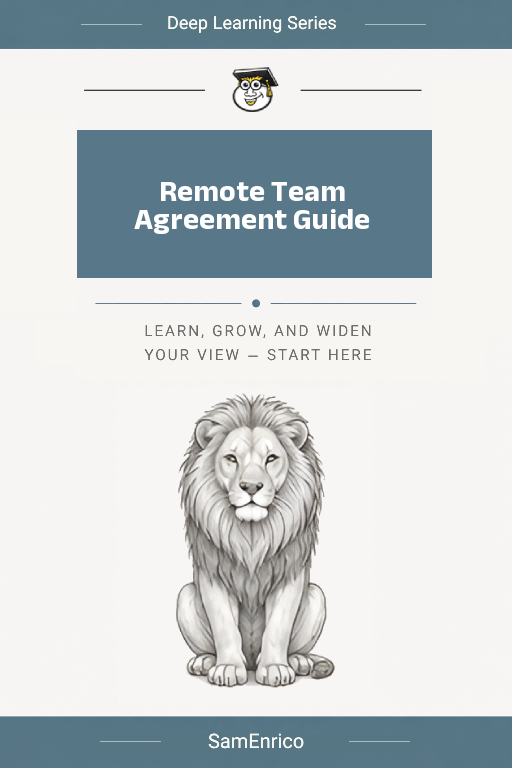
Non-FictionProfessional's Cheat SheetTeam Agreements
Remote Team Agreement Guide eBook
Create team agreements that prevent common remote
Create team agreements that prevent common remote collaboration conflicts.
Formats
Free sample
Chapter 1: The Silence That Speaks--–- Megan had been leading remote teams for three years when the email arrived that changed everything. It wasn't dramatic. There were no raised voices, no exclamation marks, no "URGENT" in the subject line. In fact, that was precisely the problem. The email was from David, her senior developer in Austin, forwarded from a client in London.
David had added exactly two words above the forwarded thread: "For awareness."Megan almost archived it. Something made her read the thread twice. The client had asked a question about delivery timelines. David had answered—correctly, thoroughly. But buried in his response was a small caveat: "Assuming Megan approves the resource shift we discussed last week." The problem was, Megan and David had never discussed any resource shift.
Not on Slack. Not on Zoom. Not even in the hallway that didn't exist.She called David. "What resource shift?"Silence. Then: "The one we talked about in the parking lot after the Q3 offsite.""David, that was seven months ago.
In a different city. While we were walking to our cars.""Right. But we agreed."Megan scrolled through seven months of Slack history, email threads, meeting notes, and project documents. The words "resource shift" appeared exactly zero times. David had been operating for half a year on an agreement that existed only in his memory of a conversation that Megan had forgotten within an hour of leaving the parking lot.
Neither of them was wrong. Neither was malicious. Both were competent, well-intentioned professionals. And their team was about to miss a major client deliverable because of a conversation that never actually happened.This is the remote work paradox of the 2020s. We have better technology than ever—Slack, Teams, Zoom, Asana, Notion, Miro, and a hundred other tools designed to make collaboration seamless.
And yet, the most common failure mode of distributed teams isn't technical. It's not about bandwidth, software, or even time zones. It's about the implicit contract—the unspoken, assumed, often invisible agreements that every team creates whether they mean to or not.In an office, those implicit contracts are constantly reinforced by proximity. You see when someone is busy. You hear when someone is on a call.
You feel the energy of a room before a deadline. You learn, through thousands of微小 interactions, how fast to expect a response, who makes which decisions, and what "urgent" actually means. Remote work strips away all of that. And when the implicit contract breaks, what's left is silence. Not hostile silence.
Not intentional silence. Just the silence of two people assuming different things, both waiting for the other to act.This chapter is about that silence—and about the first and most important step toward breaking it. The Remote Team Agreement is not a document you file away. It is the replacement for the parking lot conversation, the hallway chat, the water cooler agreement. It is the explicit, written, co-created rulebook that turns assumptions into commitments and silence into clarity.The Anatomy of an Implicit Contract Every team, whether co-located or distributed, operates under a set of unwritten rules.
Sociologists call these "implicit contracts"—the behaviors and expectations that everyone assumes but no one has documented. In a healthy office environment, these contracts work reasonably well because they are constantly reinforced by physical presence.Consider what you know about your office-based teammates without ever discussing it:You know that if someone has their office door closed, you should knock or come back later.You know that if someone is eating lunch at their desk, they are probably available for a quick question.You know that the manager who walks quickly through the bullpen is probably in a hurry and shouldn't be stopped.You know that if an email goes unanswered for more than a day, it is acceptable to ping them on Slack.None of these rules were written down. No one signed a document agreeing to them. But everyone knows them because they are observable. The physical environment provides constant feedback.
When you knock on a closed door and get a curt response, you learn. When you interrupt someone at lunch and see their annoyance, you adjust.Now take those same behaviors and move them online. The closed door becomes a Slack status icon that might mean "in a meeting," "deep focus," or simply "forgot to update it." The quick-walking manager becomes a typing indicator that might mean an urgent response or might mean nothing at all. The unanswered email becomes a mystery: Did they see it? Are they ignoring me?
Are they on vacation? Are they dead?The remote work environment is not just a different setting for the same behaviors. It is a fundamentally different information environment. The cues that sustained implicit contracts for generations of office workers simply do not exist online. And in their absence, something strange happens: people create their own implicit contracts, based on their own assumptions, often without realizing they are doing so.The Four Hidden Assumptions That Break Remote Teams Through research conducted across dozens of distributed teams, a pattern emerges.
Almost every unresolved conflict, missed deadline, or frustrated teammate traces back to one of four hidden assumptions:1. The Availability Assumption What one person assumes: "If I am online, I am available for any question at any time."What another person assumes: "If I am online, it just means I am working. I will respond when I finish my current task."The conflict: The first person feels ignored. The second person feels interrupted.2. The Urgency Assumption What one person assumes: "If I mark an email as 'high priority,' the recipient will drop everything and respond within the hour."What another person assumes: " 'High priority' means before end of day.
Everything else can wait until tomorrow."The conflict: The first person escalates to management. The second person feels blindsided.3. The Decision Assumption What one person assumes: "I have the authority to make this decision unless someone explicitly tells me otherwise."What another person assumes: "All decisions above a certain threshold require group consensus."The conflict: Work proceeds in two different directions simultaneously. Both people think they are right.4. The Documentation Assumption What one person assumes: "If it wasn't written down, it wasn't agreed."What another person assumes: "We agreed verbally.
Writing it down is a waste of time."The conflict: The David-and-Megan problem. One person acts on a memory. The other has no memory at all.These assumptions are not signs of laziness, incompetence, or bad intentions. They are the natural result of working in an environment that provides no feedback about what is expected. Every remote team member is, in some sense, building their own implicit contract from scratch, based on their previous experience, their personality, and their tolerance for ambiguity.
The problem is that no two people build the same contract.The Cost of Guessing When implicit contracts break, the costs are not merely annoying. They compound over time, creating a culture of second-guessing, covering, and silent frustration that slowly erodes both productivity and trust.The Direct Costs These are the costs you can measure in hours and dollars:Duplicated work: Two people working on the same task because neither knew…
This is the end of the free sample. Get the eBook to keep going. Buy now
About this book
Details
- Author
- Legg Floretta
- Publisher
- SamEnrico
- Language
- English
- Genre
- Non-Fiction, Professional's Cheat Sheet, Team Agreements
- Released
- 2026-05-28
- Pages (approx.)
- 158
- Available as
- eBook, Audiobook

Read better in the ZLOADR app
Your eBooks on your phone or tablet. Sign in with your SamEnrico account and start reading.
More by Legg Floretta
 The Darien Gap SurvivorLegg Floretta$11.99
 Antwerp Heist Unanswered QuestionsLegg Floretta$11.99
 Barbara McClintock Jumping Genes GuideLegg Floretta$11.99
 The Safe Fish Mercury CalculatorLegg Floretta$11.99
 Stress and Hot Flashes GuideLegg Floretta$11.99
 The Bone Collector: A Siberian Yeti’s WrathLegg Floretta$11.99
 Paddles Through the Unknown: The Daring Kayak Expedition of the Sulu SeaLegg Floretta$11.99
 How to Become a Circular-sawyer HelperLegg Floretta$11.99
 Understanding Fetal Left Ventricular AneurysmLegg Floretta$17.99
 Frugal Innovation Fit ManualLegg Floretta$12.99
 Soil Conservation TechnicianLegg Floretta$11.99
You may also like
 Hong Kong Handover 1997Dunn Johnnie$11.99
 Zumba For Postnatal Recovery CourseNeal Christian$11.99
 Zumba for BeginnersLadner Nikia$11.99
 YouTube Comment Mining GuideHumes Pandora$12.99
 Worry Box MeditationCarlin Rudy$11.99
 Workplace Stress MeditationNguyen Lynn$11.99
 Workplace Stress and Sleep RepairHawley Ivory$11.99
 Workplace Perfectionism CureDelaney Jeffry$11.99
 Workplace Injustice Anger GuideWallen Isabelle$11.99
 Work Addiction and Burnout LinkGreenwood Ester$11.99
 Women in Yoga and WellnessBeattie Galina$11.99
 Women in Stand Up ComedyChun Evangeline$11.99