
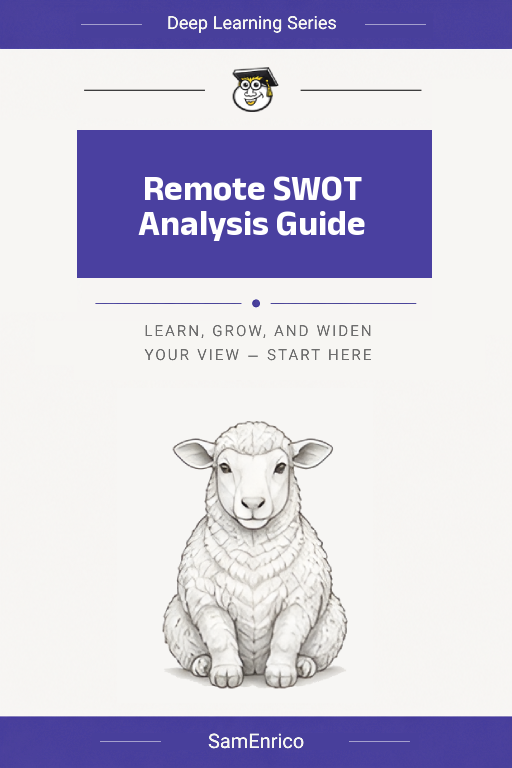
Remote SWOT Analysis Guide eBook
Complete SWOT analysis for your business plan onli
Complete SWOT analysis for your business plan online. Free collaborative templates and frameworks.
Formats
Free sample
Chapter 1: The Whiteboard Lie--–- The email arrived at 9:47 AM on a Tuesday. "Urgent: Strategy Offsite – Mandatory Attendance." Attached was a 47-slide Power Point deck, a link to a catered lunch order form, and a calendar invitation for a six-hour meeting the following Thursday. Sarah, a senior product manager at a mid-sized Saa S company, felt her stomach drop. Not because she dreaded strategy – she loved strategy – but because she knew exactly what would happen. Six hours in a physical room with a whiteboard.
The loudest people would talk first. The CEO would draw a 2x2 grid. Someone would write "innovation" on a sticky note. And in three months, no one would remember a single decision.Sarah's story is not an outlier. It is the norm.
And when the same team tried to replicate that offsite remotely during the pandemic, the results were even worse: frozen screens, muted participants checking email, and a shared Google Doc that resembled a ransom note written by committee. The problem was not the tool. The problem was not even the people. The problem was the whiteboard itself – and the century-old meeting culture it represents.This book exists because the traditional SWOT analysis, born in the 1960s at Stanford Research Institute, has been kidnapped by bad meetings. The humble framework of Strengths, Weaknesses, Opportunities, and Threats – clear, intuitive, powerful – has been buried under an avalanche of corporate theater: annual retreats, expensive facilitators, poster-sized printouts that go straight into a drawer, and the soul-crushing phrase "let's circle back on that."But something has changed.
Remote work did not kill strategy; it exposed its decay. When you cannot rely on a physical room and a shared whiteboard, you are forced to confront the truth: most strategic planning is not planning at all. It is performance. This chapter is the autopsy of that performance and the birth of something better: a rhythmic, tool-enabled, psychologically safe approach to SWOT that works for distributed teams using only free tools.The Failure Rate That Should Scare You Let us start with a number that should keep every founder, CEO, and team lead awake at night: 67 percent. According to a decades-long study by Robert S.
Kaplan and David Norton (creators of the Balanced Scorecard), nearly two-thirds of well-formulated strategies fail during execution. More recent data from the Project Management Institute pushes that number higher for remote teams – approaching 85 percent when strategies are planned in distributed environments using traditional methods.Why does this happen? The obvious answers are easy: poor communication, lack of accountability, shifting priorities. But those are symptoms, not causes. The root cause is structural.
Traditional strategic planning is designed as an event, not a process. You gather people in a room (physical or virtual), you spend hours generating ideas, you create a document, and then you return to your real job. The strategy becomes a souvenir, not a compass.Consider the anatomy of a typical offsite. Day one: icebreakers and "vision setting." Day two: SWOT analysis on poster paper. Day three: action items and a closing circle.
Everyone leaves feeling energized. Within two weeks, the poster paper is buried under other papers. Within a month, the action items have been overtaken by urgent fires. Within a quarter, no one can find the document. This is not a failure of will; it is a failure of design.The remote environment has accelerated this collapse.
Without a physical room to create artificial containment, strategic conversations bleed into Slack threads, stray Zoom calls, and passive-aggressive email chains. The SWOT analysis, already vulnerable to neglect, becomes completely unmoored. Teams either overcorrect with exhausting synchronous meetings or abandon structured strategy altogether, defaulting to whatever feels urgent that week.This chapter introduces the central diagnosis of this book: the whiteboard – that seemingly innocent rectangle of dry-erase surface – is the enemy of good strategy in a distributed world. Not because whiteboards are evil, but because they are static, single-owner, and ephemeral. A whiteboard captures only what is visible to the people in the room at that exact moment.
It excludes remote participants, late-arriving stakeholders, and anyone who needs time to process before speaking.The whiteboard is a tyranny of the present tense. And it is time to declare it dead.The Psychology of Remote Strategic Failure To understand why traditional SWOT fails remotely, we must first understand how human cognition works in distributed environments. The research is clear and unsettling.First, Zoom fatigue is not just exhaustion – it is cognitive degradation. A study from Stanford University's Virtual Human Interaction Lab found that prolonged video conferencing reduces creative problem-solving capacity by nearly 30 percent. The brain works harder to process nonverbal cues, fills in gaps left by lag, and suppresses the natural rhythm of turn-taking conversation.
When you ask a remote team to do strategic thinking, you are asking them to perform cognitive weightlifting while running on a treadmill.Second, asynchronous participation – which should be a superpower – becomes a liability without structure. Introverts and thoughtful contributors finally have space to formulate ideas without interruption. But that same space allows procrastination, perfectionism, and the dreaded "I'll get to it later" spiral. The result: contributions arrive late, diluted, or not at all. The follow-the-sun model sounds elegant in theory; in practice, it often means the New York team finishes their section, the London team overwrites it, and the Singapore team starts from scratch.Third, cognitive biases are amplified in remote settings.
Recency bias – the tendency to weigh the most recent information most heavily – runs rampant when teams rarely meet. The last customer complaint, the last sales win, the last angry email from the CEO – these become the entire strategic landscape because there is no shared artifact to provide continuity. Confirmation bias strengthens as team members retreat into siloed Slack channels, only seeing evidence that supports their existing views. And groupthink, paradoxically, can be worse in remote settings because anonymous voting tools are rarely used; instead, the first person to type an opinion in chat becomes the default anchor for everyone else.The result is a perfect storm: tired brains, delayed input, and distorted thinking. This is why your remote SWOT sessions feel so hard.
They are hard. But they are not impossible.The Shift: From Event-Based to Rhythmic Strategy Here is the first major reframe of this book. Stop thinking about strategy as an event – an offsite, a retreat, a quarterly review. Start thinking about strategy as a rhythm. Not continuous (which implies always-on intensity that burns out teams), but rhythmic: predictable, sustainable, recurring pulses of strategic work.A rhythmic approach to SWOT has three beats:First, the quarterly deep dive.
This is the most intensive pulse: three days of asynchronous pre-work (Pre-Mortem surveys, Business Model Canvas reviews) followed by a 90-minute live session. This is where the SWOT grid is rebuilt from scratch, major shifts are debated, and the TO-WS matrix (Chapter 9) generates new strategic initiatives.Second, the monthly refresh. This is a lightweight pulse: 30 minutes of asynchronous updates (team members add one new observation to each quadrant) followed by a 15-minute synchronous review. No rebuilding, no debate – just calibration.Third, the weekly micro-SWOT (for agile teams). This is a fifteen-minute stand-up format where teams share one Strength from…
This is the end of the free sample. Get the eBook to keep going. Buy now
About this book
Details
- Author
- Breedlove Denyse
- Publisher
- SamEnrico
- Language
- English
- Genre
- Non-Fiction, Startup Guide, Strategic Planning
- Released
- 2026-05-28
- Pages (approx.)
- 149
- Available as
- eBook, Audiobook

Read better in the ZLOADR app
Your eBooks on your phone or tablet. Sign in with your SamEnrico account and start reading.
More by Breedlove Denyse
 Values And Mission Alignment Customer Experience HandbookBreedlove Denyse$11.99
 The SAD Cognitive Behavioral GuideBreedlove Denyse$11.99
 Mediterranean Brain HealthBreedlove Denyse$11.99
 Email Overload FixBreedlove Denyse$11.99
 TM for Mathematicians GuideBreedlove Denyse$11.99
 The Algorithm Whisperer: How a Forgotten Genius Cracked the Code of Human BehaviorBreedlove Denyse$11.99
 Exit Driven Business PlanBreedlove Denyse$12.99
 Understanding Tricho Onychic DysplasiaBreedlove Denyse$17.99
 Asset Management ConsultantBreedlove Denyse$11.99
 How to Become a Pleat PatternmakerBreedlove Denyse$11.99
You may also like
 WPS Office Business Plan GuideHammer Jewell$12.99
 Wi Fi Market Analysis GuideWallen Isabelle$12.99
 Wi Fi Financial Forecast GuideRaymond Fernanda$12.99
 Trello Business Plan GuideHorvath Wai$12.99
 Strategyzer Remote GuideDow Loma$12.99
 Strategic Planning on a Hotspot GuideLedford Jenniffer$12.99
 Remote Financial Model GuideGarber Stefanie$12.99
 P&L Statement Online GuidePaz Myriam$12.99
 Notion Business Plan GuideZavala Rosaura$12.99
 Miro Business Plan GuideShultz Robt$12.99
 LivePlan Remote AlternativeFarrell Malinda$12.99
 Executive Summary Wi Fi GuideYoungblood Mica$12.99