
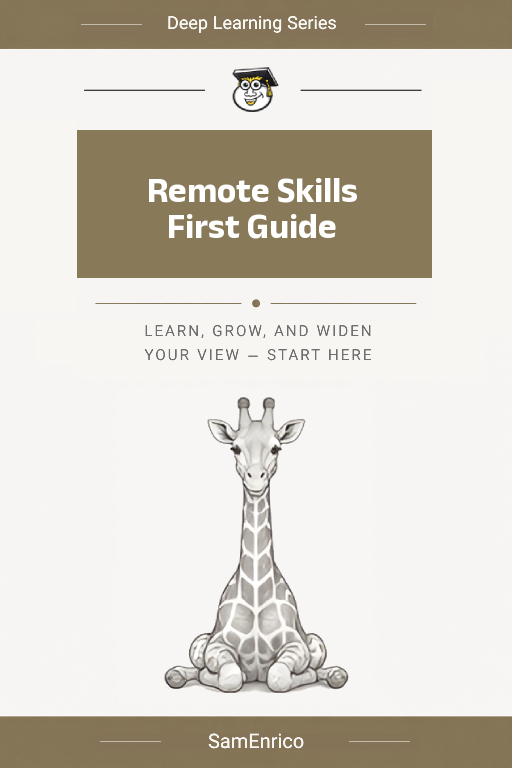
Non-FictionNon-Obvious CareerRemote Work
Remote Skills First Guide eBook
Build location independent careers in customer suc
Build location independent careers in customer success, virtual assistance, and project management using portfolio based applications instead of diplomas.
Formats
Free sample
Chapter 1: The Sheepskin Racket--For the last forty years, you have been sold a lie. It was packaged in glossy college brochures, repeated by guidance counselors, and reinforced by every well-meaning adult who told you to "get a degree so you can get a good job." The lie was simple: a diploma is the safest path to a stable career. The truth is far less comfortable. A diploma has become the most expensive permission slip in history—permission to apply for jobs that no longer require it, permission to carry debt for decades, and permission to discover that your degree in Communications or Psychology or Business Administration qualifies you for nothing in particular.Let me show you the math that the admissions office will never put in their viewbook. Since 1980, the cost of college has increased by more than 1,200 percent.
That is not a typo. Adjusted for inflation, tuition has grown twelve times faster than the median household income. The average American student now graduates with nearly 40,000indebt,andthetotalstudentloandebtinthiscountryhassurpassed40,000 in debt, and the total student loan debt in this country has surpassed 40,000indebt,andthetotalstudentloandebtinthiscountryhassurpassed1.7 trillion. Meanwhile, the wage premium for a bachelor's degree—the amount a graduate earns compared to a high school graduate—has been shrinking since 2015. The degree is losing its value at the exact moment it costs the most.But here is the pattern that the media misses.
While universities have been raising tuition, employers have been quietly dropping degree requirements. In 2017, only 15 percent of job postings for customer success roles required a four-year degree. By 2024, that number had dropped below 40 percent for all but the most traditional industries. Google, Apple, IBM, and Bank of America have all eliminated degree requirements for thousands of positions. Why?
Because they discovered what academic research has shown for decades: there is almost no correlation between holding a college degree and performing well in most customer-facing, project-based, or operational roles.What employers actually care about—what they have always cared about—is output. Can you solve the problem? Can you retain the customer? Can you deliver the project on time? Can you communicate clearly under pressure?
These are skills that a transcript cannot measure and a diploma cannot guarantee. Yet the vast machinery of hiring still filters out capable people every single day because an automated system could not find the word "Bachelor's" on their application.This book exists because that filter is breaking. And you are going to learn how to walk right through the hole in the wall.The Trust Gap That Changed Everything Let me introduce a concept that will appear in every chapter of this book, though we will only define it once here. I call it the Trust Gap.The Trust Gap is the distance between what an employer needs to believe about you and what they are willing to accept as proof. When you submit a resume, you are asking an employer to trust that your self-reported job titles and bullet points reflect real competence.
When you submit a diploma, you are asking them to trust that a university's grading system accurately predicts your future performance. Both of these are indirect signals. They require enormous leaps of faith.What an employer actually wants is direct evidence. They want to see the thing itself. They want to watch a Loom video of you automating a workflow.
They want to read a playbook you wrote for reducing customer churn. They want to click through a Notion portfolio that contains real case studies, real data, and real results. That is the difference between indirect trust and direct proof. A resume asks for trust. A portfolio delivers proof.The entire structure of this book is designed to close your Trust Gap.
Each chapter will ask you to build something tangible—an artifact that an employer can see, interact with, and evaluate. By Chapter 12, you will not be asking anyone to trust you. You will be showing them. And that is a fundamentally different negotiation.Why This Book Exists and Why It Is Different There are thousands of career books on the market. Most of them tell you to write a better resume, network more effectively, or earn a certification.
These books assume that the existing system is fair and that your job is to play by its rules more skillfully.I am telling you that the system is broken and that playing by its rules is a losing game.This book is not about optimizing your Linked In profile or learning to game applicant tracking systems. Those are defensive tactics. This book is offensive. It teaches you to bypass the filtering mechanisms entirely by showing up with proof that no algorithm can ignore. You are not going to apply for jobs the way everyone else does.
You are going to send value audits to founders who are drowning. You are going to pitch paid trials that turn into long-term retainers. You are going to build a portfolio that makes your diploma—or lack thereof—entirely irrelevant.The book is organized around three career tracks that have exploded in the remote economy: Customer Success, Virtual Assistance, and Project Management. These are not arbitrary choices. These three roles share a critical characteristic: they are fundamentally about outcomes, not credentials.
A customer success manager either reduces churn or they do not. A virtual assistant either streamlines operations or they do not. A project manager either delivers on time or they do not. In each case, the proof is in the results, not in the pedigree.You do not need a degree to excel in any of these roles. You need something far more valuable: the ability to demonstrate competence through artifacts.
And that is what this book will teach you to build.Before You Read Further: Two Paths This book serves two different audiences, and you need to know which one you are before we go any further.Path A: The Freelancer or Contractor You want to work with multiple clients. You prefer flexibility over stability. You are comfortable with variable income in exchange for autonomy. You will build a portfolio of services (CS audits, VA operations, PM sprints) and sell them directly to businesses. For you, Chapters 4 through 11 are your core curriculum, and Chapters 9 through 12 will show you how to scale from solo freelancer to agency owner or digital product creator.Path B: The Full-Time Employee You want one employer.
You prefer a steady paycheck and benefits. You are willing to trade some autonomy for predictability. You will build the same portfolio as the freelancer, but you will use it to land a full-time role and then to negotiate promotions. For you, Chapters 9 through 12 are essential for interviews and advancement, and Chapter 10 on pricing will help you negotiate salary (just replace "retainer" with "salary bump").Which path is better? Neither.
They are different answers to the question of how you want to spend your working hours. You can also start on Path A and move to Path B, or vice versa. The portfolio you build works for both. The only mistake is pretending that the choice does not exist.To help you decide, take thirty seconds right now. If you feel a spark…
This is the end of the free sample. Get the eBook to keep going. Buy now
About this book
Details
- Author
- Carder Carylon
- Publisher
- SamEnrico
- Language
- English
- Genre
- Non-Fiction, Non-Obvious Career, Remote Work
- Released
- 2026-06-01
- Pages (approx.)
- 132
- Available as
- eBook, Audiobook

Read better in the ZLOADR app
Your eBooks on your phone or tablet. Sign in with your SamEnrico account and start reading.
More by Carder Carylon
 EQ Diversity And Inclusion GuideCarder Carylon$11.99
 Rafa Nadal Unbreakable SpiritCarder Carylon$11.99
 Business Model Canvas Team GuideCarder Carylon$11.99
 Sugar Addiction TruthCarder Carylon$11.99
 SAS Mountain Troop TrainingCarder Carylon$11.99
 The Inca’s Lost Heat: How Thermodynamics Shaped Andean SurvivalCarder Carylon$11.99
 Frozen Whispers: The Lost Expedition of the *Franklin*Carder Carylon$11.99
 ESL Headset Microphone GuideCarder Carylon$12.99
 How to Become a Jig BuilderCarder Carylon$11.99
 Understanding Gamma-cystathionase DeficiencyCarder Carylon$17.99
 Collecting KeychainsCarder Carylon$11.99
You may also like
 Hong Kong Handover 1997Dunn Johnnie$11.99
 Zumba For Postnatal Recovery CourseNeal Christian$11.99
 Zumba for BeginnersLadner Nikia$11.99
 YouTube Comment Mining GuideHumes Pandora$12.99
 Worry Box MeditationCarlin Rudy$11.99
 Workplace Stress MeditationNguyen Lynn$11.99
 Workplace Stress and Sleep RepairHawley Ivory$11.99
 Workplace Perfectionism CureDelaney Jeffry$11.99
 Workplace Injustice Anger GuideWallen Isabelle$11.99
 Work Addiction and Burnout LinkGreenwood Ester$11.99
 Women in Yoga and WellnessBeattie Galina$11.99
 Women in Stand Up ComedyChun Evangeline$11.99