
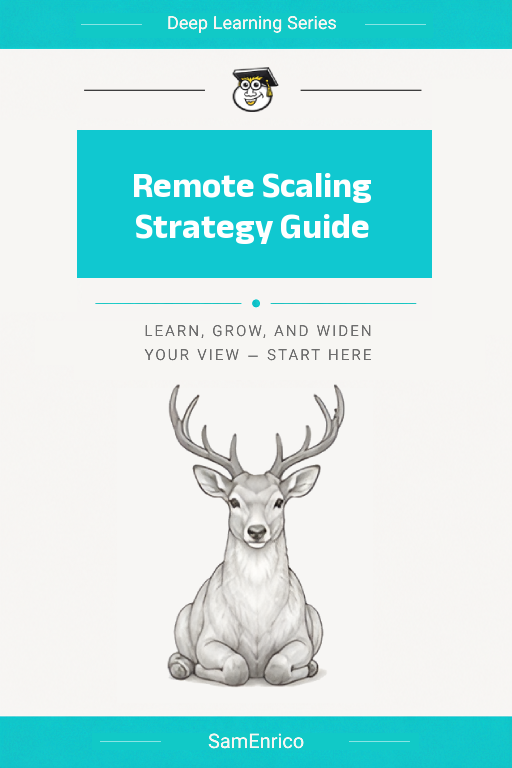
Non-FictionBusiness BriefGlobal Talent Guide
Remote Scaling Strategy Guide eBook
Scale remote teams from Kenya, Philippines, and Po
Scale remote teams from Kenya, Philippines, and Poland. Hiring processes and management.
Formats
Free sample
Chapter 1: The Perk Fallacy--–- In 2021, I sat across from a founder who had just raised forty million dollars for his Saa S company. He was brilliant, driven, and utterly convinced that his "work from anywhere" policy was the secret to his success. He had hired engineers in twelve countries, designers in six more, and a customer support team spread across three continents. He showed me his employee satisfaction scores—ninety-four percent—with the pride of a parent showing baby photos.Eighteen months later, that same founder called me from his home office, which he had not left in three weeks. His company had burned through half the funding.
His engineering velocity had collapsed. His support team was missing SLAs. And his once-proud distributed workforce had splintered into warring factions—the Europe team complaining that Asia never documented anything, the Asia team complaining that the US woke up demanding answers to questions already answered, and the Latin America team caught in the middle, unsure who to listen to."What went wrong?" he asked me. "I did everything the books said. I trusted my people.
I gave them freedom. I didn't care where they worked."That was the problem. He didn't care where they worked. He treated geography as irrelevant, time zones as an inconvenience, and cultural differences as something that smart, well-intentioned people could just work through. He was running a remote work experiment disguised as a scaling strategy.
And when the experiment hit real-world complexity—different legal systems, different communication norms, different expectations of authority—it collapsed under its own weight.This book is not for that founder. He has already learned his lesson the expensive way. This book is for the leader who wants to avoid his fate—who senses that "work from anywhere" is not enough, that something deeper is required to turn distributed teams into a genuine competitive advantage.That something is the difference between remote work and remote scaling.The Perk Strategy Is Not a Strategy Let me be direct: if your global hiring plan begins and ends with "we let people work from anywhere," you do not have a strategy. You have a perk. And perks are what companies offer when they cannot articulate a real competitive advantage.I have reviewed the internal documents of over seventy companies that attempted to scale globally in the past five years.
The ones that failed almost universally shared a single trait: they treated remote work as an employee benefit rather than an operating model. They celebrated "no meeting Wednesdays" and "unlimited PTO" while ignoring the fundamental question of how work actually moved from one time zone to another.The ones that succeeded asked a different question. They asked: "How do we structure our global team so that work progresses twenty-four hours a day, with no idle handoffs, no duplicate effort, and no waiting?"That question changes everything. It forces you to think about handoff protocols—the specific mechanisms by which incomplete work passes from one person to another. It forces you to think about documentation standards—the minimum information required for someone who has never seen a task to pick it up and run with it.
It forces you to think about overlap windows—the precious hours when two regions are both awake and can collaborate in real time.None of these questions appear on the typical "remote work best practices" list. They are too operational, too unsexy, too detailed for the conference circuit. But they are the difference between a distributed team that hums and one that sputters.The Three-Pillar Framework for Remote Scaling After studying both failures and successes, I have distilled remote scaling into three interdependent pillars. Everything in this book builds on these pillars. If you understand nothing else, understand these.Pillar One: Geo-Strategic Role Allocation Not every role belongs in every country.
I cannot say this more plainly, because it is the most violated principle in global hiring.A customer support agent in Poland might be perfectly competent, but they are working in a time zone that has minimal overlap with US customers during US business hours. A software architect in the Philippines might be brilliant, but they are working fifteen hours ahead of the US team, making real-time collaboration impossible. A data annotator in Poland might be expensive, but the same work in Kenya costs half as much with equal quality.The Global Talent Matrix (introduced here and used throughout the book) matches roles to regions based on three criteria:Time zone alignment with your primary customers or core team Skill density in that specific function within that country Cultural communication style (direct vs. indirect, high-context vs. low-context)When you violate the matrix, you pay the mismatch penalty: higher turnover, longer onboarding, and lower quality.
When you follow the matrix, you get the opposite: teams that fit naturally into your workflow rather than fighting against it.In this book, we focus on three regions that represent the most powerful complementary talent pools in the world today:Poland: Technical depth, independence, direct communication Philippines: Service orientation, English fluency, trainability Kenya: Resilience, operations focus, emerging market access Each of these regions will get deep treatment in subsequent chapters. For now, understand that choosing a region is not about finding the cheapest labor. It is about finding the best strategic fit for each role.Pillar Two: Synchronous-Asynchronous Balance The second pillar is the most misunderstood concept in distributed work. Most leaders fall into one of two camps: the sync-obsessed who fill their teams' calendars with Zoom calls, or the async-evangelists who treat any real-time communication as a failure of discipline.Both camps are wrong.The correct approach is to design your communication architecture based on the nature of the work. Some work requires real-time collaboration—architecture decisions, incident response, creative brainstorming.
Some work thrives on asynchronous execution—coding, writing, data analysis, customer support.The art of remote scaling is knowing which is which and building systems that support both.Here is the rule I teach my clients: Synchronous for decisions, asynchronous for execution.When you need to make a decision that involves multiple perspectives, conflicting data, or high stakes, get people in a room (virtual or physical). Talk it through. Argue. Decide. Then document that decision and move on.When you need to execute on a decision that has already been made, work asynchronously.
Write clear tickets. Record Loom videos. Leave detailed comments. Trust your team to execute without someone watching over their shoulder.The companies that fail at remote scaling are the ones that flip this rule. They make decisions asynchronously (endless email threads, passive-aggressive Slack messages, decisions by attrition) and then try to execute synchronously (daily standups that last an hour, pair programming on simple tasks, managers hovering over shoulders).We will spend significant time in Chapter 7 on how to design this balance for engineering teams.
But the principle applies everywhere.Pillar Three: Documentation as Infrastructure Here is a test for your current organization. Ask five people to define what "done" means for a common task—say, a bug fix or a customer support ticket. If you get five different answers, you are not ready to scale remotely.Documentation is not a luxury in distributed…
This is the end of the free sample. Get the eBook to keep going. Buy now
About this book
Details
- Author
- Lavoie Freeman
- Publisher
- SamEnrico
- Language
- English
- Genre
- Non-Fiction, Business Brief, Global Talent Guide
- Released
- 2026-06-01
- Pages (approx.)
- 152
- Available as
- eBook, Audiobook

Read better in the ZLOADR app
Your eBooks on your phone or tablet. Sign in with your SamEnrico account and start reading.
More by Lavoie Freeman
 Endometriosis MRI GuideLavoie Freeman$11.99
 Sleep Shepherd BlueprintLavoie Freeman$11.99
 Franchise Renewal Strategies AbroadLavoie Freeman$11.99
 Weekly Eisenhower Matrix PrimerLavoie Freeman$11.99
 Enki’s Wisdom: The Sage of the Abzu’s Endless DepthsLavoie Freeman$11.99
 Understanding Rhabditida InfectionsLavoie Freeman$17.99
 How to Start a Caps and Closures Made of Plastic Business (Beginners Guide)Lavoie Freeman$11.99
 University Application DeadlinesLavoie Freeman$12.99
 Macro PhotographyLavoie Freeman$11.99
You may also like
 Hong Kong Handover 1997Dunn Johnnie$11.99
 Zumba For Postnatal Recovery CourseNeal Christian$11.99
 Zumba for BeginnersLadner Nikia$11.99
 YouTube Comment Mining GuideHumes Pandora$12.99
 Worry Box MeditationCarlin Rudy$11.99
 Workplace Stress MeditationNguyen Lynn$11.99
 Workplace Stress and Sleep RepairHawley Ivory$11.99
 Workplace Perfectionism CureDelaney Jeffry$11.99
 Workplace Injustice Anger GuideWallen Isabelle$11.99
 Work Addiction and Burnout LinkGreenwood Ester$11.99
 Women in Yoga and WellnessBeattie Galina$11.99
 Women in Stand Up ComedyChun Evangeline$11.99