
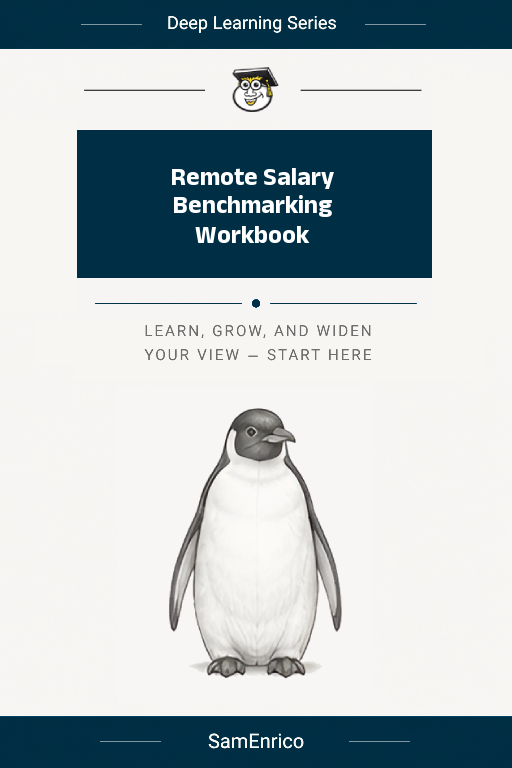
Remote Salary Benchmarking Workbook eBook
Compare market rates for roles in Kenya, Philippin
by Fair Leonie
Compare market rates for roles in Kenya, Philippines, and Poland to set competitive pay.
Formats
Free sample
Chapter 1: The Leaking Bucket--–- Every night, after her two young children were asleep, Maya opened her laptop and stared at the same spreadsheet. For six months, she had been the founder and CEO of a fast-growing remote design agency called Salama Studio, with eighteen employees spread across Nairobi, Manila, and Warsaw. She had done everything the business books said to do. She had read about company culture. She had implemented weekly one-on-ones.
She had even bought everyone a high-quality webcam and a monthly internet stipend. And yet, in the last ninety days, three of her best people had resigned. Each exit interview offered the same polite, maddening answer: "I've found an opportunity that's a better fit for my family."Maya knew what that meant. Money. But here was the part that kept her awake: she had tried to pay fairly.
She had looked up cost-of-living data online. She knew that rent in Warsaw was higher than in Nairobi, and that groceries in Manila had gotten more expensive. So she had adjusted salaries accordingly, building a tidy spreadsheet that gave her Polish project manager more than her Kenyan customer success lead, and her Filipino senior designer something in the middle. It felt rational. It felt fair.
It felt like the responsible thing to do.Then her senior designer in Manila, a gifted young woman named Jasmyn who had been with Salama Studio since day one, gave notice. The new job paid her forty percent more. Forty percent. Maya could not understand it. She had paid Jasmyn what she thought was a generous salary for Manila—well above the local average.
How could anyone pay forty percent more and still run a profitable business?The answer, which Maya would discover only after losing two more people, was that she had been asking the wrong question entirely. She had been asking, "What does it cost for Jasmyn to live comfortably in Manila?" The correct question was, "What do other companies pay someone with Jasmyn's skills in Manila?" Those two questions seem similar. They are not. They are separated by a gulf that has quietly destroyed thousands of remote teams, drained millions of dollars from startup bank accounts, and turned otherwise brilliant founders into frustrated, sleepless people staring at spreadsheets at midnight.This chapter is about that gulf. It is about why most salary strategies are accidentally designed to lose talent.
It is about the difference between cost of living and cost of labor—a distinction that sounds academic until it costs you your best engineer. And it is about the three pillars of global pay that, once understood, will transform how you think about compensation forever. By the end of this chapter, you will have taken a self-assessment that reveals exactly how much money your current pay strategy is leaking. And you will never look at a salary spreadsheet the same way again.The High Cost of Getting It Wrong Let us begin with a number that should terrify every person who manages a remote team: the average cost of replacing a single mid-level remote employee ranges from 50% to 200% of their annual salary. This is not a made-up statistic.
It comes from aggregated data across dozens of studies on remote turnover, and it includes hard costs like recruiting fees, signing bonuses, and the soft costs of lost productivity during the two-to-three-month period when a new hire is ramping up.For a senior engineer earning 60,000peryear,thatmeanslosingthemcostsyoubetween60,000 per year, that means losing them costs you between 60,000peryear,thatmeanslosingthemcostsyoubetween30,000 and $120,000. And here is the cruel math that keeps founders like Maya awake: most employees do not leave because they are unhappy with their manager or the company mission. Those things matter, of course. But the single biggest predictor of voluntary turnover in remote roles is a simple, measurable variable: whether the employee believes they are being paid fairly compared to what they could earn elsewhere.A 2023 survey of over 4,000 remote workers across twelve countries found that 67% of respondents had actively looked for a new job in the previous six months. The most commonly cited reason?
"I suspect I am underpaid." Notice the word suspect. It is not that they knew. It is that they had a feeling, based on conversations with peers or glimpsed job postings, that someone else was getting more for doing the same work. That feeling, once planted, grows like kudzu. It poisons engagement, kills discretionary effort, and eventually drives the employee to update their Linked In profile and start answering recruiter messages.Worse, there is a phenomenon called stealth quitting.
This is when an employee does not formally resign but mentally checks out. They do the absolute minimum required to avoid being fired. They stop speaking up in meetings. They take longer to respond to Slack messages. They produce work that is technically acceptable but never exceptional.
And they do all of this while still collecting a full paycheck. Stealth quitting can go on for six months or more before the employee finally leaves. During that time, you are paying 100% of their salary for perhaps 40% of their productive output. One study estimated that stealth quitting costs remote-first companies an average of $25,000 per employee per year in lost productivity. Multiply that by a team of twenty, and you are burning half a million dollars in invisible waste.Maya's experience at Salama Studio was a textbook case.
After Jasmyn left, Maya did a post-mortem. She discovered that Jasmyn had been quietly interviewing for four months before she resigned. In those four months, her output had dropped by an estimated 60%. She had stopped mentoring junior designers. She had stopped volunteering for challenging projects.
She had become a ghost, present but not present. Salama Studio paid Jasmyn 42,000duringthosefourmonths.Theyreceivedperhaps42,000 during those four months. They received perhaps 42,000duringthosefourmonths.Theyreceivedperhaps17,000 worth of value. The rest—$25,000—was pure waste. And that was before the cost of replacing her.This is the high cost of getting it wrong.
It is not theoretical. It is not a line item in a distant budget. It is money leaving your bank account every single day, invisibly, because your pay strategy is leaking talent.The Three Pillars of Global Pay To understand why pay strategies fail, you need a simple framework. After studying compensation practices across dozens of remote-first companies—from tiny startups to publicly traded enterprises with thousands of distributed employees—a clear pattern emerges. Every successful global pay strategy rests on three pillars.
If any one of them is weak, the entire structure collapses.Pillar One: Attraction. Can you get a candidate to accept your offer? This seems obvious, but it is surprisingly easy to mess up. Attraction is not just about the number on the offer letter. It is about how that number compares to the candidate's other options.
A candidate in Manila who is a top-tier software engineer may have five active offers simultaneously. If your offer is in the bottom two, you will not attract them. Simple as that. Attraction is the gatekeeper. If you fail here, nothing else matters.Pillar Two: Retention.
Can you keep an employee for two years or more? Retention is about what happens after the offer is signed. It is about whether…
This is the end of the free sample. Get the eBook to keep going. Buy now
About this book
Details
- Author
- Fair Leonie
- Publisher
- SamEnrico
- Language
- English
- Genre
- Non-Fiction, Business Brief, Salary Data
- Released
- 2026-06-01
- Pages (approx.)
- 143
- Available as
- eBook, Audiobook

Read better in the ZLOADR app
Your eBooks on your phone or tablet. Sign in with your SamEnrico account and start reading.
More by Fair Leonie
 Collaborative Failure Celebration GuideFair Leonie$11.99
 Skier Mental PerformanceFair Leonie$11.99
 Acupuncture for Hot FlashesFair Leonie$11.99
 Weekly Review HabitFair Leonie$11.99
 Student Tech Setup DubaiFair Leonie$11.99
 Self Hypnosis for NeuropathyFair Leonie$11.99
 International Dental IDFair Leonie$11.99
 Async Communication Best PracticesFair Leonie$11.99
 The Hollow Crown Conspiracy: Camelot's Shadow WarFair Leonie$11.99
 The Architects of Al-Andalus: Black Genius in Islamic SpainFair Leonie$11.99
 A Collector's Handbook to the Wartburg 311Fair Leonie$11.99
 How to Produce Denture AdhesiveFair Leonie$11.99