
Non-FictionBusiness BriefLeave
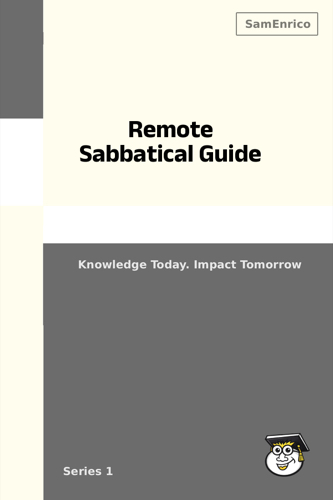
Remote Sabbatical Guide eBook
Manage team coverage during long term remote emplo
by Reed Tabitha
Manage team coverage during long term remote employee leaves of absence.
Formats
Free sample
Chapter 1: The Sabbatical Lie...--–- On a Tuesday morning in March, Sarah Chen, a senior product manager at a fast-growing fintech company, walked into her weekly leadership meeting and announced she was taking a twelve-week sabbatical. She had earned it under the company’s new unlimited PTO policy, had saved for two years, and had her itinerary planned: three weeks in Japan, a month in Italy, and the rest scattered across national parks with her phone in airplane mode. Her manager nodded, smiled, and said, “We’ll figure it out. Just keep us posted.”Six weeks into her leave, Sarah checked her email for the first time. Not to work, she told herself.
Just to make sure nothing had exploded. There were 847 unread messages. Fourteen were from her manager. Three were from her manager’s manager. One, marked “URGENT,” was from the CEO’s chief of staff.
The subject line read: “Can you hop on a 15-minute call?”Sarah never went back. Not because she quit, but because by the time she returned, her role had been restructured, her key project had been reassigned, and the team had learned to function without her. The “just keep me posted” arrangement had been a lie—not malicious, not intentional, but a lie nonetheless. Her manager had no coverage plan, no handoff protocol, no documentation system. The team had absorbed her work until three people nearly quit from burnout.
And when Sarah came back, she found herself in meetings where people apologized for “still having to include her.”This book exists because Sarah’s story is not an exception. It is the rule.The Great Misunderstanding The corporate world has spent the last decade celebrating the rise of remote work, flexible schedules, and the death of the corner office. But it has spent almost no time figuring out what happens when a remote employee actually leaves. Not for a long weekend, not for a two-week vacation, but for the kind of extended leave that modern employees increasingly expect and demand.Here is the lie that most managers believe: A sabbatical is just a longer vacation.It is not. A vacation is a pause.
A sabbatical is a transition. When an employee takes a one-week vacation, the work waits. When they take a twelve-week sabbatical, the work does not wait. It moves. It shifts.
It gets redistributed, automated, delegated, or dropped. And when the employee returns, they return to a different landscape—one where their absence has fundamentally altered how the team operates.The lie has consequences. In a 2024 survey of 1,200 remote-first companies, 68% reported that their first extended leave of absence resulted in either the returning employee quitting within six months or a coverage team member quitting within three months of the return. That is not a leave management problem. That is a organizational failure disguised as a benefit.Why This Book Is Different There are books about sabbaticals.
Most of them are written for the employee: How to Negotiate Your Leave, The Art of the Career Break, Escape the Rat Race. These books are useful, but they address the wrong audience. They assume that the only thing standing between an employee and a successful sabbatical is personal courage and a well-written proposal.That assumption is wrong. The thing standing between most employees and a successful sabbatical is a manager who has no idea how to run a team without them.There are also books about leave management. Most of them are written for HR professionals: FMLA Compliance Handbook, ADA Leave Accommodations, Multi-State Leave Law Guide.
These books are technically accurate, but they are written for compliance officers, not team leaders. They tell you what you cannot do, not what you should do. They focus on legal risk, not operational excellence.This book sits in the space between those two shelves. It is written for the manager who wants to say yes to a sabbatical without destroying their team. It is written for the HR leader who wants to build a leave coverage system that actually works.
And it is written for the employee who wants to hand their manager a playbook instead of a pleading email.The Real Cost of “Going Dark”Before we build the solution, we have to understand the problem. And the problem is not what most managers think it is.Most managers believe that the biggest risk of a long-term leave is work not getting done. So they focus on task reassignment. Who can take over the weekly reporting? Who can cover the client calls?
Who can approve the purchase orders?But task reassignment is not the hard part. The hard parts are invisible.The first invisible cost is knowledge loss. When a person works in a role for two years, they accumulate hundreds of small decisions, exceptions, and workarounds that never make it into any document. They know which client prefers email over Slack. They know which vendor invoice is always wrong and how to fix it.
They know which internal stakeholder needs to be cc’d on which type of request. This tacit knowledge is the real asset, and it walks out the door the moment the employee leaves. Studies suggest that replacing tacit knowledge costs three to five times more than replacing explicit knowledge—and that most organizations never fully recover it.The second invisible cost is team fragility. Most teams operate with a hidden assumption: that every person will be here tomorrow. That assumption allows managers to avoid cross-training, skip documentation, and rely on individual heroics.
A long-term leave exposes that fragility. If the team cannot function for three months without one person, the team was never functioning well. It was just lucky.The third invisible cost is backup burnout. When a coverage team member takes on additional responsibilities, they rarely receive additional compensation, recognition, or relief. They just work more.
And when the returning employee comes back, the backup is expected to hand back those responsibilities gracefully—often without thanks and without acknowledgment of the extra weight they carried. The data on this is stark: employees who cover for a leave colleague are 40% more likely to leave within six months of the returning employee’s return. That is not a retention problem. That is a cascading failure.The fourth invisible cost is legal exposure. Most managers have no idea that allowing a remote employee to “just check in” during leave can violate the FMLA, trigger wage claims, and expose the company to discrimination lawsuits.
The 2023 DOL guidance made this explicit: any work performed during unpaid or partially paid leave—including checking email or Slack—can invalidate the leave classification. But managers are rarely trained on this, and the result is a legal time bomb hidden inside what everyone thought was a generous benefit.These invisible costs are why most sabbaticals fail. Not because the employee didn’t deserve the break, and not because the manager didn’t want to support them. But because no one had a system.The Sabbatical-Readiness Diagnostic Before we go any further, let’s assess where you stand. The following twenty questions are designed to measure your team’s current capacity to handle an extended leave.
Answer honestly. There is no shame in scoring low—most teams do. The point is to establish a baseline so you…
This is the end of the free sample. Get the eBook to keep going. Buy now
About this book
Details
- Author
- Reed Tabitha
- Publisher
- SamEnrico
- Language
- English
- Genre
- Non-Fiction, Business Brief, Leave
- Released
- 2026-06-11
- Pages (approx.)
- 148
- Available as
- eBook, Audiobook

Read better in the ZLOADR app
Your eBooks on your phone or tablet. Sign in with your SamEnrico account and start reading.
More by Reed Tabitha
 Vitamin A For Vision And ImmunityReed Tabitha$11.99
 Self Hypnosis For Interview Success WorkbookReed Tabitha$11.99
 Email Warm Up IP GuideReed Tabitha$11.99
 Shopping List Memory Palace CourseReed Tabitha$11.99
 Stardust Pilgrims: The Last Voyage of the ArgoReed Tabitha$11.99
 Bones of the Lost Desert: The Gobi’s Forgotten DinosaursReed Tabitha$11.99
 House Sitting With ChildrenReed Tabitha$12.99
 Mentoring Junior Colleagues in USReed Tabitha$12.99
 Understanding Epstein Barr Virus MononucleosisReed Tabitha$17.99
 Lead Technical ArchitectReed Tabitha$11.99
 Ultimate Handbook Guide to Shantou : (China) Travel GuideReed Tabitha$11.99
You may also like
 Hong Kong Handover 1997Dunn Johnnie$11.99
 Zumba For Postnatal Recovery CourseNeal Christian$11.99
 Zumba for BeginnersLadner Nikia$11.99
 YouTube Comment Mining GuideHumes Pandora$12.99
 Worry Box MeditationCarlin Rudy$11.99
 Workplace Stress MeditationNguyen Lynn$11.99
 Workplace Stress and Sleep RepairHawley Ivory$11.99
 Workplace Perfectionism CureDelaney Jeffry$11.99
 Workplace Injustice Anger GuideWallen Isabelle$11.99
 Work Addiction and Burnout LinkGreenwood Ester$11.99
 Women in Yoga and WellnessBeattie Galina$11.99
 Women in Stand Up ComedyChun Evangeline$11.99