
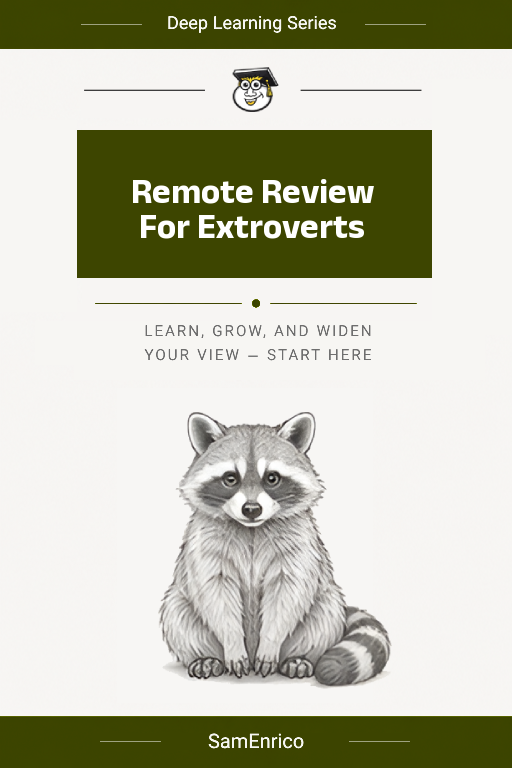
Non-FictionProfessional's Cheat SheetExtrovert Guide
Remote Review For Extroverts eBook
Engage extroverted employees during remote perform
Engage extroverted employees during remote performance reviews across time zones with interactive elements.
Formats
Free sample
Chapter 1: The Silent Scream--The silence arrived at 10:17 on a Tuesday morning.Maya, a senior account director known for her booming laugh and ability to work a room like a maestro, had just submitted her quarterly self-review. She had poured her energy into it—three pages of wins, two honest admissions of struggle, and a final paragraph thanking five teammates by name. She hit "share" on the Google Doc, pinged her manager a cheerful "All set! 🚀," and then she waited.She refreshed at 10:45. Nothing.At 12:30, during lunch, she checked her phone.
No comments. No reactions.At 3:00, she watched her manager’s status light flicker from "In a Meeting" to "Active" to "Away." Still nothing.By 5:00 PM, the silence had become a physical weight. Maya closed her laptop, turned to her partner, and said, "I think I’m in trouble at work." When asked why, she couldn’t point to any negative feedback—because there wasn’t any. There was simply no feedback at all. And for an extrovert like Maya, no feedback was the loudest form of rejection she knew.This book is written for every Maya in every distributed company.
It is written for the managers who have watched their most energetic, socially-driven employees go quiet. And it is written to solve a problem that most remote work literature has ignored: the unique, painful, and entirely solvable crisis of the extrovert in the asynchronous void.Welcome to Remote Review for Extroverts.Let’s begin with the scream that no one is hearing.The Broken Promise of "Async First"For the past five years, the remote work movement has celebrated one virtue above almost all others: asynchronous communication. Write it down. Record it. Let people respond on their own time.
The gospel of async has liberated introverts from the tyranny of the conference room, allowed deep workers to focus without interruption, and given caregivers the flexibility to parent and produce in equal measure.These are real and important gains. I do not dismiss them.But there is a shadow side to the async revolution, and it has landed hardest on a group no one expected to struggle: extroverts.Let me be precise. The extrovert is not someone who simply "likes people." The extrovert, in the psychological sense that Carl Jung first defined and that modern neuroscience has since validated, is someone who draws energy from external interaction. When an extrovert speaks, they are not just transmitting information—they are processing, regulating, and recharging. The act of talking to someone, of seeing a face react in real time, of hearing a laugh or a thoughtful "hmm"—these are not accessories to work.
For the extrovert, they are the work's emotional fuel.Now take that fuel source and stretch it across time zones. Replace the live audience with a shared document. Replace the impromptu hallway praise with a scheduled Slack reminder. You have not simply changed the medium; you have changed the metabolic conditions under which the extrovert operates.The research bears this out. A 2022 study from the National Bureau of Economic Research found that extroverted workers experienced a 23% larger drop in job satisfaction after transitioning to remote work than their introverted colleagues.
Not because they disliked remote work, but because the feedback mechanisms they relied on had been stripped away without being replaced. They weren't suffering from Zoom fatigue (a real but different phenomenon). They were suffering from feedback starvation.This chapter is the diagnosis. The rest of the book is the prescription. But before we can build a new system, we have to understand exactly why the old one failed so spectacularly for the extrovert.The Performance Anxiety of the Extrovert Let me introduce a concept that will run through every chapter of this book: The Performance Anxiety of the Extrovert.Most people assume that extroverts are immune to anxiety.
After all, they seem so confident in meetings, so quick to volunteer, so comfortable in the spotlight. But this assumption confuses behavior with internal state. The extrovert who talks the most is often the one most terrified of silence—not because they fear being wrong, but because they fear being invisible.Here is the distinction that changes everything:Introvert performance anxiety sounds like: "I'm afraid I'll say the wrong thing and be judged."Extrovert performance anxiety sounds like: "I'm afraid no one will respond at all, and I'll cease to exist."The introvert fears negative feedback. The extrovert fears no feedback.Think back to Maya. She didn't receive a single critical comment in her Google Doc.
By every objective measure, her manager had not yet responded—neutral, not negative. But Maya's nervous system did not register neutrality. It registered abandonment. Because for an extrovert, a silent document is not a neutral space. It is a void.
And the void screams.This is not a character flaw. It is a neurobiological reality. Functional MRI studies have shown that social rejection—including the perception of being ignored—activates the same pain pathways as physical injury. For extroverts, whose social reward systems are more densely wired, the experience of being left on "read" for eight hours can produce measurable cortisol spikes.The traditional remote review process, built around asynchronous writing and delayed feedback, is a machine designed to produce exactly this cortisol spike in your extroverted employees. You didn't mean to harm them.
You were trying to be efficient. But efficiency without psychology is a form of neglect.The Extrovert Isolation Index: A Diagnostic Tool Before we go any further, let me give you a tool to assess whether your current review process is feeding or starving your extroverted employees. I call it the Extrovert Isolation Index.Take five minutes right now to rate your organization's current performance review system on the following seven statements. Use a scale of 1 (strongly disagree) to 5 (strongly agree).In our review process, employees receive live, verbal feedback at least once per week.Our review documents are reviewed and commented on within 24 hours of submission.Public recognition (team channels, all-hands, etc.) is a regular part of our feedback culture.Employees can choose between written, video, or live formats for their self-reviews.Negative feedback is delivered privately, while positive feedback is often delivered publicly.Our review cycles take no more than one week from submission to completion.Managers are trained to signal warmth and engagement in written feedback (e.g., using emojis, exclamation points, or video responses rather than bare text).Scoring:28–35: Low isolation. Your extroverts are likely thriving.21–27: Moderate isolation.
Your extroverts are probably compensating with after-hours venting sessions or increased anxiety.14–20: High isolation. Your extroverts are at risk of disengagement, burnout, or attrition.7–13: Critical isolation. Your review process is actively harming your extroverted talent.If you scored in the moderate, high, or critical ranges, the rest of this book is your blueprint for change.The Cost of Silence: What You Lose When Extroverts Shut Down I want to pause here and name something uncomfortable. Many leaders reading this book will be tempted to think: "Well, if extroverts can't handle async work, maybe they're just not a good fit for remote teams."This is a mistake. And it is an expensive one.Extroverts are not a niche personality type to be accommodated.…
This is the end of the free sample. Get the eBook to keep going. Buy now
About this book
Details
- Author
- Thompson Grady
- Publisher
- SamEnrico
- Language
- English
- Genre
- Non-Fiction, Professional's Cheat Sheet, Extrovert Guide
- Released
- 2026-06-01
- Pages (approx.)
- 141
- Available as
- eBook, Audiobook

Read better in the ZLOADR app
Your eBooks on your phone or tablet. Sign in with your SamEnrico account and start reading.
More by Thompson Grady
 Gum Phobia Chewing DesensitizationThompson Grady$11.99
 Polish Bugged Cafe ConspiraciesThompson Grady$11.99
 Dad Stress Management GuideThompson Grady$11.99
 Stress and Chronic Hives GuideThompson Grady$11.99
 AI Classroom Discussion GeneratorThompson Grady$11.99
 The Spy Who Stole the Golden FleeceThompson Grady$11.99
 Understanding Massa–casaer–ceulemans SyndromeThompson Grady$17.99
 Overhead Crane OperatorThompson Grady$11.99
 How to Start a Peanut Butter Manufacturing BusinessThompson Grady$11.99
 Time Blocking Templates for ExecutivesThompson Grady$12.99
You may also like
 Hong Kong Handover 1997Dunn Johnnie$11.99
 Zumba For Postnatal Recovery CourseNeal Christian$11.99
 Zumba for BeginnersLadner Nikia$11.99
 YouTube Comment Mining GuideHumes Pandora$12.99
 Worry Box MeditationCarlin Rudy$11.99
 Workplace Stress MeditationNguyen Lynn$11.99
 Workplace Stress and Sleep RepairHawley Ivory$11.99
 Workplace Perfectionism CureDelaney Jeffry$11.99
 Workplace Injustice Anger GuideWallen Isabelle$11.99
 Work Addiction and Burnout LinkGreenwood Ester$11.99
 Women in Yoga and WellnessBeattie Galina$11.99
 Women in Stand Up ComedyChun Evangeline$11.99