
Non-FictionProfessional's Cheat SheetEngineering
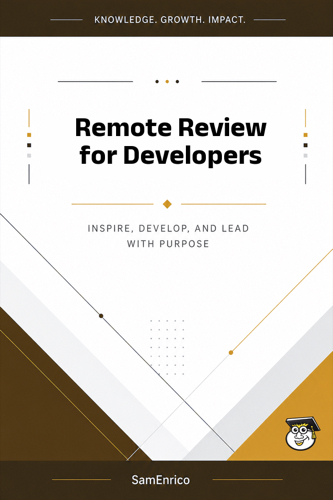
Remote Review for Developers eBook
Use GitHub metrics and PR reviews for async develo
Use GitHub metrics and PR reviews for async developer evaluations.
Formats
Free sample
Chapter 1: The $200 Million Typo--–- The Slack message came in at 11:47 PM on a Tuesday. Brian, a senior engineer at a fast-growing fintech startup, had just pushed his 47th commit of the week. His Git Hub graph was a solid wall of green. His Slack status flickered between "active" and "away" every few minutes, even at midnight. He was, by every traditional measure, a model remote employee.The message was from the CTO.
"Brian, the fraud loss just hit $200k per day. We need you on this."Brian replied within 90 seconds. He always did.For the next three days, he worked like a machine. He produced 3,400 lines of code across 12 pull requests. He attended 14 Zoom calls, sometimes two at once.
He left 45 comments on other people's PRs, mostly pointing out missing semicolons and indentation errors. His manager, Sarah, felt a wave of relief every time she saw his name in Slack. "At least someone is working," she told the VP of Engineering.Meanwhile, another engineer on the team—Ida—had been quiet. Her last commit was four days ago. Her Slack status had been set to "Do Not Disturb" for most of the week.
She hadn't attended the fraud crisis meetings because, as she wrote in a single terse message, "I need uninterrupted time to think about the state machine."Sarah almost put Ida on a performance improvement plan.The Problem That Everyone Could See But No One Measured The fraud bug was a race condition in the payment authorization flow. When two transactions hit the same user account within 47 milliseconds, the system would authorize both even if the combined amount exceeded the available balance. It was the kind of bug that only appears at scale—and the startup had just crossed 2 million daily active users.Brian's approach was aggressive and visible. He added retry logic. He wrapped critical sections in mutexes.
He added logging, then more logging. His PRs were massive—one exceeded 2,800 lines. Each PR triggered a flurry of Slack notifications, review requests, and "quick syncs" that turned into 45-minute calls.By Day 3, Brian had deployed six attempted fixes. The fraud loss had increased to $340k per day. Two of his fixes had introduced new bugs, including one that temporarily blocked legitimate transactions.
The customer support team was drowning in tickets.Ida, meanwhile, had produced exactly one pull request. It was 52 lines long.The PR description contained four sections: "Problem," "Root Cause Analysis," "Solution," and "Risks." The root cause analysis identified that the race condition was not actually a race—it was a fundamental flaw in how the system represented account state. The 52-line change re-architected the state machine to use version vectors instead of timestamps.The PR received three comments:"This is elegant. Have you considered the migration path?" (from a senior architect)"I don't fully understand this but it looks right. Can we pair on it?" (from a junior developer)"Merge this immediately." (from the CTO)It merged in 47 minutes.
The fraud loss dropped to zero within 2 hours of deployment. The migration path that the senior architect asked about? Ida had already written the migration script in a separate, 28-line PR. It had been sitting in draft mode for two days while she thought through edge cases.The Performance Review That Never Happened (But Should Have)Three months later, during quarterly reviews, Sarah sat down to evaluate her team. She had a spreadsheet.
It contained:Lines of code written (Brian: 28,400; Ida: 3,200)Pull requests opened (Brian: 89; Ida: 24)Comments on PRs (Brian: 312; Ida: 47)Slack messages sent (Brian: 4,200; Ida: 890)"Responsiveness score" (Brian: 98% replied within 5 minutes; Ida: 34% replied within 5 minutes)On paper, Brian was a superstar. Ida was a problem.But Sarah had a gut feeling. She remembered the fraud crisis. She remembered the 52-line fix. She remembered that Brian's six attempted fixes had made things worse, and that his 28,400 lines of code included 11,000 that had been reverted or refactored within two weeks.She also remembered something else: Ida had been promoted twice at her previous company.
Brian had been let go from his last job after 14 months.Sarah decided to look deeper. She exported the team's Git Hub data—not just the high-level counts, but the actual timelines. What she found changed how she thought about performance forever.The Four Metrics That Revealed the Truth Sarah discovered that traditional metrics (lines of code, commit count, Slack activity) were not just unhelpful—they were actively misleading. They rewarded visibility over value, activity over outcome.She needed new metrics. After three weeks of research, conversations with other engineering managers, and a deep dive into the DORA (Dev Ops Research and Assessment) reports, she landed on four measurements that actually predicted performance in remote, async environments.Metric 1: Cycle Time (Work Time Only)Definition: The time from the first commit on a PR to when that PR is marked "Ready for review." This measures coding efficiency—how quickly a developer can translate a requirement into working code.What it excludes: Waiting time.
If a developer finishes code in 2 hours but waits 3 days for a review, that waiting time is not their fault. Cycle time measures what the developer controls.Sarah's discovery: Brian's cycle time averaged 14 hours per PR. Ida's averaged 3 hours. Brian wasn't faster—he was more visible. He spread his work across more hours, more commits, and more Slack messages.
Ida worked in concentrated bursts.Metric 2: Waiting Time (Pickup Time)Definition: The time from "Ready for review" to the first substantive comment. This measures team responsiveness—how quickly the organization unblocks its developers.What it reveals: High waiting time is almost never a developer problem. It's a team process problem, a prioritization problem, or a management failure.Sarah's discovery: Brian's waiting time averaged 15 minutes because he pinged reviewers every 30 minutes. Ida's waiting time averaged 22 hours because she opened a PR and waited quietly. The metric didn't reveal that Ida was less responsive—it revealed that the team's review culture rewarded pinging over patience.Metric 3: Review Depth Definition: The number of substantive comments (those that ask "why," suggest architectural alternatives, identify risks, or teach something) divided by the total number of comments on PRs the developer reviewed.
Trivial comments ("typo," "LGTM," "fix formatting") do not count as substantive.What it measures: Collaboration quality, mentorship ability, and technical leadership.Sarah's discovery: Brian's Review Depth was 0.12. Of his 312 comments, only 37 were substantive. The rest were nitpicks. Ida's Review Depth was 0.68—she rarely left shallow comments, and when she did review, she asked questions that made people think.Metric 4: Lead Time for Change Definition: The time from code written to deployed in production. This is the only metric that measures the entire system—code, review, testing, deployment—end to end.What it reveals: How quickly value reaches users.
Low lead time correlates with higher quality, lower stress, and happier customers.Sarah's discovery: Brian's lead time averaged 9 days. Ida's averaged 2 days. Despite Brian's frantic activity, his changes took over four times longer to reach production—and many of them were reverted within days.The Deeper Problem: Why Traditional Metrics Survive You might be thinking: "Of course Sarah discovered this. It's obvious in hindsight." But if it's so obvious, why do most engineering organizations still evaluate remote developers based…
This is the end of the free sample. Get the eBook to keep going. Buy now
About this book
Details
- Author
- Winfrey Betsey
- Publisher
- SamEnrico
- Language
- English
- Genre
- Non-Fiction, Professional's Cheat Sheet, Engineering
- Released
- 2026-06-07
- Pages (approx.)
- 142
- Available as
- eBook, Audiobook

Read better in the ZLOADR app
Your eBooks on your phone or tablet. Sign in with your SamEnrico account and start reading.
More by Winfrey Betsey
 Hand Gesture Decoding WorkbookWinfrey Betsey$11.99
 Affirmations For Resilience HandbookWinfrey Betsey$11.99
 Medical Diagnosis TraumaWinfrey Betsey$11.99
 Robotics Industry Capital GuideWinfrey Betsey$11.99
 The Immortal Admiral: Yi Sun-sin and the Turtle Ship TriumphWinfrey Betsey$11.99
 Financial Consulting Services SetupWinfrey Betsey$11.99
 Hospitality and Tourism ESG ComparisonWinfrey Betsey$12.99
 Marketing Mentor LinkedIn GuideWinfrey Betsey$12.99
 Understanding ParaphiliaWinfrey Betsey$17.99
 How to Become a Sewer-pipe CleanerWinfrey Betsey$11.99
You may also like
 Hong Kong Handover 1997Dunn Johnnie$11.99
 Zumba For Postnatal Recovery CourseNeal Christian$11.99
 Zumba for BeginnersLadner Nikia$11.99
 YouTube Comment Mining GuideHumes Pandora$12.99
 Worry Box MeditationCarlin Rudy$11.99
 Workplace Stress MeditationNguyen Lynn$11.99
 Workplace Stress and Sleep RepairHawley Ivory$11.99
 Workplace Perfectionism CureDelaney Jeffry$11.99
 Workplace Injustice Anger GuideWallen Isabelle$11.99
 Work Addiction and Burnout LinkGreenwood Ester$11.99
 Women in Yoga and WellnessBeattie Galina$11.99
 Women in Stand Up ComedyChun Evangeline$11.99