
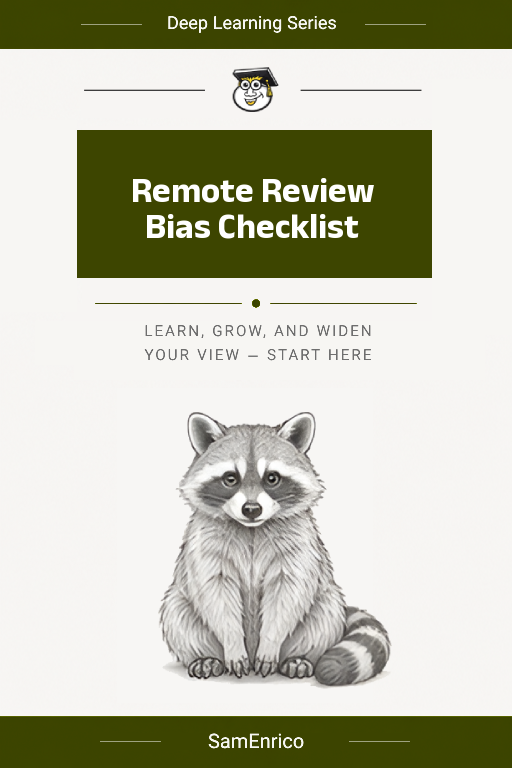
Non-FictionProfessional's Cheat SheetHR PlaybookFairness Guide
Remote Review Bias Checklist
Avoid proximity bias, recency bias, and async comm
by Yoon Alexis
Avoid proximity bias, recency bias, and async communication gaps. Includes blind evaluation methods, calibrated rating scales, and self-audit questions for managers.
Formats
About this book
Free sample
Chapter 1: The Visibility Trap---– On a Tuesday morning in March, a senior software engineer named Elena opened her performance review. She had closed forty-seven tickets that quarter, mentored two junior developers, and rebuilt a legacy database migration that saved the company eleven hours of manual work each week. Her manager’s feedback included the phrase “needs to be more present in team channels.” Elena lived in Athens, Greece. Her manager was in San Francisco. The nine-hour time difference meant that when Elena was writing code at 2 PM local time, her manager was asleep.
When her manager was active on Slack at 10 AM Pacific, Elena was cooking dinner. She had never missed a deadline. She had never failed to respond within twenty-four hours. But “presence” was measured in visibility, not output. Elena updated her Linked In profile that same afternoon.This is the visibility trap.
And it is the single most destructive force in remote performance reviews.Every day, managers like Elena’s make the same cognitive error. They confuse what they can see with what matters. The employee who posts frequently in Slack, jumps into every Zoom call, and replies to messages within minutes appears valuable. The employee who enters deep work mode, delivers results without fanfare, and works across time zones appears invisible. Both may produce identical or even divergent output in favor of the quiet one.
But only the visible employee gets remembered at review time.This chapter dismantles the first and most insidious bias in remote work: proximity bias, reframed for the digital age. You will learn why your brain rewards visibility over value, how to measure your own interaction patterns, and the single most important tool for seeing the invisible work on your team. By the end of this chapter, you will never again mistake a noisy Slack channel for productive output.The Neuroscience of Proximity Bias Proximity bias is not a character flaw. It is a feature of the human brain, and understanding its mechanics is the first step to overriding it. Your brain evolved to trust what is physically near.
Thousands of years ago, the tribe member you could see gathering berries was obviously contributing. The tribe member who disappeared…
This is the end of the free sample. Get the eBook to keep going. Buy now
Contents
- Chapter 1
- Chapter 2
- Chapter 3
- Chapter 4
- Chapter 5
- Chapter 6
- Chapter 7
- Chapter 8
- Chapter 9
- Chapter 10
- Chapter 11
- Chapter 12
Details
- Author
- Yoon Alexis
- Publisher
- SamEnrico
- Language
- English
- Genre
- Non-Fiction, Professional's Cheat Sheet, HR Playbook, Fairness Guide
- Released
- 2026-05-30
- Pages (approx.)
- 150
- Available as
- eBook, Audiobook

Read better in the ZLOADR app
Your eBooks on your phone or tablet. Sign in with your SamEnrico account and start reading.
More by Yoon Alexis
 IBS Gut Brain Axis WorkbookYoon Alexis$11.99
 Serial Predators In National ParksYoon Alexis$11.99
 Harvard Extension vs LSE PrerequisitesYoon Alexis$11.99
 Attorney Sex Addiction RecoveryYoon Alexis$11.99
 Shadows of the Silk Road: The Unseen War of the Silk Road RebelsYoon Alexis$11.99
 The Last Oasis: Bedouin Survival and the Lost City of UbarYoon Alexis$11.99
 Understanding Human Granulocytic EhrlichiosisYoon Alexis$17.99
 How to Start a Bricks and Mouldings Made of Magnesite Business (Beginners Guide)Yoon Alexis$11.99
 Five Year Digital Payments ForecastYoon Alexis$12.99
 Quinoa HarvestingYoon Alexis$11.99
You may also like
 Hong Kong Handover 1997Dunn Johnnie$11.99
 Zumba For Postnatal Recovery CourseNeal Christian$11.99
 Zumba for BeginnersLadner Nikia$11.99
 YouTube Comment Mining GuideHumes Pandora$12.99
 Worry Box MeditationCarlin Rudy$11.99
 Workplace Stress MeditationNguyen Lynn$11.99
 Workplace Stress and Sleep RepairHawley Ivory$11.99
 Workplace Perfectionism CureDelaney Jeffry$11.99
 Workplace Injustice Anger GuideWallen Isabelle$11.99
 Work Addiction and Burnout LinkGreenwood Ester$11.99
 Women in Yoga and WellnessBeattie Galina$11.99
 Women in Stand Up ComedyChun Evangeline$11.99