
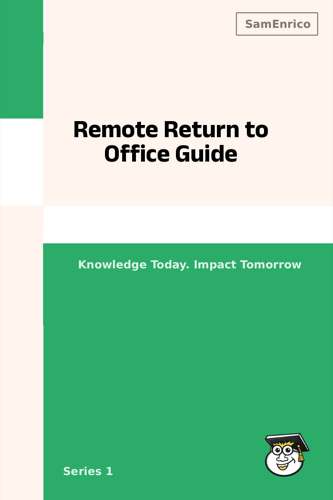
Non-FictionBusiness BriefChange Management
Remote Return to Office Guide Audiobook
Communicate and implement hybrid mandates without
by Vargas Emily
Communicate and implement hybrid mandates without losing top talent.
Formats
Free sample
Chapter 1: The Broken Promise--–- In March 2020, millions of knowledge workers packed their laptops into backpacks, cleared a corner of their dining tables, and did something unprecedented: they proved that the office was not, in fact, essential to productivity. For three years, they delivered results, closed deals, wrote code, designed products, and served customers from spare bedrooms, kitchen counters, and makeshift desks in living rooms. They worked through school closures, pet interruptions, and Zoom fatigue. They adapted. And then, in 2023, the mandates began arriving.
“Return to the office three days a week.” “Return to the office four days a week.” “Return to the office full-time or find another job.”The whiplash was stunning. Employees who had been told “you are trusted to work anywhere” were suddenly told “you are not trusted unless we can see you.” The psychological contract between employer and employee—that unwritten, invisible agreement about mutual expectations, trust, and reciprocity—was shredded in a single email. And leaders were baffled when their best people started updating their Linked In profiles.This chapter diagnoses the fundamental failure of most RTO mandates: they are perceived not as strategic business decisions but as betrayals of trust. We will explore the concept of the psychological contract, introduce the Trust Tax framework for quantifying the hidden costs of forced commutes, and explain why mandates without mutual understanding are ultimatums that will cost you your top talent. By the end of this chapter, you will understand why your employees are resisting—and why that resistance is not rebellion but rational self-preservation.The Psychological Contract You Didn't Know You Had Every employment relationship contains two contracts.
The first is written, explicit, and legally binding: salary, benefits, job description, non-disclosure agreements. The second is unwritten, implicit, and emotionally binding: trust, autonomy, mutual respect, and the belief that both parties will act in good faith. Organizational scholars Denise Rousseau and Sandy Wayne spent decades studying this phenomenon, which they named the psychological contract. Unlike the legal contract, which you can hold in your hand, the psychological contract lives in the minds of employees. It is the answer to the question: “What do I owe my employer, and what do they owe me?”Before the pandemic, the typical psychological contract in white-collar work looked something like this: I will show up on time, work hard, be available during business hours, and stay late when needed.
In return, my employer will provide job security, a predictable schedule, a safe workplace, and reasonable accommodation for life events.…
This is the end of the free sample. Get the Audiobook to keep going. Buy now
About this book
Details
- Author
- Vargas Emily
- Publisher
- SamEnrico
- Language
- English
- Genre
- Non-Fiction, Business Brief, Change Management
- Released
- 2026-06-10
- Pages (approx.)
- 150
- Available as
- eBook, Audiobook

Listen in the VoxFlicks app
Audiobooks and audio dramas wherever you go. Sign in with your SamEnrico account and press play.
More by Vargas Emily
 Job Loss Identity Recovery GuideVargas Emily$11.99
 Micronutrients For VegansVargas Emily$11.99
 Body Image Resilience WorkbookVargas Emily$11.99
 Insecure Attachment Healing GuideVargas Emily$11.99
 The Silk Road of Science: How a Russian Chemist Unlocked the Secrets of Fermentation in Central AsiaVargas Emily$11.99
 The Silk Road's Shadow: What If Marco Polo Never Returned?Vargas Emily$11.99
 Understanding Erdheim–chester DiseaseVargas Emily$17.99
 Licensed MechanicVargas Emily$11.99
 Remote Cross Cultural MentoringVargas Emily$12.99
 ATS Friendly CV Writing GuideVargas Emily$12.99
 Ultimate Handbook Guide to Seoul : (South Korea) Travel GuideVargas Emily$11.99
You may also like
 Hong Kong Handover 1997Dunn Johnnie$11.99
 Zumba For Postnatal Recovery CourseNeal Christian$11.99
 Zumba for BeginnersLadner Nikia$11.99
 YouTube Comment Mining GuideHumes Pandora$12.99
 Worry Box MeditationCarlin Rudy$11.99
 Workplace Stress MeditationNguyen Lynn$11.99
 Workplace Stress and Sleep RepairHawley Ivory$11.99
 Workplace Perfectionism CureDelaney Jeffry$11.99
 Workplace Injustice Anger GuideWallen Isabelle$11.99
 Work Addiction and Burnout LinkGreenwood Ester$11.99
 Women in Yoga and WellnessBeattie Galina$11.99
 Women in Stand Up ComedyChun Evangeline$11.99