
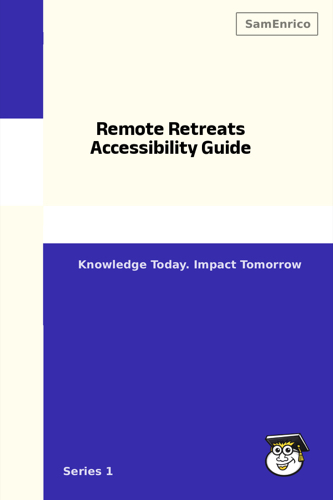
Non-FictionBusiness BriefAccessibility
Remote Retreats Accessibility Guide eBook
Ensure venues and activities accommodate physical
Ensure venues and activities accommodate physical disabilities.
Formats
Free sample
Chapter 1: The Hidden Ledger--–- On a rainy Tuesday in the Cascade Mountains, I watched a thirty-seven-year-old woman named Sarah transfer from her power wheelchair to a wooden picnic bench using only her arms and a folded jacket for padding. She had driven four hours from Seattle. She had booked the cabin six months in advance. She had called twice to confirm that the path from the parking lot to the picnic area was "firm and level." The property manager had assured her it was. What the manager meant was that the path was firm for a person walking in hiking boots, and level compared to the cliff trail behind the lodge.
For Sarah's chair, the path was a washboard of exposed roots and winter-heaved asphalt, each bump transmitting through her spine like a minor car accident. She made the transfer not because the picnic bench was comfortable, but because her back hurt so much from the journey that she could not stay in her chair another minute.I was not supposed to be there. I had come to the retreat to give a workshop on accessible marketing. The owner had hired me as a consultant after receiving a letter from a disability rights attorney—not a lawsuit, yet, but the kind of letter that makes insurance carriers nervous. My job was to help them look better on paper.
Instead, I spent the afternoon talking to Sarah while she ate her sandwich with one hand and massaged her own shoulder with the other."I don't want special treatment," she told me, not for the first time in her life. "I want to know what is actually here. Not what someone thinks I want to hear. What is actually here."That conversation changed how I think about accessibility. Before Sarah, I believed that the problem was design—wrong slopes, narrow doors, soft surfaces.
After Sarah, I understood that the deeper problem is information. Retreat owners do not know what they do not know. Disabled travelers cannot trust what they are told. And in that gap between ignorance and mistrust, billions of dollars of economic activity simply evaporate.The Information Asymmetry That Destroys Trust Economists have a term for situations where one party knows more than the other: information asymmetry. In used car sales, the seller knows if the transmission is failing.
In health insurance, the patient knows if they smoke. In remote retreats, the owner knows—or should know—the exact width of every doorway, the slope of every path, the height of every toilet. The traveler knows their own body, their specific mobility device, their unique transfer techniques. Neither party knows what the other knows. And neither fully trusts the other.This asymmetry creates a market failure.
Disabled travelers develop elaborate strategies to extract honest information. They call three times and ask the same question in different ways, looking for inconsistencies. They cross-reference Google Earth images with website photos. They demand to speak to "someone who has actually used a wheelchair here." Some travelers have told me they book backup hotels they do not intend to use, just to have a safe place to flee to if the retreat fails them. This is not paranoia.
This is rational risk management learned through repeated betrayal.Retreat owners, for their part, develop their own defensive strategies. They use vague language—"most areas are accessible," "we can usually accommodate," "please call for details"—that protects them from lawsuits while providing almost no useful information. They take photos from angles that hide obstacles. They describe gravel paths as "natural terrain features." I have even seen a retreat website that called a four-inch step "a charming threshold detail." The step was not charming. It was a wall to anyone in a manual chair.Everyone loses in this system.
Travelers waste hours on research and still arrive anxious. Owners lose bookings from people who gave up before calling. The retreat industry as a whole sacrifices a growing, loyal, high-spending market segment because no one has figured out how to tell the truth efficiently.The Cost of Vague Language: A Sentence-by-Sentence Autopsy Let me show you how information asymmetry operates on a typical retreat website. I have anonymized this example, but it is real. The "Accessibility" page reads as follows:"Our retreat center welcomes guests of all abilities.
We have several cabins that can accommodate wheelchairs, with ground-floor entries and accessible bathrooms. The main lodge and dining hall are reachable via paved pathways. Please contact our guest services team to discuss your specific needs before booking."To an nondisabled reader, this sounds reasonable, even welcoming. To a disabled reader, every sentence is a red flag."Welcomes guests of all abilities" is legally meaningless. It signals that the owner has received advice to include inclusive language but has not invested in meaningful accommodation.
It is the accessibility equivalent of "thoughts and prayers.""Several cabins that can accommodate wheelchairs" is actively misleading without further detail. "Accommodate" could mean a thirty-six-inch doorway, or it could mean a staff member will help lift the wheelchair over the threshold. "Accessible bathrooms" could mean a roll-in shower with grab bars, or it could mean a pedestal sink that leaves no room for a wheelchair to turn. The reader has no way to know."Reachable via paved pathways" is almost always a lie. In my experience, when retreats use the word "paved," they mean asphalt that has cracked, heaved, and buckled after years of freeze-thaw cycles.
A cracked path is not accessible. It is an obstacle course painted black."Please contact us to discuss your specific needs" is the most damaging phrase on the page. What it communicates to the disabled traveler is: We have not done the work of measuring our own property. We will make you do that work for us. And we will make you educate us about our own failures, one painful phone call at a time.Imagine requiring every able-bodied guest to call and explain, "I use two feet to walk, size nine shoes, no assistive devices.
Will your gravel path work for me?" It would be absurd. But disabled travelers are expected to perform this absurdity before every single booking, often multiple times, often to staff members who have never used a wheelchair and cannot imagine what "needs" might arise.The Access Passport: Flipping the Information Burden This book proposes a radical inversion: instead of forcing disabled travelers to extract information from retreat owners, we will train retreat owners to produce standardized, verifiable accessibility data that travelers can use without a single phone call. I call this system the Access Passport, and you will find its complete template in Chapter 3.The Access Passport is not a checklist. It is a data set. For every cabin, bathroom, path, and activity area, the retreat owner provides specific measurements: doorway width in inches (not "wide enough"), slope percentage (not "gentle"), toilet seat height from floor (not "standard"), shower threshold height (not "low"), bed clearance on three sides (not "plenty of room").
The owner also provides photographs taken from wheelchair height—roughly nineteen inches off the ground—so travelers can see exactly what their view will be.This level of detail seems daunting. It is…
This is the end of the free sample. Get the eBook to keep going. Buy now
About this book
Details
- Author
- Escalante Celine
- Publisher
- SamEnrico
- Language
- English
- Genre
- Non-Fiction, Business Brief, Accessibility
- Released
- 2026-06-08
- Pages (approx.)
- 139
- Available as
- eBook, Audiobook

Read better in the ZLOADR app
Your eBooks on your phone or tablet. Sign in with your SamEnrico account and start reading.
More by Escalante Celine
 Downsizing Emotional Attachment CourseEscalante Celine$11.99
 Caffeine Timing for Focus WorkEscalante Celine$11.99
 Navigating Pet EuthanasiaEscalante Celine$11.99
 Norwegian Resistance Cross CountryEscalante Celine$11.99
 The Last Empress: Exile in SwitzerlandEscalante Celine$11.99
 Frozen Revelations: The Arctic Secrets of the Human BodyEscalante Celine$11.99
 Understanding Chromosomal TriplicationEscalante Celine$17.99
 JEE Revision Techniques GuideEscalante Celine$12.99
 Budget Ethics And ComplianceEscalante Celine$12.99
 Rapa Turnip HarvestingEscalante Celine$11.99
 How to Become a Inspection Supervisor IiEscalante Celine$11.99
You may also like
 Hong Kong Handover 1997Dunn Johnnie$11.99
 Zumba For Postnatal Recovery CourseNeal Christian$11.99
 Zumba for BeginnersLadner Nikia$11.99
 YouTube Comment Mining GuideHumes Pandora$12.99
 Worry Box MeditationCarlin Rudy$11.99
 Workplace Stress MeditationNguyen Lynn$11.99
 Workplace Stress and Sleep RepairHawley Ivory$11.99
 Workplace Perfectionism CureDelaney Jeffry$11.99
 Workplace Injustice Anger GuideWallen Isabelle$11.99
 Work Addiction and Burnout LinkGreenwood Ester$11.99
 Women in Yoga and WellnessBeattie Galina$11.99
 Women in Stand Up ComedyChun Evangeline$11.99