
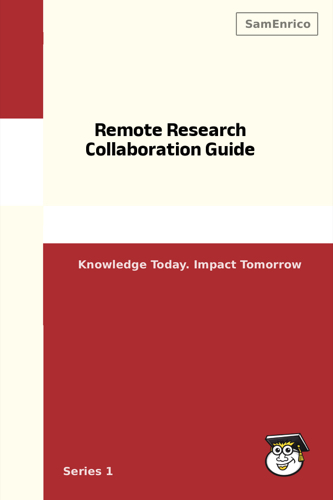
Remote Research Collaboration Guide eBook
Teaches scientists to coordinate studies and share
Teaches scientists to coordinate studies and share data across distances.
Formats
Free sample
Chapter 1: The 5,000-Person Problem--–- In 2012, a scientific paper appeared that had more authors than most small towns have residents. The discovery of the Higgs boson credited 5,111 scientists across dozens of countries, from CERN’s Large Hadron Collider to university labs on four continents. The author list alone spanned 24 pages. If you printed the paper and stacked the pages, the author list would be taller than the actual research.This was not an anomaly. It was a signal.The Human Genome Project involved thousands of researchers across six countries and took thirteen years.
The Event Horizon Telescope collaboration—the team that produced the first image of a black hole—linked radio dishes from Hawaii to Spain to the South Pole, requiring data from eight separate observatories to be stitched together with such precision that the final image was equivalent to reading a newspaper in New York from a café in Paris. The first detection of gravitational waves, announced in 2016, credited over 1,000 authors from more than 100 institutions.Welcome to the age of hyper-authorship. Welcome to the 5,000-person problem.This book exists because the way science gets done has fundamentally changed, but the way scientists are trained has not. You know how to design an experiment, analyze data, and write a paper. You probably do not know how to coordinate a team across eight time zones, build trust without a single handshake, or prevent a free-rider from destroying a multi-year project.
No one taught you. Your Ph D advisor never mentioned it. And yet, here you are—expected to collaborate remotely, share data across continents, and produce science that is more complex than any single lab can handle.This chapter explains why we got here, why distance is no longer a barrier to entry but remains a profound barrier to trust, and why the “lone genius” myth is not just inaccurate but actively harmful to your career. By the end, you will recognize the hidden tension that defines modern science—the rival-collaborator dynamic—and you will understand why mastering remote collaboration is no longer optional.The Myth That Won’t Die Let us name the ghost in the room: the lone genius.Isaac Newton, 1665-66. Plague closes Cambridge.
He retreats to his family farm in Woolsthorpe. Eighteen months later, he has invented calculus, discovered the laws of motion and universal gravitation, and cracked the nature of white light. All alone. No collaborators. No Zoom calls.
Just a mind and an apple tree.The story is apocryphal in parts (the apple probably did not hit his head), but the mythology is real. It shapes how scientists see themselves and each other. Graduate students learn to protect their projects. Postdocs learn to compete for first authorship. Principal investigators learn to guard their grants.
The implicit message: real science happens when brilliant individuals lock themselves in rooms and emerge with answers.This myth is catastrophic for remote collaboration.Here is what the myth gets wrong: Newton corresponded constantly. His “alone” period was not isolation—he wrote hundreds of letters to other natural philosophers, sharing results, testing ideas, and, yes, competing viciously (see his decades-long war with Leibniz over who invented calculus first). Newton was not a lone genius. He was a rival-collaborator, just like the 5,111 physicists on the Higgs paper. The difference is scale, not kind.Contemporary science is organized differently.
The problems have changed. No single lab—no matter how brilliant its PI—can sequence a human genome alone, detect a gravitational wave alone, or image a black hole alone. These require distributed instrumentation (telescopes on different continents), distributed expertise (specialists in optics, signal processing, astrophysics, and data science), and distributed funding (grants from multiple agencies across multiple countries).The lone genius model is not just nostalgic. It is a luxury that no longer exists. The question is not whether you will collaborate remotely.
The question is whether you will do it well.The Rival-Collaborator Tension Here is the central insight that organizes this entire book: modern scientists are not friends. They are not teammates in the feel-good sense. They are rivals who must collaborate.This is the rival-collaborator tension—the defining psychological dynamic of 21st-century science. You compete for the same limited resources: grants, tenure slots, speaking invitations, prestigious journal space, and, ultimately, scientific legacy. Your collaborator at another university is also your competitor.
They want the same Nature paper. They want the same NIH funding line. They may be reviewing your grant proposal even as you share data with them.This is not a bug. It is a feature.Healthy competition fuels rigor. When rival labs pursue the same question, they replicate each other’s findings (intentionally or not).
They develop alternative methods, catch each other’s errors, and accelerate discovery. The race between the public Human Genome Project and the private company Celera Genomics drove both teams to finish years ahead of schedule. Neither would have moved as fast without the other breathing down their neck.But competition also poisons collaboration. The fear of being “scooped” makes scientists hoard data. The pressure to be first makes them obscure methods.
The drive for individual credit makes them marginalize junior colleagues or technical staff. Remote work amplifies every one of these tendencies. When you never see your collaborator’s face, it is easier to imagine them as a threat rather than a partner. When you communicate only through email, it is harder to share a half-formed idea that might get stolen.The rival-collaborator tension will appear in every chapter of this book. In Chapter 5, it shows up as the free-rider problem—someone who benefits from the team’s work without contributing.
In Chapter 6, it becomes cultural—different norms about competition and credit across countries. In Chapter 7, it is the fear of being scooped that prevents data sharing. In Chapter 11, it is authorship disputes—the purest expression of rivals fighting over the spoils of collaboration.You cannot eliminate this tension. You can only manage it. The scientists who succeed in remote research are not the ones who pretend competition does not exist.
They are the ones who build systems—trust frameworks, data transfer agreements, authorship contracts—that harness competition’s benefits while containing its damage.The Trust Barrier Geographic distance is no longer a barrier to entry. Technology solved that.You can share a terabyte of data via Globus or Aspera in hours. You can video-conference with Tokyo, London, and São Paulo simultaneously. You can run code on a supercomputer across the continent and see results on your laptop. The physical constraints that limited science to local clusters have evaporated.But distance remains a profound barrier to trust.Trust is what happens when you know—not hope, not assume, but know—that your collaborator will do what they said they would do.
When you are in the same building, trust builds automatically. You see them working. You overhear their phone calls. You walk past their office and notice they are stressed. You grab coffee and learn about their family, their fears, their past failures.
This ambient awareness creates a baseline of trust that makes collaboration frictionless.Remove proximity, and trust becomes fragile. You do not see your collaborator struggling with a bug in their…
This is the end of the free sample. Get the eBook to keep going. Buy now
About this book
Details
- Author
- Minton Jacquline
- Publisher
- SamEnrico
- Language
- English
- Genre
- research, Self-Help
- Released
- 2026-06-09
- Pages (approx.)
- 151
- Available as
- eBook, Audiobook

Read better in the ZLOADR app
Your eBooks on your phone or tablet. Sign in with your SamEnrico account and start reading.
More by Minton Jacquline
 The Door Holding SignalMinton Jacquline$11.99
 The Academic Email AnxietyMinton Jacquline$11.99
 Fiverr Order Cancellation RecoveryMinton Jacquline$11.99
 The Sudden Parent Loss GuideMinton Jacquline$11.99
 Gambling Addiction Recovery for Seniors GuideMinton Jacquline$11.99
 Breathing Protocol For PresentersMinton Jacquline$11.99
 Volleyball Shoulder and Spine CourseMinton Jacquline$11.99
 High Potency Cannabis RisksMinton Jacquline$11.99
 Silicon Siege: How Google’s Algorithms Reshaped the WorldMinton Jacquline$11.99
 Whispers from the Black Obelisk: The Forgotten Encounter of Hatshepsut’s ExpeditionMinton Jacquline$11.99
 The Shield of Greece: The Ingenious Mind of Aeneas TacticusMinton Jacquline$11.99
 Understanding Bacterial VaginosisMinton Jacquline$17.99
You may also like
 Scientific Research On TM GuideMartens Nathanial$11.99
 Research Proposal Methodology Section MasteryPauley Debroah$11.99
 Research Proposal Appendix CompilationRaines Tyisha$11.99
 Academic Researcher Distraction GuideFord Virgil$11.99
 TM Research and ScienceCovert Nicki$11.99
 Social Anxiety Research ReviewRoberge Cole$11.99
 Research Proposal Significance Section GuideBock Tory$12.99
 Research Proposal Reviewer PsychologyLugo Tawanda$11.99
 Research Proposal Research Questions DesignLara Robbi$11.99
 Research Proposal References and CitationsPatten Shanice$11.99
 Research Proposal Mixed Methods DesignCameron Omega$11.99
 Research Proposal Data Management PlanAnderson Roberto$12.99