
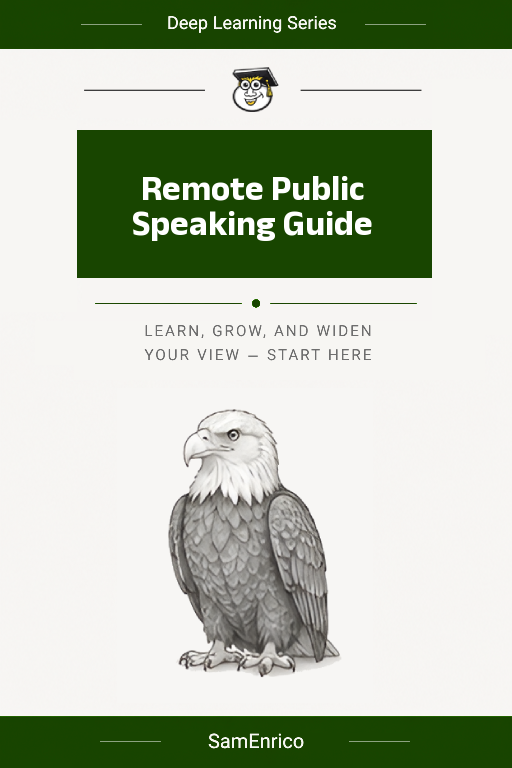
Remote Public Speaking Guide eBook
Master virtual presentations with eye contact, voc
by Belk Valene
Master virtual presentations with eye contact, vocal variety, and engaging slides. Keep remote audiences focused.
Formats
Free sample
Chapter 1: The Ghost in the Grid--–- The webinar was supposed to be her moment. Sarah, a senior director of sales at a mid-sized tech firm, had spent three days preparing a thirty-slide deck she'd delivered to standing ovations in conference rooms from Austin to Amsterdam. She knew this material cold. She knew her jokes landed. She knew exactly when to pause for laughter and when to lean into the lectern for the serious part.
At 2:00 PM on a Tuesday, she clicked "Share Screen," smiled at the Brady Bunch of faces on her laptop, and began.Forty-seven minutes later, she closed Zoom and cried at her kitchen table.Not because the content was bad. Not because she stumbled over words. But because she had just experienced something for which her fifteen years of speaking experience had not prepared her: the silent, invisible, uniquely humiliating void of the remote room.Three people had kept their cameras on. One of them was her boss, who spent the entire presentation typing furiously into an email thread she could see reflected in his glasses. Another attendee, camera off, had unmuted at minute twelve to ask if she could "speed it up" because she had a hard stop.
The chat log contained exactly two messages: a link someone posted to a competing product, and the word "Thanks" from an intern who had clearly been told to say something. When Sarah finished her closing slide and asked, "Any questions?" the silence lasted so long she checked to see if she had been disconnected. She hadn't. She just wasn't worth responding to.Sarah had become a ghost. Present but invisible.
Speaking but unheard. A face in a grid that everyone had already mentally checked out of.This book exists because Sarah's story is not an exception. It is the rule. And it is happening to you, right now, on every call where you assume that what works in person will work through a screen.The Great Misunderstanding Here is the single biggest mistake almost every remote presenter makes: they treat the virtual room as if it were a physical room with a smaller audience and a pane of glass between them.This mistake is understandable. The platforms actively encourage it.
Zoom, Teams, and Meet all present themselves as windows into a shared space. The gallery view mimics a classroom. The "raise hand" feature simulates a real hand. Even the language we use—"join a meeting," "step into the virtual room"—conspires to make us believe that remote speaking is just in-person speaking with slightly worse technology.It is not. It is an entirely different medium, with its own physics, its own psychology, and its own unforgiving failure modes.Consider what happens in a physical room.
When you speak, you receive immediate, multi-sensory feedback. You see heads nodding or tilting. You hear the shuffle of papers or the creak of chairs. You feel the temperature of the room—warm when engagement is high, cold when you've lost them. This feedback loop is so automatic that most speakers don't even notice it happening.
But it is constantly calibrating your performance. You speed up when you sense restlessness. You slow down when you see confusion. You tell a story when you feel the energy dipping.Now strip all of that away.In the virtual room, you speak into a void. The faces on your screen are delayed by milliseconds that feel like minutes.
Their expressions are flattened by compression algorithms that prioritize bandwidth over emotion. The silence after you finish a point is not a thoughtful pause—it is an abyss. And worst of all, you can see yourself, which means you are simultaneously performing and criticizing, speaking and judging, present and dissociating.This is not a minor adjustment. This is a complete rewiring of the fundamental act of human communication.The Physics of Virtual (And Why It Destroys In-Person Skills)To understand why remote speaking fails, you must first understand the technical realities that govern it. These are not excuses.
They are constraints. And once you understand them, you can stop fighting them and start designing around them.Latency: The 200ms Death of Conversation Human conversation operates on a rhythm measured in milliseconds. In person, the gap between one person finishing a sentence and another beginning is typically 100 to 200 milliseconds. That tiny window signals attentiveness, engagement, and natural turn-taking.On Zoom, baseline latency ranges from 150 to 300 milliseconds—and that's under ideal conditions. Add a bad Wi-Fi connection, a VPN, or an international participant, and latency can stretch to a full second or more.This doesn't sound like much until you experience it.
When you finish a sentence and someone responds after a one-second pause, your brain doesn't interpret that as thoughtful consideration. It interprets it as disinterest, confusion, or technical failure. Worse, the latency causes accidental interruptions—you think the other person is done, so you start speaking, only to talk over them because their audio hasn't reached you yet. The result is a conversation that feels stilted, awkward, and fundamentally untrustworthy.Frame Rate: Where Micro-Expressions Go to Die In person, human beings communicate a tremendous amount of information through micro-expressions—tiny, involuntary facial movements that last 1/15th to 1/25th of a second. A slight eyebrow raise signals skepticism.
A tiny lip purse signals disagreement. A micro-smile signals warmth.Zoom and Teams typically transmit video at 15 to 30 frames per second. That sounds fine until you realize that a 1/20th of a second micro-expression appears on exactly one or two frames. If those frames are lost to compression—and they almost always are—the expression simply vanishes. Your audience receives a smoothed, flattened, emotionless version of your face.This is why people on Zoom often look angry, bored, or blank when they feel perfectly fine.
The technology is literally erasing their emotional signals.Compression: The Equalizer of Emotion Audio compression algorithms are designed to prioritize speech intelligibility above all else. They boost frequencies associated with consonant sounds (which convey meaning) and suppress frequencies associated with emotional tone (which convey feeling). This is why your clever sarcasm lands as flat rudeness, why your warm encouragement sounds like corporate boilerplate, and why your passionate plea registers as monotone whining.The algorithm doesn't hate you. It's just doing its job. Its job is to make sure people hear the words "the budget is approved." Its job is not to make sure they feel your excitement about it.The Self-View Demon Finally, and most insidiously, there is the camera's red recording light and the window that shows you, yourself, speaking.In a physical room, you exist in space but you cannot see yourself.
Your attention goes outward, toward the audience. On video, your attention is split. Part of you is speaking. Part of you is watching yourself speak. And that watching part is merciless.Neuroscience research shows that seeing your own face triggers activity in the same brain regions associated with social evaluation and judgment.
You are not just speaking to an audience. You are speaking to a mirror that judges every flared nostril, every asymmetrical eyebrow, every strand of hair that has drifted out of place.This is not vanity. This is biology. Your…
This is the end of the free sample. Get the eBook to keep going. Buy now
About this book
Details
- Author
- Belk Valene
- Publisher
- SamEnrico
- Language
- English
- Genre
- Non-Fiction, Professional's Cheat Sheet, Virtual Communication
- Released
- 2026-06-01
- Pages (approx.)
- 135
- Available as
- eBook, Audiobook

Read better in the ZLOADR app
Your eBooks on your phone or tablet. Sign in with your SamEnrico account and start reading.
More by Belk Valene
 Emotional Regulation For PCOSBelk Valene$11.99
 Vaginismus Self Esteem GuideBelk Valene$11.99
 Liking Persuasion FactorBelk Valene$11.99
 Sexual Addiction and Social MediaBelk Valene$11.99
 The Iron Masters of Meroë: Forging the Future of KushBelk Valene$11.99
 Ultimate Handbook Guide to Denver : (United States) Travel GuideBelk Valene$11.99
 Learn to Play the HarpsichordBelk Valene$11.99
 Maintenance LeadBelk Valene$11.99
You may also like
 Remote Presentation Tech ChecklistGist Hunter$12.99
 Remote Presentation Setup GuideSwart Jannette$12.99
 Remote Presentation Nervousness GuideKang Cheri$12.99
 Remote Presentation Eye ContactBriggs Clint$12.99
 Remote Presentation Vocal TipsBedard Zelda$12.99
 Remote Presentation Slide DesignSwain Tory$12.99
 Remote Presentation Q&A GuideHoover Elidia$12.99
 Engaging Remote Audiences GuideMallen Theda$12.99
 Remote Presentation Body LanguageHowell Rosemarie$12.99