
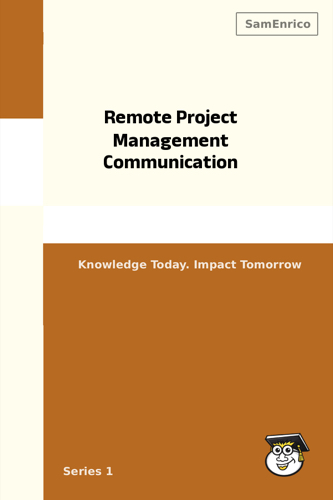
Non-FictionSelf-HelpProject Management
Remote Project Management Communication eBook
Teaches updating stakeholders and coordinating tas
Teaches updating stakeholders and coordinating tasks across digital tools.
Formats
Free sample
Chapter 1: The Invisible Cost...--–- The email arrived at 11:47 PM on a Tuesday. "Can you jump on a quick call?" The sender was a sponsor I hadn't heard from in three weeks. The project had been green across every dashboard. The team was reporting progress. No one had raised a blocker.
And yet, I knew—with the kind of dread that settles into your bones before you can name it—that something was very, very wrong.The call lasted four minutes. "We're pausing the initiative," the sponsor said. "The executive team doesn't have confidence in the timeline anymore." When I asked what had changed, the answer was devastating in its simplicity: "We just can't see what's happening. And if we can't see it, we can't trust it."That project did not fail because the team was incompetent. It did not fail because the work was impossible.
It failed because of a phenomenon so subtle, so invisible, that most project managers do not even know it has a name. It failed because of the visibility vacuum—the silent killer of remote project management.This is the problem that this book exists to solve.The Hallway That No Longer Exists For decades, project management relied on a secret infrastructure that no one ever documented in a process manual. That infrastructure was called proximity.Think back to any successful project you have ever managed in a physical office. Did you ever walk past a team member's desk and casually ask, "How's that report coming?" Did you ever overhear a conversation in the breakroom that alerted you to a brewing conflict? Did you ever glance at a whiteboard from across the room and notice that a task had been stuck in the same column for three days?Those moments were not accidents.
They were the invisible nervous system of traditional project management. They were the hallways, the coffee stations, the shared walls that allowed information to flow without meetings, without emails, without formal status reports. Proximity was your silent partner.Now consider your current remote environment. That partner has vanished.The hallway conversations are gone. The desk drop-bys are gone.
The ability to read a room, to sense tension in a five-second glance, to notice that someone looks overwhelmed before they say a word—all of it is gone. What remains is a series of digital windows: Slack channels, Zoom grids, email threads, and shared documents. And through those windows, you can only see what people choose to show you.This is the visibility vacuum—the gap between what is actually happening on a project and what stakeholders can perceive from a distance. In a physical office, that gap is small. You can see work in progress.
You can see who is collaborating and who is isolated. You can see the sticky notes on a monitor that say "URGENT: Legal review pending."In a remote environment, that gap is enormous. And it is filled with the worst possible substance: assumptions.The Proximity Bias That Destroys Trust There is a reason why remote projects feel more stressful than co-located ones, even when the work is identical. That reason is called proximity bias—and it is not your fault, but it is your problem to solve.Proximity bias is the unconscious human tendency to trust, value, and reward what is physically or digitally nearby. It is a cognitive shortcut that evolved over millions of years: if something is close, it is likely relevant or dangerous.
If something is far away, it is likely safe to ignore.In a physical office, proximity bias manifests as the manager who promotes the employee they see working late, even if the remote employee worked later but logged off quietly. It is the sponsor who trusts the team they can visit in person over the team that delivers results from another city.In a remote environment, proximity bias takes a more insidious form. Stakeholders do not just undervalue remote workers. They undervalue remote work itself. They cannot see the work, so they assume the work is not happening.
They cannot see the progress, so they assume there is no progress. They cannot see the challenges, so they assume the project is either perfectly on track or secretly doomed—with no middle ground.I have seen this pattern repeat across hundreds of projects. A remote team delivers exactly what they promised, exactly when they promised it. And yet, the sponsor expresses "concerns about velocity." The executive asks for "more visibility." The stakeholder demands "a better sense of where things really stand."These concerns are not about the work. They are about the visibility of the work.
And until you understand that distinction, you will spend your entire career fighting a battle you cannot win.Busy Versus Progress: The Great Confusion Here is the single most important distinction in remote project management—and the one that most teams get wrong.In a physical office, busy looks like progress. When a manager walks past a desk and sees someone typing furiously, surrounded by papers, frowning at their screen, the manager thinks: "Good. Work is happening." That visual cue is so powerful that it overrides actual data. The manager feels informed, even if they have not seen a single deliverable.In a remote environment, busy is invisible. That same person could be typing a novel, responding to personal emails, or reorganizing their desktop icons.
Or they could be solving the most critical technical problem of the quarter. No one can tell the difference from a Slack status emoji.This creates a perverse incentive. Remote workers learn to perform busy-ness in digital spaces. They send more messages. They react with emojis faster.
They join more meetings and speak more often. They learn that digital presence is the closest substitute for physical presence—and they optimize for it.But digital presence is not progress. A person can be present in every meeting, responsive to every message, and visible on every call, while delivering absolutely nothing of value. Conversely, a person can be invisible for three days, deep in focused work, and emerge with a completed milestone that moves the entire project forward.The stakeholder cannot see the difference. And when stakeholders cannot see the difference, they default to rewarding presence over production.The solution is not to demand more visibility.
The solution is to change what visibility means.Radical Transparency: The Only Antidote If proximity is no longer your silent partner, you need a new partner. That partner is data.Radical transparency is not a buzzword. It is a discipline. It means making project data so accessible, so current, and so unambiguous that stakeholders never need to ask "What is happening?" because the answer is already visible.Radical transparency requires a shift in mindset. Instead of asking, "How can I show stakeholders that we are working?" ask, "What data would prove, beyond any doubt, that we are making progress?" Instead of asking, "How can I reassure the sponsor?" ask, "What would a rational, data-driven person need to see to feel confident?"This is not about surveillance.
It is not about tracking keystrokes or monitoring screen time. Those are attempts to measure busy-ness remotely, and they fail…
This is the end of the free sample. Get the eBook to keep going. Buy now
About this book
Details
- Author
- Stubblefield Verena
- Publisher
- SamEnrico
- Language
- English
- Genre
- Non-Fiction, Self-Help, Project Management
- Released
- 2026-06-08
- Pages (approx.)
- 156
- Available as
- eBook, Audiobook

Read better in the ZLOADR app
Your eBooks on your phone or tablet. Sign in with your SamEnrico account and start reading.
More by Stubblefield Verena
 The Plagiarism Fear GuideStubblefield Verena$11.99
 Anticipatory Grief and Palliative CareStubblefield Verena$11.99
 Curie Daughter IreneStubblefield Verena$11.99
 Step Two Open Mindedness ExercisesStubblefield Verena$11.99
 Upwork Portfolio OptimizationStubblefield Verena$11.99
 Murdoch Sky TVStubblefield Verena$11.99
 Gaslighted Childhood RecoveryStubblefield Verena$11.99
 Pharmaceutical GH vs Natural BoostStubblefield Verena$11.99
 The Vanishing Highway: The Phantom of I-70Stubblefield Verena$11.99
 The Midnight Swap: The Untold Story of the 1996 NBA Blockbuster That Changed Two DynastiesStubblefield Verena$11.99
 Rum Runners & Royalty: The Untold Story of Queen Elizabeth’s Secret Caribbean EspionageStubblefield Verena$11.99
 The Complete Guide to the Three Day DietStubblefield Verena$11.99
You may also like
 Hong Kong Handover 1997Dunn Johnnie$11.99
 Zumba For Postnatal Recovery CourseNeal Christian$11.99
 Zumba for BeginnersLadner Nikia$11.99
 YouTube Comment Mining GuideHumes Pandora$12.99
 Worry Box MeditationCarlin Rudy$11.99
 Workplace Stress MeditationNguyen Lynn$11.99
 Workplace Stress and Sleep RepairHawley Ivory$11.99
 Workplace Perfectionism CureDelaney Jeffry$11.99
 Workplace Injustice Anger GuideWallen Isabelle$11.99
 Work Addiction and Burnout LinkGreenwood Ester$11.99
 Women in Yoga and WellnessBeattie Galina$11.99
 Women in Stand Up ComedyChun Evangeline$11.99