
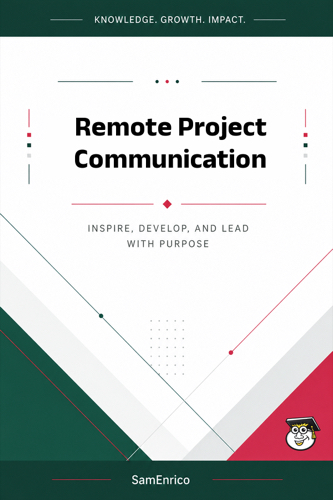
Remote Project Communication eBook
Update stakeholders and coordinate tasks using Asa
by Morse Kirby
Update stakeholders and coordinate tasks using Asana, Trello, or Jira.
Formats
Free sample
Chapter 1: The Status Meeting Autopsy--The email arrived at 4:47 PM on a Thursday. Maria had been staring at her Asana board for eleven minutes, trying to remember what she had been doing before the last three interruptions. The subject line read: “Quick check-in on the Q4 launch – got 5 minutes?”She calculated the real cost of those five minutes. The context switch would cost her twenty-three minutes to recover. The meeting itself would run fifteen, not five.
And because the stakeholder would ask for a status update she had already posted to the project board that morning, she would feel a familiar wave of resentment. By the time the call ended, she would have lost forty-three minutes of productive work. Multiply that by the twelve status meetings she attended each week, and Maria was losing nearly nine hours every seven days to meetings whose primary purpose was transmitting information that already lived in her project management tool.Maria is not real. But her calendar is. And if you are reading this book, so is yours.Let us perform an autopsy on the modern status meeting.
Not because meetings are inherently evil—they are not. Some conversations require human voices, real-time negotiation, and the messy beauty of synchronous interaction. But the vast majority of status meetings are not that. They are rituals of mistrust. They are theater.
They are the tax we pay because our communication systems have failed, and rather than fix the systems, we add another recurring calendar invite.This chapter will dissect the corpse of the broken status meeting. We will identify its cause of death (spoiler: it was murdered by a combination of time zone lag, CC fatigue, and the illusion of transparency). We will meet its victims (the project managers who never get deep work done, the team members who resent update admin, and the stakeholders who remain uninformed despite endless meetings). And we will establish the single most important principle of this entire book: visibility does not equal communication.By the end of this chapter, you will understand why your current approach to remote project communication is failing. You will have a framework for diagnosing your own team’s specific breakdowns.
And you will be ready to build something better—starting with Chapter 2’s Single Source of Truth.But first, we must look closely at the body.The Three Wounds That Kill Remote Communication Every failed communication system dies from one or more of three specific wounds. These are not abstract management theories. They are measurable, observable, and almost certainly present in your project right now.Wound One: Time Zone Lag Information ages. This is not a metaphor. When a developer in San Francisco completes a task at 5 PM Pacific Time, and a project manager in London sees that update at 9 AM GMT the next day, that information is sixteen hours old.
In those sixteen hours, decisions may have been made, dependencies may have shifted, and the stakeholder in New York may have already asked “Where are we on that task?” three times.Time zone lag creates two specific pathologies.First, duplicated work. When Team A does not know that Team B has already solved a problem, Team A solves it again. A study of distributed software teams found that time zone differences increased duplicate effort by 34 percent, not because teams were incompetent but because information traveled slower than questions. By the time an answer arrived, the asker had already moved on—or worse, had already done the work unnecessarily.Second, the asynchronous waiting loop. Consider this sequence: Maria asks a question in Asana at 9 AM her time.
Her colleague in Singapore sees it at 9 PM Maria’s time, responds at 10 PM. Maria sees the response at 9 AM the next day, needs clarification, asks a follow-up at 9:30 AM. Singapore sees it at 9:30 PM, responds at 10:30 PM. A simple question that would take ninety seconds in a room together now consumes two calendar days. During those two days, Maria’s task is blocked.
The project stalls. And nobody is at fault—the system is simply not designed for asynchronous reality.The tragedy of time zone lag is that most teams never measure it. They feel it as frustration, as “why is this taking so long,” as a vague sense of slowness. But they do not calculate the actual hours lost to waiting. When Maria finally tracked her team’s “time to answer” metric across three time zones, she discovered that the average question took eleven hours to receive a first response.
Eleven hours. That meant any blocked task automatically lost half a day before anyone even looked at it.Wound Two: CC Fatigue The carbon copy field was invented for a different era. In the age of paper memos, CC meant “for your information but no action required”—a polite nod to stakeholders who should be aware but not involved. In the age of email, CC became a coping mechanism for anxiety. Managers CC everyone “just in case.” Stakeholders demand to be CCed “so we don’t miss anything.” And the result is an inbox full of messages that are 90 percent irrelevant to any given recipient.CC fatigue manifests in three behaviors, none of them productive.Selective reading.
When every email includes fifteen names in the CC line, recipients learn to ignore the CC line entirely. Important information that should have been seen is missed because it was buried in a thread where the reader had trained themselves to see noise.The bystander effect. When everyone is CCed, no one feels responsible. A question that requires an answer gets thirty recipients and zero replies. Each person assumes someone else will handle it.
The project stalls while everyone waits for someone else to act.Inbox as task list. The most destructive manifestation of CC fatigue is when professionals start using their email inbox as a de facto project management tool. They flag messages, move them to folders, and attempt to track work through a medium that was never designed for workflow management. This is like using a garden hose to put out a house fire—technically possible, catastrophically inefficient.The irony of CC fatigue is that it is driven by a desire for transparency. Stakeholders ask to be CCed because they do not trust that they will be informed otherwise.
But the very act of CCing everyone reduces the signal-to-noise ratio so dramatically that the transparency they sought becomes impossible. They see everything, so they see nothing.Wound Three: The Illusion of Transparency This is the most insidious wound because it is invisible to the people who suffer from it. The illusion of transparency is the cognitive bias where people overestimate the extent to which others understand their internal state. In project communication, it sounds like this: “I updated the task, so everyone knows.” “I left a comment, so the team is aware.” “I moved the card to Done, so the stakeholder has been notified.”None of these assumptions are true.Updating a task does not notify anyone unless you have configured notifications. Leaving a comment does not mean anyone has read it.
Moving a card to Done does not trigger an automatic stakeholder email unless you have built that automation. The illusion…
This is the end of the free sample. Get the eBook to keep going. Buy now
About this book
Details
- Author
- Morse Kirby
- Publisher
- SamEnrico
- Language
- English
- Genre
- Non-Fiction, Self-Help, Project Management
- Released
- 2026-06-12
- Pages (approx.)
- 153
- Available as
- eBook, Audiobook

Read better in the ZLOADR app
Your eBooks on your phone or tablet. Sign in with your SamEnrico account and start reading.
More by Morse Kirby
 Dream Rehearsal for Medical PTSDMorse Kirby$11.99
 Sex Addiction For Women WorkbookMorse Kirby$11.99
 Period Disposal Etiquette GuideMorse Kirby$11.99
 Dreams After Terrorist AttackMorse Kirby$11.99
 The Vanishing Sky of RendleshamMorse Kirby$11.99
 The Silk Road’s Last Stand: How a 13th-Century Trade War Reshaped the WorldMorse Kirby$11.99
 Fire InspectorMorse Kirby$11.99
 Essay Writing GPT Prompt GuideMorse Kirby$12.99
 Renewable Energy Asset Management OutlookMorse Kirby$12.99
 Understanding Hemangioma, Capillary InfantileMorse Kirby$17.99
 How to Become a Seam PresserMorse Kirby$11.99
You may also like
 Todoist Advanced ProjectsBox Wendi$11.99
 Self Esteem for Project LeadersSilverman Johnny$11.99
 Pomodoro Goal Breakdown MethodHatley Ruthanne$11.99
 Active Listening For ScrumMackay Chin$11.99
 Weekly Project ReviewBustamante Soon$11.99
 Project Weekly Review GuideBraswell Janell$11.99
 EQ For Project ManagersEng Aretha$11.99
 Workaholism in Project ManagementMalcolm Misti$11.99
 Stakeholder Mapping GuideHutchinson Angle$11.99
 Project Manager Stress GuideDozier Asia$11.99
 Project Management CreativityHathaway Colene$11.99
 Scheduling for Multiple ProjectsAvalos Margarite$11.99