
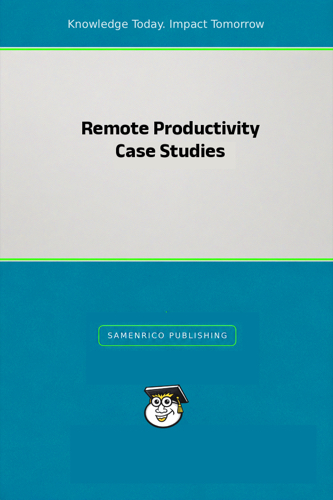
Non-FictionBusiness BriefCase Studies
Remote Productivity Case Studies Audiobook
Real companies that measure remote work effectivel
Real companies that measure remote work effectively.
Formats
Free sample
Chapter 1: Defining the Undefinable...-- The CEO's question seemed simple enough. "Is remote work working?" she asked, looking around the conference table at her leadership team. The head of people pointed to the latest engagement survey: 87 percent satisfaction. The CFO pointed to the real estate savings: $4 million annually. The head of engineering pointed to the Slack metrics: messages were up, response times were down.
Everyone had data. Everyone had an answer. But no one had answered the question.Because the question itself was flawed. "Working" for whom? By what measure?
Compared to what? The CEO was asking for a simple answer to a complex question. And that is the productivity paradox: we want to know if remote work is productive, but we cannot agree on what productivity means, let alone how to measure it across different roles, teams, and individuals.This chapter is about that paradox. It will not give you a single number or a universal truth. It will give you something more valuable: a framework for defining and measuring productivity in your own organization, for your own roles, with your own data.
You will learn why most organizations measure the wrong things, how to distinguish activity from output, and why the five-level framework from the ROI Institute is the closest thing we have to a gold standard. You will also learn why baseline data matters, what a control group is, and why Trip.com's randomized controlled trial is the envy of remote work researchers everywhere.But first, we need to confront the question that everyone is asking and no one can answer.The Great Debate: Is Remote Work More Productive?Walk into any executive conference room and you will hear the same argument. One side cites studies showing that remote workers are more productive. The other side cites studies showing the opposite. Both sides have data.
Both sides are convinced. Both sides cannot be right.The research is conflicting because the conditions vary. A study of data entry workers at a call center may show productivity increases of 13 percent when they work from home. A study of software engineers at a tech company may show productivity decreases of 8 percent. A study of patent examiners at the USPTO may show no change at all.
These findings are not contradictory. They are contextual. The question is not "Is remote work more productive?" The question is "Under what conditions is remote…
This is the end of the free sample. Get the Audiobook to keep going. Buy now
About this book
Details
- Author
- Espinosa Pennie
- Publisher
- SamEnrico
- Language
- English
- Genre
- Non-Fiction, Business Brief, Case Studies
- Released
- 2026-06-10
- Pages (approx.)
- 130
- Available as
- eBook, Audiobook

Listen in the VoxFlicks app
Audiobooks and audio dramas wherever you go. Sign in with your SamEnrico account and press play.
More by Espinosa Pennie
 Meditation Pain CourseEspinosa Pennie$11.99
 Teen Grief Parent Death GuideEspinosa Pennie$11.99
 Napping for Medical ResidentsEspinosa Pennie$11.99
 Mania Prevention HandbookEspinosa Pennie$11.99
 Strava Run Comparison TrapEspinosa Pennie$11.99
 Jumia Performance MetricsEspinosa Pennie$11.99
 Personal Crisis While LeadingEspinosa Pennie$11.99
 Assertiveness For The AnxiousEspinosa Pennie$11.99
 The Last Broadcast: The Mysterious Signals of the Wow! SignalEspinosa Pennie$11.99
 The Ballerina and the King: The Royal Dance Legacy of the African DiasporaEspinosa Pennie$11.99
 The Golden Healers of Nubia: Pioneers of Ancient MedicineEspinosa Pennie$11.99
 The Mineral Guide to HemimorphiteEspinosa Pennie$11.99
You may also like
 Hong Kong Handover 1997Dunn Johnnie$11.99
 Zumba For Postnatal Recovery CourseNeal Christian$11.99
 Zumba for BeginnersLadner Nikia$11.99
 YouTube Comment Mining GuideHumes Pandora$12.99
 Worry Box MeditationCarlin Rudy$11.99
 Workplace Stress MeditationNguyen Lynn$11.99
 Workplace Stress and Sleep RepairHawley Ivory$11.99
 Workplace Perfectionism CureDelaney Jeffry$11.99
 Workplace Injustice Anger GuideWallen Isabelle$11.99
 Work Addiction and Burnout LinkGreenwood Ester$11.99
 Women in Yoga and WellnessBeattie Galina$11.99
 Women in Stand Up ComedyChun Evangeline$11.99