
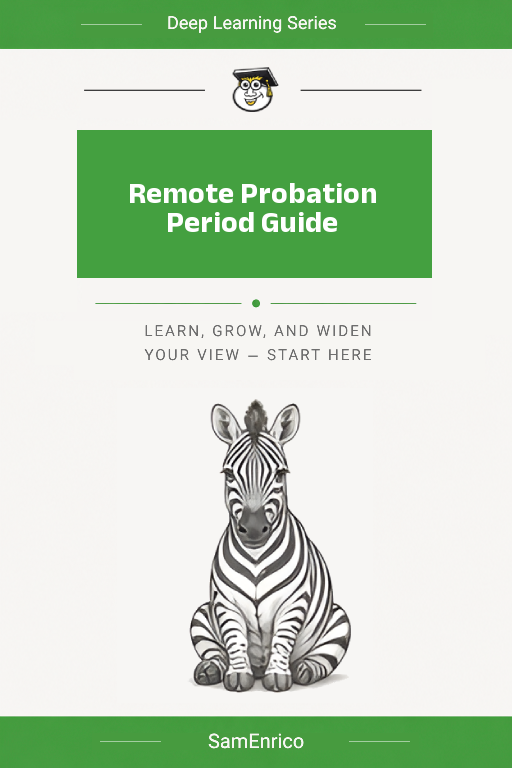
Non-FictionBusiness BriefPerformance Management
Remote Probation Period Guide Audiobook
Structure trial periods for Kenyan, Filipino, and
Structure trial periods for Kenyan, Filipino, and Polish remote workers with clear KPIs and legal protections.
Formats
Free sample
Chapter 1: The Six-Month Countdown--–- Maria Villanueva, founder of a fast-growing Saa S company in Austin, Texas, thought she had found the perfect senior developer. His name was Joshua, he lived in Manila, and his resume was immaculate. She extended an offer, he signed, and she told herself the hard part was over. Ninety days later, she received a summons from the National Labor Relations Commission of the Philippines. Joshua had been terminated on day 179 of his 180-day probation.
Maria’s mistake? She had not provided written performance standards on his first day. The NLRC ruled that Joshua was automatically regularized on day one because the standards were missing. Maria owed him back wages, 13th-month pay, separation pay, and legal fees totaling $34,000. Her only defense—that his work was unsatisfactory—meant nothing because she had never defined “satisfactory” in writing.This chapter is about why the Philippines has the most employer-friendly probation system in Southeast Asia on paper, and the most dangerous trap for the unwary remote employer in practice.
You will learn the absolute six-month rule, the automatic regularization trap, the Telecommuting Act’s equal benefits requirement, and the step-by-step process to structure a bulletproof probation period for Filipino remote workers. By the end of this chapter, you will never accidentally create a permanent employee again.The Absolute Six-Month Cap The Philippine Labor Code, specifically Article 296 (formerly Article 281), is ruthlessly clear: probationary employment shall not exceed six months from the date the employee started working. Not from the contract signing date. Not from the orientation date. From the first day the employee performed work.
That means if Joshua started on January 1, his probation expired on June 30. Not July 1. Not “approximately six months.” June 30 at 11:59 PM.This six-month cap is absolute for almost all roles. The only statutory exception is when the employee is engaged in learning a profession or trade that requires a longer period under industry practice, such as certain apprenticeships. For remote workers—developers, virtual assistants, marketers, customer support agents—there is no exception.
You have 180 days, no more.What makes the Philippine system unique is what happens at the end of those 180 days. In many countries, probation simply ends and the employee continues. In the Philippines, probation does not automatically end. Instead, the employer must take affirmative action to either regularize the employee or terminate them before the deadline. Silence is not an option.
If the 180th day arrives and you have done nothing—no written notice of regularization, no termination notice—the law treats the…
This is the end of the free sample. Get the Audiobook to keep going. Buy now
About this book
Details
- Author
- Ricketts Aliza
- Publisher
- SamEnrico
- Language
- English
- Genre
- Non-Fiction, Business Brief, Performance Management
- Released
- 2026-06-01
- Pages (approx.)
- 132
- Available as
- eBook, Audiobook

Listen in the VoxFlicks app
Audiobooks and audio dramas wherever you go. Sign in with your SamEnrico account and press play.
More by Ricketts Aliza
 Zumba Glute Activation GuideRicketts Aliza$11.99
 Anki For Fashion DesignRicketts Aliza$11.99
 The Financial Stress and UtilitiesRicketts Aliza$11.99
 Resistance TrainingRicketts Aliza$11.99
 The Sober Living GuideRicketts Aliza$11.99
 Idea Implementation for BusinessRicketts Aliza$11.99
 White Sands Desert CrossingRicketts Aliza$11.99
 Managing Distractions for PhotographersRicketts Aliza$11.99
 The Quantum Cosmos: Galileo’s Telescope and the Birth of Modern AstronomyRicketts Aliza$11.99
 Shadows of the Black Prince: The Phantom Brigade of 1396Ricketts Aliza$11.99
 Velvet Bent: Agrostis GrassRicketts Aliza$11.99
 The Essential Guide to KaraokeRicketts Aliza$11.99
You may also like
 Hong Kong Handover 1997Dunn Johnnie$11.99
 Zumba For Postnatal Recovery CourseNeal Christian$11.99
 Zumba for BeginnersLadner Nikia$11.99
 YouTube Comment Mining GuideHumes Pandora$12.99
 Worry Box MeditationCarlin Rudy$11.99
 Workplace Stress MeditationNguyen Lynn$11.99
 Workplace Stress and Sleep RepairHawley Ivory$11.99
 Workplace Perfectionism CureDelaney Jeffry$11.99
 Workplace Injustice Anger GuideWallen Isabelle$11.99
 Work Addiction and Burnout LinkGreenwood Ester$11.99
 Women in Yoga and WellnessBeattie Galina$11.99
 Women in Stand Up ComedyChun Evangeline$11.99