
Non-FictionSelf-HelpPublic Speaking
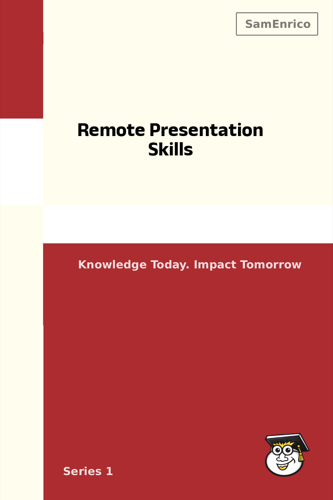
Remote Presentation Skills eBook
Deliver engaging virtual presentations that hold a
by Ahern Jimmie
Deliver engaging virtual presentations that hold audience attention.
Formats
Free sample
Chapter 1: The Screen Slump Epidemic--–- The first time I lost a promotion because of a screen, I didn't even know it was happening. I had delivered what I thought was a solid quarterly update—clean slides, accurate data, a few well-placed jokes. I logged off feeling good. Three days later, my boss called to say the VP had "concerns about my executive presence." When I asked for specifics, the feedback landed like a punch to the gut: "You seemed distracted. Low energy.
Hard to read." I had been sitting in my home office, fully focused, with a neutral expression that I thought made me look thoughtful. On their screens, I looked bored, checked out, and untrustworthy. No one had told me that virtual presenting is not easier than in-person—it is fundamentally harder. This book exists because that feedback changed my career, and I have spent the last five years learning, testing, and teaching exactly what separates an unignorable virtual presenter from someone who gets passed over.The Great Misconception When the world shifted to remote work in 2020, millions of professionals breathed a collective sigh of relief about one specific thing: no more standing in front of a room. No more sweaty palms before a stage.
No more worrying about where to put your hands. The assumption was that presenting from home, from behind a screen, would be easier. You could hide. You could keep notes on your second monitor. If you messed up, you could blame the Wi-Fi.
This assumption was wrong. Dangerously wrong.The reality is that virtual presenting requires more intentionality, more structure, and more energy than any in-person presentation you have ever given. When you stand in front of a live audience, you have the advantage of physical presence. Your body language fills the room. Your eye contact connects with real humans whose expressions you can read in real time.
The audience feels social pressure to stay engaged because they can see each other. The person checking their phone in the third row knows everyone else can see them. That social accountability keeps attention anchored.Now consider the virtual room. Your audience is alone, probably in their home, wearing comfortable clothes, with their phone sitting three inches from their keyboard. No one can see if they open a new tab and check email.
No one can see if they mute their microphone and take a work call on their cell phone. No one can see if they stand up and walk away to get coffee in the middle of your most important point. The social accountability that holds a physical room together evaporates entirely in the virtual space.This creates a paradox that most presenters never recognize: you have less control over the environment, but you need more control over the audience's attention. You cannot rely on the room to do any of the work for you. Every single ounce of engagement must be manufactured, designed, and delivered by you.
The presenter who succeeds in the virtual world is not the one with the most charisma. It is the one who understands that virtual presenting is a different medium entirely, requiring different rules, different preparation, and a completely different mindset.The Science of Zoom Fatigue You have felt it. After three back-to-back video calls, your brain feels like it has run a marathon. Your eyes ache. Your shoulders are tight.
You feel strangely exhausted even though you have not left your chair. This is not a personal weakness. This is Zoom Fatigue, and it has a name because scientists have studied it extensively.The primary driver of Zoom Fatigue is what researchers call "hyper gaze." In a physical room, eye contact is organic. You look at someone, they look away, you look at your notes, you scan the room. Your eyes and brain have natural rhythms of connection and disconnection.
On a video call, however, everyone on the screen appears to be staring directly at you at all times. Even when they are looking at their second monitor or checking their phone, the angle of their laptop camera makes it seem like they are maintaining intense, unbroken eye contact. Your brain interprets this as a constant state of social evaluation, which triggers a low-grade stress response that accumulates over time.The second driver is what researchers call "mirror anxiety." When you are on a video call, you can see yourself. Your own face sits there in the corner of the screen, reflecting back every micro-expression, every hair out of place, every tired blink. This constant self-monitoring is exhausting.
In physical life, you rarely stare at your own face for hours at a time. On video calls, you do exactly that. Your brain splits its attention between the content of the meeting and the question of whether you look okay. This split attention drains cognitive resources rapidly.The third driver is reduced mobility. In a physical meeting, you shift in your chair, lean back, lean forward, stand up, walk to a whiteboard, gesture broadly.
These small movements help regulate your attention and energy. On a video call, you are largely confined to a small frame. Your camera has a limited field of view. If you lean back too far, you disappear. If you gesture too wide, your hands vanish.
This physical constraint forces you into a posture of stillness that is unnatural and exhausting.Here is what this means for you as a presenter: when you begin your presentation, your audience is already somewhat fatigued. They have likely been on calls before yours. Their cognitive reserves are not full. They are starting from a deficit. If you deliver a presentation that requires high focus, complex information processing, or sustained attention without breaks, you are asking them to spend cognitive currency they do not have.
They will not rise to the challenge. They will check out. And then they will blame you, not their own fatigue, for the fact that they stopped paying attention.The Resting Business Face Problem Lorraine K. Lee, a virtual presentation expert who has trained thousands of professionals, identified one of the most subtle and damaging forces in remote communication: what she calls the Resting Business Face. You know Resting Business Face.
It is the expression you default to when you are concentrating. Your eyebrows are slightly lowered. Your mouth is neutral, perhaps even turned down slightly at the corners. Your jaw is set. You look serious, focused, and maybe a little bit annoyed.In a physical meeting, Resting Business Face is neutral.
It does not help you, but it does not hurt you. The people in the room can see your whole body. They can see that you are leaning forward, that you are taking notes, that you are nodding along. They have context to interpret your face correctly. They know you are concentrating, not disapproving.On a screen, all of that context vanishes.
The camera typically shows only your face and shoulders. Your hands are out of frame. Your body language is invisible. The only signal your audience has is your face. And if your face is neutral, they do not read it as concentration.
They read it as boredom, disinterest, or even hostility. I have watched recording after recording of perfectly competent presenters who…
This is the end of the free sample. Get the eBook to keep going. Buy now
About this book
Details
- Author
- Ahern Jimmie
- Publisher
- SamEnrico
- Language
- English
- Genre
- Non-Fiction, Self-Help, Public Speaking
- Released
- 2026-06-07
- Pages (approx.)
- 137
- Available as
- eBook, Audiobook

Read better in the ZLOADR app
Your eBooks on your phone or tablet. Sign in with your SamEnrico account and start reading.
More by Ahern Jimmie
 TM Complete Beginners GuideAhern Jimmie$11.99
 The Mayor's Secret DealAhern Jimmie$11.99
 Small Talk for Social MediaAhern Jimmie$11.99
 IBS Antibiotic Treatment GuideAhern Jimmie$11.99
 The Great Emoji Heist: How a Single Symbol Took Over the WorldAhern Jimmie$11.99
 Understanding Cleft Palate Stapes Fixation OligodontiaAhern Jimmie$17.99
 Supervision ManagerAhern Jimmie$11.99
 Sendy YC Application BlueprintAhern Jimmie$12.99
 Production Schedule RiskAhern Jimmie$12.99
 How to Start a Prepared Culture Media for Micro-organisms Business (Beginners Guide)Ahern Jimmie$11.99
You may also like
 Hong Kong Handover 1997Dunn Johnnie$11.99
 Zumba For Postnatal Recovery CourseNeal Christian$11.99
 Zumba for BeginnersLadner Nikia$11.99
 YouTube Comment Mining GuideHumes Pandora$12.99
 Worry Box MeditationCarlin Rudy$11.99
 Workplace Stress MeditationNguyen Lynn$11.99
 Workplace Stress and Sleep RepairHawley Ivory$11.99
 Workplace Perfectionism CureDelaney Jeffry$11.99
 Workplace Injustice Anger GuideWallen Isabelle$11.99
 Work Addiction and Burnout LinkGreenwood Ester$11.99
 Women in Yoga and WellnessBeattie Galina$11.99
 Women in Stand Up ComedyChun Evangeline$11.99