
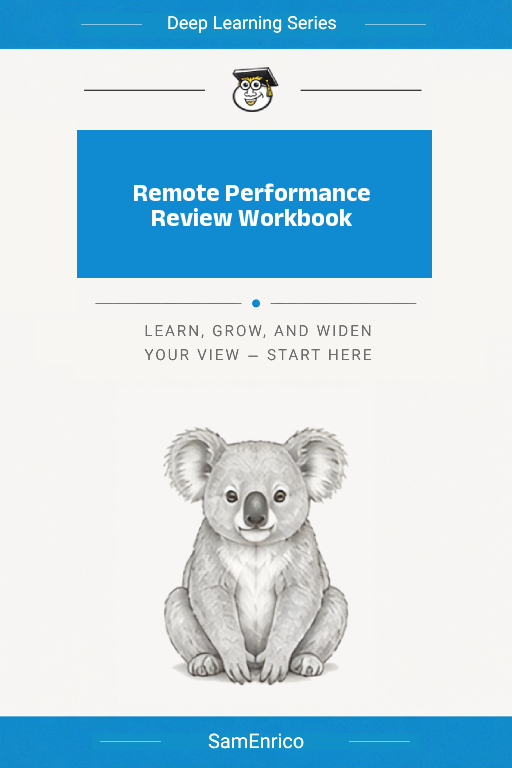
Non-FictionBusiness BriefPerformance Management
Remote Performance Review Workbook eBook
Design KPIs for Kenyan, Filipino, and Polish remot
Design KPIs for Kenyan, Filipino, and Polish remote employees. Use 360 feedback, OKRs, and quarterly reviews that respect cultural communication styles.
Formats
Free sample
Chapter 1: The Cultural Mirror--–- Every manager eventually faces the same quiet crisis. You are sitting in a remote video review, screen divided into four or six or nine faces from Nairobi, Manila, and Warsaw. The Polish employee has just delivered a critique of a process failure—direct, data-driven, and utterly without malice. The Filipino employee has gone silent, eyes down, nodding politely. The Kenyan employee has shifted the conversation to ask about your weekend.
And you, the manager, have no idea what just happened. You cannot tell who agrees, who disagrees, who is offended, and who is simply waiting for you to stop talking. Your performance review form, carefully designed with SMART goals and rating scales, sits uselessly in a shared drive. The data you are collecting will be wrong. Not slightly wrong.
Fundamentally, culturally wrong.This chapter exists because most performance management literature assumes a Western, low-context, individualistic, monochronic cultural baseline. That baseline does not exist in Kenya, the Philippines, or Poland. If you attempt to apply a standard Silicon Valley OKR system or a traditional 360 feedback survey to these teams, you will not get slightly inaccurate data. You will get actively misleading data. You will promote the wrong people.
You will fire the wrong people. You will spend thousands of hours in meetings that produce resentment instead of growth.Before you can design KPIs, write review scripts, or calibrate ratings, you need a cultural mirror. You need to see not what you assume about your employees, but what they actually see, hear, and feel when you speak. This chapter provides that mirror through the lens of Erin Meyer’s Culture Map, adapted specifically for Kenyan, Filipino, and Polish remote teams. By the end of this chapter, you will understand why a Polish “no” is not rude, why a Filipino “yes” is not agreement, and why a Kenyan missed deadline is not laziness.
You will never look at a performance review the same way again.Why Culture Is Not a Soft Skill Let us be precise about what culture is and is not. Culture is not a collection of holidays, food preferences, or charming quirks. That is the tourist version of culture. The operational version of culture is a set of unspoken rules about how to show respect, how to handle disagreement, how to relate to authority, and how to understand time. These rules are not preferences.
They are survival mechanisms. A Filipino employee who violates the rule of saving face does not simply feel awkward. They feel shame so acute that they may resign rather than return to a meeting where they were publicly corrected. A Polish employee who receives vague, indirect feedback does not feel mildly annoyed. They conclude that their manager is incompetent or dishonest.
A Kenyan employee who is held to a rigid deadline without acknowledgment of a community obligation does not feel inconvenienced. They feel that the company does not see them as fully human.This is the stakes. This is why cultural intelligence is not a “nice to have” for remote managers. It is the mechanism that determines whether your performance data is accurate or fictional.Most managers discover this the hard way. They implement a standard performance review system purchased from a Western software vendor.
They run a pilot. The data looks clean. Then they try to make a promotion decision, and everything falls apart. The Filipino employee who received “Excellent” ratings from their Filipino manager cannot explain why they are being passed over for a Polish employee with “Good” ratings. The Polish manager cannot understand why their direct, honest feedback caused a Kenyan employee to stop speaking in team meetings.
The Kenyan team, which consistently delivers under pressure, somehow receives lower individual scores than anyone else.The problem is not the people. The problem is the mirror. You have been looking at a reflection that was never designed for them.The Four Cultural Dimensions That Destroy Performance Reviews Erin Meyer’s Culture Map identifies eight dimensions along which cultures differ. For performance reviews in remote teams spanning Kenya, the Philippines, and Poland, four dimensions matter most: communication context, power distance, time orientation, and feedback style. Each dimension explains a specific type of failure in traditional reviews.Communication Context: High Versus Low Low-context cultures communicate meaning primarily through words.
If a Polish manager says “This report is insufficient,” they mean exactly that. There is no hidden social message. The report did not meet the standard. The manager expects the employee to respond to the factual claim, not to the emotional tone. High-context cultures communicate meaning primarily through relationship, silence, and nonverbal cues.
If a Filipino employee says “We will try,” they are not making a probabilistic statement about effort. They are saying “This request is impossible, but I cannot shame you by refusing directly.” The words are a container. The meaning is in the context.The collision happens when a Polish manager hears a Filipino “We will try” and interprets it as a 50 percent probability of success. The Polish manager schedules a follow-up. The Filipino employee, now trapped, either overcommits to an impossible task or loses face by admitting the truth later.
The Polish manager concludes that the Filipino employee is unreliable. The Filipino employee concludes that the Polish manager is cruel. Both are wrong. Both are acting rationally within their own cultural framework. Neither has the map to understand the other.This is why every performance review system fails before it starts if it does not account for communication context.
The same words produce opposite meanings. The same silence produces opposite interpretations.Power Distance: Respect Versus Equality Power distance measures how comfortable a culture is with hierarchy. Low power distance cultures (Poland) treat managers and employees as fundamentally equal. A Polish junior employee will openly disagree with a senior manager if the data supports it. They expect to be heard.
They expect their manager to respond to arguments, not to titles. High power distance cultures (Philippines, Kenya) treat hierarchy as natural and necessary. A Filipino junior employee will never openly disagree with a manager, regardless of the data. Disagreement is not a professional difference of opinion. It is an act of disrespect that damages the relationship permanently.The collision happens when a Polish manager asks for “honest feedback” in a 360 review.
The Polish junior employee provides it. The Filipino junior employee, sitting in the same meeting, is horrified. They cannot imagine a world where a subordinate critiques a superior. They will either refuse to participate or provide glowing, useless feedback that protects everyone’s face. The Polish manager concludes that the Filipino team is either hiding problems or lacks critical thinking.
The Filipino team concludes that the Polish manager is dangerous and cannot be trusted. Again, both are wrong. Again, neither has the map.Standard 360 feedback systems assume low power distance. They assume that anonymity is enough to protect junior employees. In high power distance cultures, anonymity does not work.
Employees recognize each other’s writing style. They know who said what. And they know that retribution, even if subtle, is possible. The only safe response is silence or praise.Time Orientation: Linear Versus Polychronic Linear time cultures (Poland) treat time as…
This is the end of the free sample. Get the eBook to keep going. Buy now
About this book
Details
- Author
- Caswell Olympia
- Publisher
- SamEnrico
- Language
- English
- Genre
- Non-Fiction, Business Brief, Performance Management
- Released
- 2026-06-01
- Pages (approx.)
- 142
- Available as
- eBook, Audiobook

Read better in the ZLOADR app
Your eBooks on your phone or tablet. Sign in with your SamEnrico account and start reading.
More by Caswell Olympia
 Grandparent Loss SupportCaswell Olympia$11.99
 Body Scan for Frequent FlyersCaswell Olympia$11.99
 Using Walker with DignityCaswell Olympia$11.99
 Tinder Swipe Compulsion HelpCaswell Olympia$11.99
 The Pyramid Scheme: Egypt's First Billion-Dollar FraudCaswell Olympia$11.99
 Rental AgentCaswell Olympia$11.99
 How to Produce Low-voc AdhesiveCaswell Olympia$11.99
 10 Ways to Use Grapefruit Juice (Recipe Book)Caswell Olympia$11.99
You may also like
 Hong Kong Handover 1997Dunn Johnnie$11.99
 Zumba For Postnatal Recovery CourseNeal Christian$11.99
 Zumba for BeginnersLadner Nikia$11.99
 YouTube Comment Mining GuideHumes Pandora$12.99
 Worry Box MeditationCarlin Rudy$11.99
 Workplace Stress MeditationNguyen Lynn$11.99
 Workplace Stress and Sleep RepairHawley Ivory$11.99
 Workplace Perfectionism CureDelaney Jeffry$11.99
 Workplace Injustice Anger GuideWallen Isabelle$11.99
 Work Addiction and Burnout LinkGreenwood Ester$11.99
 Women in Yoga and WellnessBeattie Galina$11.99
 Women in Stand Up ComedyChun Evangeline$11.99