
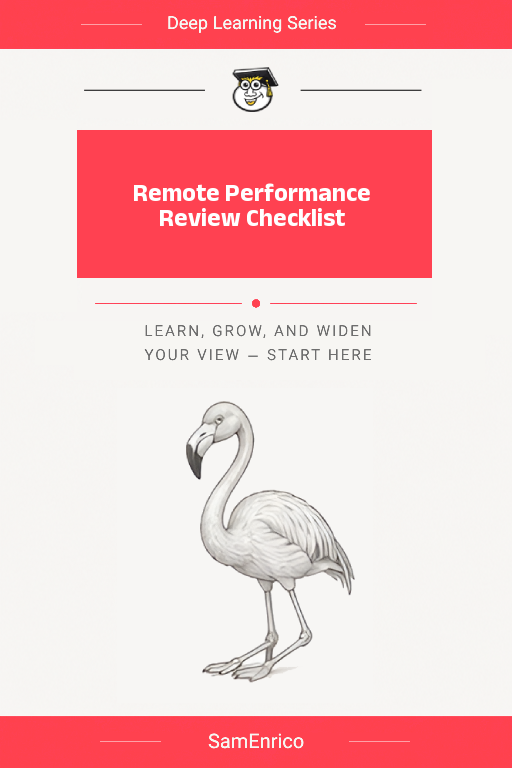
Remote Performance Review Checklist eBook
Complete checklist for remote performance reviews.
by Mccool Nelda
Complete checklist for remote performance reviews. Pre-work, meeting, documentation, and follow-up steps.
Formats
Free sample
Chapter 1: The Proximity Tax--–- In March of 2021, a mid-sized software company called Stride Analytics did something unusual. They pulled five years of performance review data and mapped it against employee seating charts from their pre-remote office. The results were quietly leaked to a management blogger, and within weeks, the numbers were being shared in Slack channels from Seattle to Singapore. Employees who had sat within fifty feet of their manager’s desk received “exceeds expectations” ratings forty-three percent more often than identical employees sitting just five hundred feet away. Same job titles.
Same deliverables. Same quarterly outcomes. But proximity had been rewarded as if it were productivity.The blog post that broke the story was titled “The Proximity Tax,” and it went viral for one simple reason: every remote worker who read it felt a chill of recognition. They had all been the person five hundred feet away. They had all watched the person at the next desk get the promotion, the bonus, the benefit of the doubt.
And now, working from home, they wondered if the tax had followed them onto Zoom.This book begins with that story not to shame managers—most of whom have no idea they are doing it—but to name the problem. Proximity bias is not malice. It is a cognitive shortcut, a feature of the human brain that evolved in a world where “close” meant “safe” and “far” meant “dangerous.” Your brain is not trying to be unfair. It is trying to be efficient. But efficiency, in the context of performance evaluation, is a liar.The annual performance review was already broken before remote work.
Studies from Gallup, Mc Kinsey, and Harvard Business Review have piled up for decades, each one reaching the same conclusion: traditional reviews do not improve performance, they do not accurately measure contribution, and employees hate them. In 2019, the Society for Human Resource Management found that only fourteen percent of organizations felt their review process was worth the time it took. Eighty-six percent were essentially performing a ritual they knew was pointless.Then the pandemic came. Offices emptied. Hallway conversations became Slack messages.
The visual cues that managers had unconsciously relied upon—a person at their desk, a nod in a meeting, a late-night email timestamp—evaporated overnight. And suddenly, the flimsiness of memory-based evaluation was exposed for everyone to see.This chapter is about why the old way fails, why remote work makes it worse, and why that catastrophic failure is actually the best thing that could have happened to performance management. Because when you cannot see someone working, you are finally forced to look at what they actually produce. Remote work does not destroy fair reviews. It demands them.The Anatomy of a Broken System Let us start with a simple question: What is the purpose of a performance review?
Most managers will say something like “to give feedback” or “to help employees grow” or “to align on goals.” Those are noble intentions. But in practice, the annual review serves three very different functions, and they are often in direct conflict with one another.First, the review is an evaluation. It judges past performance and assigns a rating that affects compensation, promotion, and sometimes continued employment. Second, the review is a development conversation. It is supposed to help the employee improve.
Third, the review is a documentation tool. It creates a legal and HR record that protects the company in case of disputes.These three functions pull in opposite directions. An employee will not be open about their weaknesses if those weaknesses will be used to deny them a raise. A manager will not give honest critical feedback if they know it will be read by an HR lawyer six months later in a termination hearing. The result is a document that tries to do everything and accomplishes nothing.But even if you could magically separate these functions, the annual review would still fail because of how human memory works.
Cognitive psychologists have known for decades that memory is not a recording device. It is a reconstruction. Every time you recall an event, you are not playing back a video. You are rebuilding the scene from fragments, and in that rebuilding, you introduce errors. This is called reconstructive memory, and it is the enemy of fair evaluation.Consider what happens when a manager sits down in December to write an annual review for an employee they have managed for eleven months.
They are not remembering the employee’s work from January. They are remembering the highlights—the big win in March, the missed deadline in October, the moment of frustration in November. Psychologists call this the peak-end rule: people judge an experience based on its most intense moment and its most recent moment, not its average.A study published in the Journal of Applied Psychology found that managers who conducted annual reviews recalled only fifteen percent of the specific behaviors they had observed throughout the year. They filled in the other eighty-five percent with general impressions, assumptions, and—most damagingly—the events of the last thirty days. An employee who had a terrible first quarter but a brilliant final month would be rated higher than an employee who was consistently good all year.
Recency error is not a bug. It is a feature of the human brain. And it makes annual reviews fundamentally unfair.Proximity Bias: The Invisible Tax Recency error is bad enough. But proximity bias is worse because it is invisible to the person committing it. You do not know you are doing it.
No manager wakes up and says, “Today I will reward the people I see and punish the people I don’t.” But that is exactly what happens.The term “proximity bias” emerged from research on open-plan offices, but its roots go much deeper. In evolutionary psychology, proximity signaled safety and belonging. The people closest to you were your tribe. The people farther away were outsiders. Your brain learned to favor the near over the far because, for most of human history, that was a survival advantage.In a modern office, this evolutionary hangover manifests in dozens of small ways.
The manager stops by the desk of the person nearest to them for a “quick question.” That quick question turns into a conversation. That conversation creates rapport. That rapport makes the manager more likely to think of that employee when a interesting project comes up. That interesting project leads to visibility. Visibility leads to a good review.
None of this is conscious. None of it is malicious. But the cumulative effect is devastating for the person whose desk is five hundred feet away.Now translate this to remote work. The physical desk is gone, but the cognitive bias remains. The manager now spends more time in video calls with the employees who happen to share their time zone.
They respond faster to Slack messages from the people they worked with in the old office. They give the benefit of the doubt to the person who speaks up in meetings, not realizing that the person who stays silent might be in a noisy apartment or caring for a child just off-camera.A 2022…
This is the end of the free sample. Get the eBook to keep going. Buy now
About this book
Details
- Author
- Mccool Nelda
- Publisher
- SamEnrico
- Language
- English
- Genre
- Non-Fiction, Professional's Cheat Sheet, HR Playbook
- Released
- 2026-06-01
- Pages (approx.)
- 146
- Available as
- eBook, Audiobook

Read better in the ZLOADR app
Your eBooks on your phone or tablet. Sign in with your SamEnrico account and start reading.
More by Mccool Nelda
 The Beginner Stretching RoutineMccool Nelda$11.99
 Mentor Next Generation ImmigrantsMccool Nelda$11.99
 Stress Menopause Symptom GuideMccool Nelda$11.99
 Ragnarok and the Fox’s Last LaughMccool Nelda$11.99
 Learn to Play the GehuMccool Nelda$11.99
 How to Become a Lithographed-plate InspectorMccool Nelda$11.99
 IT Solution ArchitectMccool Nelda$11.99
You may also like
 Remote Performance Review ToolsGainey Annelle$12.99
 Remote Performance Review ScriptsWeeks Tona$12.99
 Asynchronous Performance Review TemplateCard Milan$12.99
 Time Zone Performance Review SchedulingGuyton Reyna$12.99
 Remote Performance Review Best PracticesWilks Cecile$12.99
 Remote Performance Reviews GuideBaumann Andera$12.99
 Remote Performance Review Bias GuideKirk Cordelia$12.99
 Remote Performance Review Follow UpMorrissey Concetta$12.99
 Remote Performance Review CalibrationBatten Alexandria$12.99