
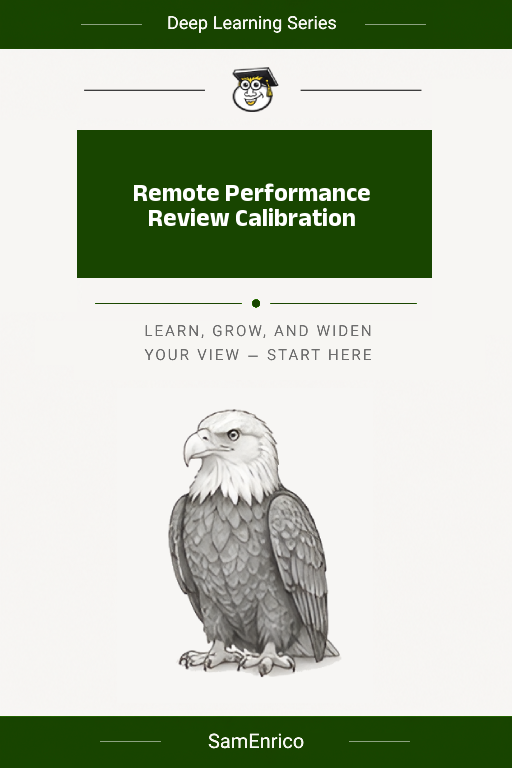
Non-FictionProfessional's Cheat SheetHR Playbook
Remote Performance Review Calibration eBook
Calibrate performance ratings across distributed t
Calibrate performance ratings across distributed teams. Manager alignment sessions and norming techniques.
Formats
Free sample
Chapter 1: The Fairness Fracture...--–- The Slack message appeared at 11:47 PM on a Tuesday. “Hey, quick question—did your team get rated yet?” It was from Priya, a senior product manager in Bangalore, to her former colleague David in Austin. Both had joined the same remote-first startup six months earlier. Both had received identical offers. Both had worked through weekends, led critical projects, and absorbed the invisible labor of a distributed team finding its footing.
But when performance reviews came out, Priya received “Meets Expectations” while David received “Exceeds Expectations.” Same role. Same level. Same company. Different managers. Different ratings.
Priya’s manager, based in London, had seen her once on video—after midnight her time—for a tense thirty-minute check-in. David’s manager, in the same building as him before the company went remote, had known him for two years. The fairness fracture had opened, and no one in leadership seemed to notice. This book exists because that fracture runs through nearly every distributed organization today.Performance calibration is the process where managers and leaders come together to review and align performance ratings across teams. The goal is simple: ensure that two employees doing comparable work receive comparable ratings, even if they report to different managers in different locations.
Without calibration, a manager’s subjective interpretation dominates. One leader’s “solid performer” becomes another’s “needs improvement.” When those inconsistent ratings feed into compensation decisions, promotion pipelines, and talent reviews, inequity becomes systemic. And when that inequity happens across time zones and video calls, the fracture becomes a canyon.This chapter establishes the foundation for everything that follows. You will learn what performance calibration actually is, why remote work changes every assumption you had about evaluating people, and the seven signs that your organization needs a dedicated remote calibration process. You will also learn the two distinct phases of calibration—norming and rating—and why remote organizations must norm extensively before they ever assign a number.
By the end of this chapter, you will understand why the fairness fracture exists and what it will cost you if you ignore it.What Performance Calibration Actually Is Let us start with a definition. Performance calibration is a structured process where managers and HR leaders review employee performance ratings together to ensure consistency across teams. It is not about changing individual manager’s opinions. It is about aligning them to a shared standard.Here is how it works in practice. Managers assign preliminary ratings to their direct reports using a common rubric.
Then those managers meet—ideally in groups of three to five—to review those ratings. For each employee, the manager explains their rationale and presents evidence. Other managers ask questions, challenge assumptions, and share their own perspectives based on their experience with similar roles. After discussion, managers may adjust their ratings up or down. The final ratings are then locked, calibrated against the organization’s standards, not just one manager’s judgment.Without calibration, consider what happens.
A sales director in Boston might rate top performers at 4 out of 5, reserving 5 for truly exceptional, once-in-a-career achievement. A sales director in Dublin, trained in a different corporate culture, might give 4 to solid performers and reserve 5 for anyone who exceeds quota. When those ratings feed into a company-wide compensation review, the Boston team appears to underperform relative to Dublin—not because they actually do, but because their manager calibrates differently. The Dublin team gets more raises. The Boston team loses talent.
The fracture spreads.Calibration solves this by forcing managers to defend their ratings against a shared standard. It exposes leniency, severity, and central tendency. It surfaces unconscious bias. It creates a conversation where “I feel like they’re doing well” is replaced by “Here are the three specific deliverables they completed ahead of schedule, and here is the customer feedback praising their responsiveness.”Why Remote Changes Everything Traditional calibration assumes managers can observe their teams. They see who arrives early, who stays late, who collaborates effectively in the break room, who handles pressure during a client visit.
Those observations are imperfect and biased, but they at least provide data. Remote calibration has no such luxury, and the challenges compound in four critical ways.First, proximity bias reverses. In an office, proximity bias favors employees physically near the manager—the ones who share a floor, a hallway, a coffee station. In remote settings, proximity bias shifts to digital proximity. The employee who posts frequently in Slack, speaks in every Zoom meeting, messages their manager at all hours of the night—they appear more productive, more engaged, more valuable.
The employee who quietly ships excellent work, meets every deadline, but never chimes in on a company-wide channel appears less productive. Neither form of visibility reliably correlates with actual performance. But both shape ratings.Second, time zones create asynchronous information asymmetry. A manager in San Francisco cannot observe a direct report in London working at 2 PM GMT. They see completed work—the pull request, the finished deck, the closed ticket—not the process of completing it.
They do not see the late nights, the collaboration with peers, the problem-solving under pressure. They only see outcomes. Outcomes matter, but they are not the whole story. Without observation, managers lean on whatever data they have, which is often incomplete.Third, cultural norms around self-promotion vary dramatically. In some cultures, employees are taught to highlight their achievements, to advocate for themselves, to ensure their work is visible.
In other cultures, modesty is valued. Employees are taught that their work will speak for itself. In remote settings, where managers cannot observe work directly, the self-promoter gains an enormous advantage. They are remembered. They are rated higher.
The modest employee, equally productive, is forgotten. The fracture here is not just about fairness—it is about systematically undervaluing entire cultural approaches to work.Fourth, the cost of inconsistency multiplies. When one team rates leniently and another rates strictly, remote employees notice. They talk in Slack channels. They compare notes in private groups.
They see their colleagues receiving higher ratings for what looks like similar work. If perceived inequity drives attrition, losing a high-performing remote employee costs far more than losing someone down the hall. Recruitment, onboarding, lost productivity, team morale—the ripple effects are enormous. And the employee who leaves will tell others why. The fracture becomes a reputation.These four challenges are not minor adjustments to an existing process.
They are fundamental shifts that require a complete rethinking of how performance is evaluated, discussed, and aligned.Seven Signs You Need Better Remote Calibration Your organization might already need a dedicated remote calibration process. Here are seven diagnostic signs.Sign One: Rating inflation varies by location. Employees in your headquarters city consistently receive higher ratings than remote employees doing comparable work. Or employees in certain remote locations consistently rate higher or lower than others. When you run a report of average ratings by city, the disparities jump off the page.Sign Two: Managers express uncertainty in calibration meetings.
They say things like “I think they are doing well, but it is hard to tell remotely” or “I do not have as much visibility as I would like.” Uncertainty is not…
This is the end of the free sample. Get the eBook to keep going. Buy now
About this book
Details
- Author
- Batten Alexandria
- Publisher
- SamEnrico
- Language
- English
- Genre
- Non-Fiction, Professional's Cheat Sheet, HR Playbook
- Released
- 2026-05-29
- Pages (approx.)
- 137
- Available as
- eBook, Audiobook

Read better in the ZLOADR app
Your eBooks on your phone or tablet. Sign in with your SamEnrico account and start reading.
More by Batten Alexandria
 Chinese Immigrant Garment EmpireBatten Alexandria$11.99
 Reentry EQ SkillsBatten Alexandria$11.99
 Infidelity Self Blame GuideBatten Alexandria$11.99
 The Beginner Cardio GuideBatten Alexandria$11.99
 The Silk Road of the North: How the Vikings Built a Trade EmpireBatten Alexandria$11.99
 Keep Case Key ManagementBatten Alexandria$11.99
 10 Ways to Use Egg Substitutes (Recipe Book)Batten Alexandria$11.99
 Learn to Play the GottuvadhyamBatten Alexandria$11.99
You may also like
 Hong Kong Handover 1997Dunn Johnnie$11.99
 Zumba For Postnatal Recovery CourseNeal Christian$11.99
 Zumba for BeginnersLadner Nikia$11.99
 YouTube Comment Mining GuideHumes Pandora$12.99
 Worry Box MeditationCarlin Rudy$11.99
 Workplace Stress MeditationNguyen Lynn$11.99
 Workplace Stress and Sleep RepairHawley Ivory$11.99
 Workplace Perfectionism CureDelaney Jeffry$11.99
 Workplace Injustice Anger GuideWallen Isabelle$11.99
 Work Addiction and Burnout LinkGreenwood Ester$11.99
 Women in Yoga and WellnessBeattie Galina$11.99
 Women in Stand Up ComedyChun Evangeline$11.99