
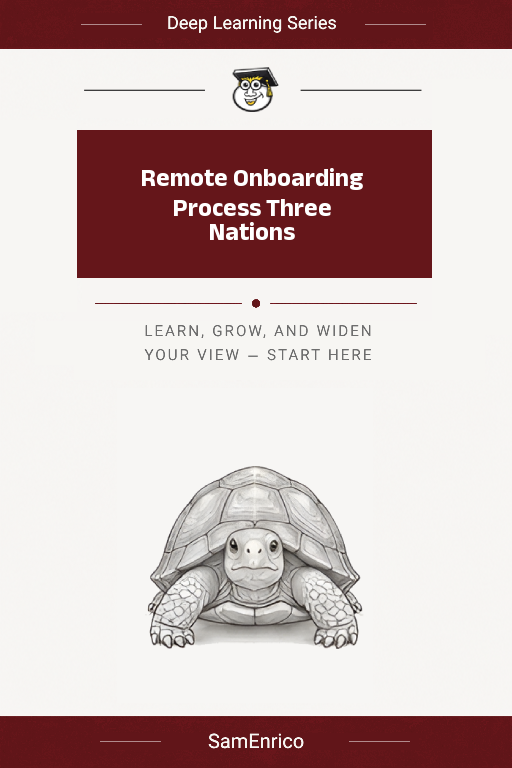
Non-FictionBusiness BriefOnboarding
Remote Onboarding Process Three Nations eBook
Design day one to week four onboarding that works
Design day one to week four onboarding that works across time zones and cultural expectations.
Formats
Free sample
Chapter 1: The Zero-Passive Reality--–- In the spring of 2021, a fintech company headquartered in Berlin did something that seemed reasonable at the time. They hired a brilliant backend engineer named Priya, based in Bangalore, to join a team that was otherwise split between Berlin and London. Priya had ten years of experience, perfect references, and a reputation for solving problems that others called unsolvable.Her onboarding plan was the same one the company had used successfully for years with local hires. On day one, she would join a welcome call at 10:00 AM Berlin time. She would be introduced to the team.
She would be given access to the company wiki. She would shadow a few sprint planning meetings. She would ask questions as they came up. She would ramp up gradually over ninety days.There was only one problem. Ten AM Berlin time is 1:30 PM in Bangalore.
That was fine. The welcome call was recorded. Priya watched it that evening. The sprint planning meetings, however, happened at 3:00 PM Berlin time, which is 6:30 PM in Bangalore. She joined those live, staying an extra two hours each day to participate.
The "ask questions as they came up" part proved more difficult. Her colleagues in Berlin were offline by the time she started her deep work block at 8:00 PM Bangalore time. Her questions sat in Slack overnight. By the time answers arrived the next morning Berlin time, Priya had either solved the problem herself—often incorrectly—or lost momentum entirely.She lasted seventy-eight days. In her exit interview, she told HR that the company was "wonderful" but that she had received an offer she "could not refuse." The truth, which she shared with a former colleague six months later, was simpler: she never felt like she was part of the team.
She was always catching up, always waiting, always alone.Priya did not fail. The company's onboarding process failed her. And it failed her for one reason: it was designed for a world that no longer exists.The Watercooler Illusion For most of modern corporate history, onboarding was a proximity-powered process. New employees sat in offices, cubicles, or open floor plans where they could see and hear the people they needed to learn from. They absorbed culture through osmosis.
They picked up norms by accident. They built relationships through incidental contact—the shared elevator, the coffee machine queue, the five-minute walk to a meeting room.This ambient learning environment was so pervasive, so invisible, that most organizations never acknowledged it existed. They built onboarding plans around the explicit stuff—the HR paperwork, the IT setup, the training videos—and assumed that the implicit stuff would take care of itself. And for a long time, it did. The implicit stuff was in the air, and new hires breathed it in without thinking.Then the air changed.When teams went remote, the implicit stuff did not follow.
The watercooler did not move to Zoom. The hallway conversations did not migrate to Slack. The ambient learning environment evaporated overnight. And most companies, in their rush to ship laptops and set up VPNs, never stopped to ask what had been lost.This is what I call the watercooler illusion: the mistaken belief that organizational culture, norms, and tacit knowledge can be transmitted remotely through the same mechanisms that worked in person. They cannot.
In-person transmission relies on passive absorption. Remote transmission requires active construction. If you do not build it, it does not exist.Passive Learning Versus Active Construction Let me define two terms that will appear throughout this book.Passive learning is knowledge acquisition that happens without deliberate effort from the learner. You overhear a conversation and learn something. You watch a colleague handle a difficult client and absorb their technique.
You notice which Slack channels your manager pays attention to and adjust your behavior accordingly. Passive learning is efficient, invisible, and entirely dependent on proximity.Active construction is knowledge acquisition that requires deliberate effort from both the teacher and the learner. Someone writes a document, and you read it. Someone records a video, and you watch it. Someone answers a question in a structured forum, and you search for it.
Active construction is slower, more expensive, and the only method that works in distributed environments.Here is the uncomfortable truth that most leaders do not want to hear: in a distributed team, passive learning drops to zero. Not close to zero. Exactly zero. There is no ambient knowledge floating in the digital air. There is no osmosis.
There is no "you will pick it up as you go."Every single piece of knowledge that a new hire needs must be deliberately captured, organized, and made accessible. Every norm must be explicitly stated. Every process must be documented. Every expectation must be written down.This sounds exhausting. And it is—at first.
But what most organizations fail to realize is that the work of active construction replaces the hidden work of passive learning. In an office, the organization paid for the learning environment through rent, utilities, and the opportunity cost of interrupted work. In a distributed world, the organization must pay for the learning environment through documentation, asynchronous communication, and intentional design.The total cost is not higher. It is just visible for the first time.Why Your Current Onboarding Is Probably Broken If you are reading this book, there is a high probability that your organization's onboarding process is built on assumptions that no longer hold. Let me help you diagnose the problem.Take out your current onboarding plan—the document, the checklist, the sequence of tasks that a new hire follows in their first thirty to ninety days.
Go through it line by line and look for the following phrases:"Ask a teammate for help with...""Shadow a meeting to learn how we...""You will pick up the norms as you go...""Reach out to someone on the team if you get stuck...""Observe how others handle..."Each of these phrases is a red flag. Each one represents a piece of passive learning that you have outsourced to chance. In a co-located environment, these instructions were reasonable because the conditions for passive learning existed. In a distributed environment, they are abdications.Let me be specific about what breaks when you rely on these phrases remotely.The Question Asker's Dilemma When you tell a new hire to "ask a teammate if you get stuck," you are assuming that asking is easy. It is not.
In a distributed environment, asking a question requires the new hire to make several calculations in real time:Which channel should I use? (Public or private? Team-specific or general?)Who is the right person to ask? (How do I know what they know?)When should I expect an answer? (Are they online?
In a different time zone?)Am I bothering them? (Is this question too obvious? Have I tried hard enough to solve it myself?)These calculations are stressful. They create friction. And friction discourages questions.
Many new hires, particularly those from cultures where interrupting a colleague is seen as disrespectful, will simply not ask. They will struggle in silence, waste hours on avoidable confusion, and gradually conclude that they are…
This is the end of the free sample. Get the eBook to keep going. Buy now
About this book
Details
- Author
- Irizarry Helene
- Publisher
- SamEnrico
- Language
- English
- Genre
- Non-Fiction, Business Brief, Onboarding
- Released
- 2026-05-29
- Pages (approx.)
- 154
- Available as
- eBook, Audiobook

Read better in the ZLOADR app
Your eBooks on your phone or tablet. Sign in with your SamEnrico account and start reading.
More by Irizarry Helene
 Citation Rules Audio Digest CourseIrizarry Helene$11.99
 Returning to School After Job LossIrizarry Helene$11.99
 Uber Vehicle Selection HandbookIrizarry Helene$11.99
 Spaced Repetition Memory SystemIrizarry Helene$11.99
 Scott Peterson Diary EntriesIrizarry Helene$11.99
 Assertiveness With Ex PartnersIrizarry Helene$11.99
 Presuppositions in ScriptsIrizarry Helene$11.99
 UK VAT Records Keeping Requirements WorkbookIrizarry Helene$11.99
 Andrew Carnegie SteelIrizarry Helene$11.99
 The Iron Fleet: How One Man Built a Global Shipping Empire from ScratchIrizarry Helene$11.99
 The Day the Internet Broke: How a Single Bug Almost Erased the WebIrizarry Helene$11.99
 The Ballad of the Red Queen’s GambitIrizarry Helene$11.99
You may also like
 Hong Kong Handover 1997Dunn Johnnie$11.99
 Zumba For Postnatal Recovery CourseNeal Christian$11.99
 Zumba for BeginnersLadner Nikia$11.99
 YouTube Comment Mining GuideHumes Pandora$12.99
 Worry Box MeditationCarlin Rudy$11.99
 Workplace Stress MeditationNguyen Lynn$11.99
 Workplace Stress and Sleep RepairHawley Ivory$11.99
 Workplace Perfectionism CureDelaney Jeffry$11.99
 Workplace Injustice Anger GuideWallen Isabelle$11.99
 Work Addiction and Burnout LinkGreenwood Ester$11.99
 Women in Yoga and WellnessBeattie Galina$11.99
 Women in Stand Up ComedyChun Evangeline$11.99