
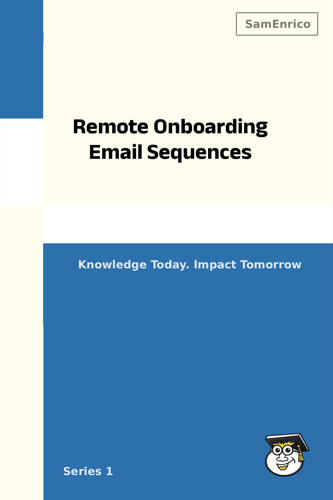
Non-FictionSelf-HelpOnboarding
Remote Onboarding Email Sequences eBook
Welcomes new hires with automated digital touchpoi
Welcomes new hires with automated digital touchpoints.
Formats
Free sample
Chapter 1: The Virtual Handshake--–- On a Tuesday morning in March, a talented software engineer named Sarah accepted a remote job offer from a fast-growing tech company. She spent the next hour texting her partner, updating her Linked In profile, and imagining her first day. Then, silence. For eleven days, she received exactly two emails: one confirming her start date and another asking her to fill out a W-4 form. No welcome.
No "here's what to expect." No human voice. By the night before her first day, Sarah had convinced herself she had made a terrible mistake. She almost didn't log in the next morning.Sarah's story is not an outlier. It is the norm.This is the book that fixes that.The $20,000 Silence Let us begin with a simple question: What is the cost of doing nothing?When a new hire signs an offer letter, they are making a significant life decision. They have likely turned down other opportunities, informed their current employer of their departure, and begun rearranging their personal life to accommodate a new role.
In return, most companies offer a static PDF handbook, a single "Welcome to the team" email, and radio silence until Day 1.This silence has a name in behavioral psychology: post-decision dissonance.First identified by social psychologist Leon Festinger in 1957, cognitive dissonance theory suggests that after making a difficult decision, individuals experience psychological discomfort and actively seek reassurance that they chose correctly. In the context of hiring, this means that within 48 hours of accepting an offer, a candidate begins doubting their choice. They wonder if they could have negotiated a better salary. They worry about the company culture. They question whether they will fit in with their new team.The antidote to post-decision dissonance is predictable, consistent, and personal communication.
In the physical office era, this happened organically. A manager might stop by the new hire's desk. A peer might invite them to lunch. The water cooler provided spontaneous touchpoints that, however imperfect, signaled belonging.Remote work has eliminated those organic moments.What remains is the inbox.The 40% Acceleration Here is the central claim of this book, supported by data from organizations that have implemented structured remote onboarding email sequences: A well-designed automated email sequence reduces Time-to-First-Value (TTFV) by approximately 40% while simultaneously lowering new hire anxiety by a statistically significant margin.Let me define TTFV precisely, because this metric will appear throughout the book.Time-to-First-Value is the duration between a new hire's start date and their first meaningful contribution to the organization. For a salesperson, this might be their first qualified meeting or closed deal.
For an engineer, their first merged pull request. For a customer success manager, their first resolved ticket. For a marketing manager, their first campaign launched.TTFV matters because it is the strongest predictor of first-year retention that does not require waiting for the employee to leave. Research consistently shows that new hires who achieve an early win are significantly more likely to remain past their first anniversary. The psychological mechanism is straightforward: competence creates confidence, and confidence creates commitment.Yet most companies treat TTFV as an accident rather than an outcome.
They hire talented people, point them toward a knowledge base, and hope for the best. This is the equivalent of throwing a passenger the keys to an airplane and wishing them luck.Automated email sequences change this by systematically guiding new hires through the three phases of onboarding: Pre-boarding (Day -14 to Day 0), Orientation (Day 1), and Ramp-up (Day 2 to Day 90). Each email in the sequence serves a specific psychological function: reducing anxiety, building confidence, signaling competence, or fostering belonging.Why This Book Exists Before we go further, let me address a question that may be forming in your mind: "Is this just another book about email marketing applied to HR?"No. This is a book about behavioral change through digital touchpoints.The difference is critical. Email marketing is concerned with opens, clicks, and conversions.
This book is concerned with psychological safety, cognitive load, and the construction of belonging in a distributed environment. The email is merely the vehicle; the destination is a new hire who feels seen, supported, and capable.I have spent the past several years analyzing onboarding sequences from over fifty organizations, ranging from five-person startups to Fortune 500 enterprises. I have interviewed new hires who wept with relief when a well-timed email arrived, and I have interviewed new hires who quietly began job searching again because their employer could not be bothered to send a simple "We are glad you are here."This book synthesizes what works, what fails, and why.The Anatomy of Remote Anxiety To understand why automated email sequences are so effective, we must first understand the specific anxieties that remote new hires experience. These are not abstract fears; they are predictable, patterned, and solvable.Anxiety 1: The Abandonment Fear Every remote new hire wonders, at some point in their first two weeks, whether anyone knows they exist. This is not paranoia; it is a reasonable response to an environment where there is no physical desk, no office badge, no shared kitchen.
In a remote setting, presence is not visible. A new hire could theoretically go an entire day without speaking to another human being.The abandonment fear peaks between Day -7 and Day 0. The offer has been signed, but the start date has not arrived. The new hire has likely given notice at their previous job. They are financially and emotionally committed.
And then... nothing.Automated email sequences directly counter the abandonment fear by providing predictable, consistent touchpoints before Day 1 ever arrives. A welcome email sent within one hour of the e-signature signals organizational competence. A shipping notification for hardware proves that action is being taken behind the scenes. A preview of Week 1 objectives reduces uncertainty.Anxiety 2: The Imposter Overwhelm By Day 2 of a remote onboarding, the new hire has typically received between 47 and 93 separate pieces of information: passwords, links, document links, meeting invitations, Slack channels, acronyms, organizational charts, project management tools, and the ever-present "Welcome to the team" thread that generates 38 replies.Cognitive load theory tells us that human working memory is severely limited.
When presented with too much information too quickly, individuals experience overwhelm, leading to reduced comprehension, retention, and confidence. This is the imposter syndrome accelerator: the new hire concludes, "Everyone else seems to understand this except me."Automated email sequences combat overwhelm through timed release of information. Instead of a single "Welcome" email with twenty-seven links, the sequence delivers information in small, manageable chunks at predictable intervals. The Day 1 morning email contains credentials and exactly one goal. The Day 1 mid-morning email contains the IT checklist.
The Day 1 lunch email contains a Door Dash code and permission to log off.This is not about withholding information. It is about scaffolding —providing the right information at the right time so that each piece of knowledge builds on the previous one.Anxiety 3: The Cultural Blindness Remote new hires cannot observe culture by osmosis. They cannot watch how people dress, listen to how meetings are conducted, or notice which founder's photo hangs in the hallway. Every cultural norm must be explicitly taught or accidentally discovered.The problem with accidental discovery is that it…
This is the end of the free sample. Get the eBook to keep going. Buy now
About this book
Details
- Author
- Armstead Glinda
- Publisher
- SamEnrico
- Language
- English
- Genre
- Non-Fiction, Self-Help, Onboarding
- Released
- 2026-06-08
- Pages (approx.)
- 145
- Available as
- eBook, Audiobook

Read better in the ZLOADR app
Your eBooks on your phone or tablet. Sign in with your SamEnrico account and start reading.
More by Armstead Glinda
 Volleyball Hypnosis GuideArmstead Glinda$11.99
 Acupuncture for Postnatal DepressionArmstead Glinda$11.99
 Rainforest Calming ImageryArmstead Glinda$11.99
 Poster Design CanvaArmstead Glinda$11.99
 Nap for Extended Work HoursArmstead Glinda$11.99
 Self Hypnosis for Diverticulitis PainArmstead Glinda$11.99
 Astraphobia Storm FearArmstead Glinda$11.99
 Whispers of the Renaissance: The Alchemy of GeniusArmstead Glinda$11.99
 The Viking Navigators: Secrets of the Northern SeasArmstead Glinda$11.99
 How to Produce Desktop WallpaperArmstead Glinda$11.99
 A Collector's Handbook to the Wolseley 40Armstead Glinda$11.99
 Ecommerce Upsell StrategyArmstead Glinda$12.99
You may also like
 Hong Kong Handover 1997Dunn Johnnie$11.99
 Zumba For Postnatal Recovery CourseNeal Christian$11.99
 Zumba for BeginnersLadner Nikia$11.99
 YouTube Comment Mining GuideHumes Pandora$12.99
 Worry Box MeditationCarlin Rudy$11.99
 Workplace Stress MeditationNguyen Lynn$11.99
 Workplace Stress and Sleep RepairHawley Ivory$11.99
 Workplace Perfectionism CureDelaney Jeffry$11.99
 Workplace Injustice Anger GuideWallen Isabelle$11.99
 Work Addiction and Burnout LinkGreenwood Ester$11.99
 Women in Yoga and WellnessBeattie Galina$11.99
 Women in Stand Up ComedyChun Evangeline$11.99