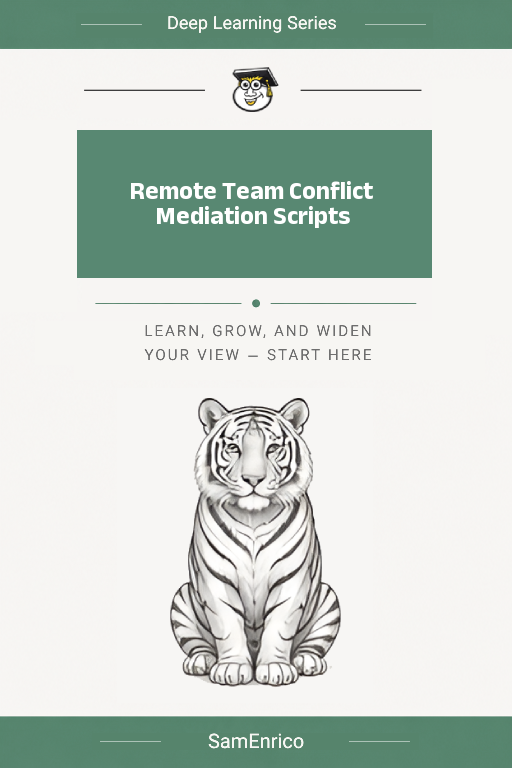
Remote Mediation Scripts eBook
Word-for-word scripts for mediating remote team co
Word-for-word scripts for mediating remote team conflicts via video or phone.
Formats
Free sample
Chapter 1: The Tech Contract--–- The video freezes mid-sentence. You are saying something important—something about accountability, about shared goals, about the way forward. And then you are a statue. Your mouth hangs open. Your eyes are fixed on a point that no longer exists.
On the other side of the screen, two people who were already angry with each other now have a new target: you.By the time your connection returns, the damage is done. One participant has muted and is now typing furiously in a private Slack channel. The other has turned off their camera and is staring at their own reflection, wondering why they agreed to this meeting at all. Neither heard what you said. Both have drawn the same conclusion: the mediator doesn't care enough to get their technology to work.This is not an exaggeration.
This is the first five minutes of thousands of remote mediations every single day.Here is what the research on virtual conflict resolution has established beyond any reasonable doubt: technical glitches are not neutral. When a participant freezes, drops audio, or lags, the other party almost never thinks, "Ah, what an unfortunate but predictable consequence of distributed communication infrastructure." They think, "They don't care about this conversation." They think, "They are checking email." They think, "They are doing this on purpose."The technical failure is real. But the damage is psychological. And the damage happens in milliseconds.This chapter exists because every other chapter in this book depends on the foundation we build here. You cannot mediate a credit dispute (Chapter 6) if the participants believe you are incompetent.
You cannot re-engage a silent participant (Chapter 7) if they have already decided you are disrespectful. You cannot draft an agreement in real time (Chapter 10) if the technology fails before you type the first word.This chapter provides the single most important tool in remote mediation: the Tech Contract. It is a two-step, pre-negotiated agreement about how technology failures will be handled. It takes ninety seconds to deliver. It will save you hours of frustration.
And it transforms the enemy of remote mediation—unreliable technology—into an ally.Let us begin.The Core Insight: Tech Issues Feel Like Disrespect Before we get to the scripts, we need to understand why this works. Because if you do not believe the premise, the script will sound like empty words.In face-to-face mediation, when someone coughs, sneezes, or spills coffee, no one assumes malice. These are obvious, embodied human moments. They are visible. They are shared.
They elicit patience.In remote mediation, the equivalent events—a frozen screen, a dropped call, a lag spike—are invisible to everyone except the person experiencing them. The other participants see only the result: a gap, a silence, a sudden absence. And the human brain, which evolved to detect threat in ambiguity, fills the gap with the worst possible explanation.This is not a flaw in your participants. It is a feature of how our nervous systems work. Ambiguous social absence is processed in the same brain regions as physical pain.
When you freeze on screen, the other person does not merely feel annoyed. They feel, at a low level, rejected.The Tech Contract works because it replaces ambiguity with predictability. When participants know, in advance, exactly what will happen when technology fails, their brains stop searching for threatening explanations. The failure becomes a known event in a shared script, not a mysterious betrayal.This is the principle that undergirds everything in this chapter and, indeed, much of this book. We call it the Normalization Principle.
You will see it referenced throughout later chapters. Here it is in its simplest form:Name the cause, not the character.When something goes wrong, describe the mechanism—lag, freeze, drop-off, audio loss. Do not apologize as if you have done something wrong. Do not imply that the other person should have expected this. Just name it.
Move on. The normalization happens in the naming.The Two-Step Tech Contract (How It Works)The Tech Contract has two steps. They must happen in order. Neither can be skipped.Step One: Written Consent (24 hours before the session)The first step occurs before the mediator speaks a single word aloud. It happens in writing, in the pre-meditation email you send to all participants.
This email (see Appendix for the complete template) includes the Tech Contract as a plain-language agreement that participants must acknowledge before the session begins.Why written first? Because consent given under pressure is not consent. If you wait until the session to introduce the Tech Contract, participants may feel trapped. They are already in the room—virtual or otherwise. They may agree to avoid awkwardness, not because they actually understand or accept the terms.
Written consent, sent twenty-four hours in advance, gives participants time to object, to ask questions, or to opt for written-only mediation (also covered in the Appendix).The written Tech Contract includes three elements:The Normalization Statement: A sentence that explains, in neutral terms, that technology failures are expected and will be handled without blame.The 10-Second Rule: A clear statement that if a participant freezes, the mediator will wait ten seconds before taking action.The Backup Plan: A statement that if a technical issue cannot be resolved in two minutes, the session will switch to phone or be rescheduled.Here is exactly what that looks like in an email:Before our session, let me share how we will handle any technology issues. Video and audio connections sometimes fail. This is normal. It does not mean anyone is disinterested or disrespectful. If you freeze or drop audio, I will wait ten seconds.
If you do not return, I will assume you are reconnecting. If the issue takes longer than two minutes to resolve, we will either switch to a phone call or reschedule—whichever the group prefers. No blame will be assigned for technology failures. Please reply with "I understand" before our session.That is it. It is short.
It is clear. It asks for a reply. The reply is your proof of consent.Step Two: Verbal Confirmation (First 90 seconds of the session)The second step happens in the first ninety seconds of the live session. It is not a renegotiation. It is a confirmation.
The script is designed to acknowledge that participants have already seen the written contract and to give them a final opportunity to ask questions.Here is the exact script:"You all saw the tech contract in the email I sent yesterday. Just to confirm before we begin: if anyone freezes, I will wait ten seconds. If I freeze, you have the floor until I return. If something takes longer than two minutes, we will switch to phone or reschedule without blame. Does anyone have any questions about that before we proceed?"Notice what this script does not do.
It does not apologize. It does not over-explain. It does not invite debate about whether the rules are fair. It assumes agreement because agreement has already been given in writing. The only thing being offered here is a final check for questions.This two-step structure eliminates the contradiction that plagues less careful approaches.
The written email establishes informed consent. The verbal script confirms that consent still holds. There is no conflict because the…
This is the end of the free sample. Get the eBook to keep going. Buy now
About this book
Details
- Author
- Fultz Talitha
- Publisher
- SamEnrico
- Language
- English
- Genre
- Non-Fiction, Professional's Cheat Sheet, Scripts
- Released
- 2026-06-01
- Pages (approx.)
- 160
- Available as
- eBook, Audiobook

Read better in the ZLOADR app
Your eBooks on your phone or tablet. Sign in with your SamEnrico account and start reading.
More by Fultz Talitha
 The Mongolia Horse ExpeditionFultz Talitha$11.99
 Motivation EQ Mastery CourseFultz Talitha$11.99
 Anxiety Sleep MeditationFultz Talitha$11.99
 Antwerp Heist Tourist DrawFultz Talitha$11.99
 Detective Homicide Stress GuideFultz Talitha$11.99
 The Great Moon Hoax: When Science Became SpectacleFultz Talitha$11.99
 The Phantom of the Radio: How a Broadway Legend Reinvented SoundFultz Talitha$11.99
 Spray Gun Operation (Hvlp)Fultz Talitha$11.99
 Understanding Fg SyndromeFultz Talitha$17.99
 How to Become a Disbursement ClerkFultz Talitha$11.99
 German Founder Visa ManualFultz Talitha$12.99