
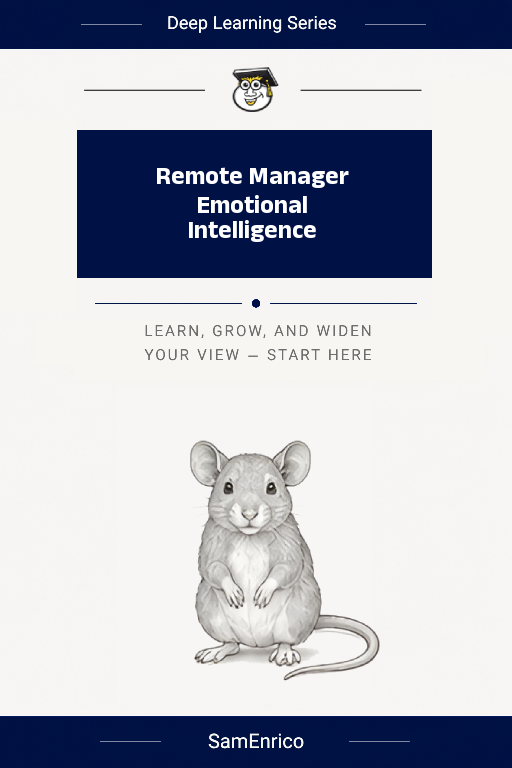
Non-FictionProfessional's Cheat SheetEmotional Intelligence
Remote Manager Emotional Intelligence eBook
Develops EQ skills for detecting remote team tensi
Develops EQ skills for detecting remote team tension through text cues, video micro-expressions, and response latency patterns.
Formats
Free sample
Chapter 1: The Empathy Gap--–- The email arrived at 11:47 PM on a Tuesday. Elena, a senior product manager at a mid-sized Saa S company, had been staring at her screen for fourteen hours. Her back ached. Her eyes burned. She had not eaten since a protein bar at noon.
When her manager's message popped up—"Quick check-in: how's the Q4 roadmap coming? Need anything from me?"—she felt her stomach clench.Her fingers hovered over the keyboard for forty-seven seconds. In that pause, she cycled through three possible responses. The first was honest: "I'm drowning. The engineering team is two weeks behind, marketing changed their requirements again, and I haven't slept through the night in a month." She deleted that after twelve seconds.
The second was measured: "We're facing some challenges with the timeline. Can we talk through resource allocation tomorrow?" She deleted that after twenty seconds. The third was the one she sent: "All good! Roadmap is on track. Will share an update at the standup.
Thanks for checking in!"She added two exclamation points and a period for emphasis. Then she closed her laptop, put her head on her desk, and cried for seven minutes before dragging herself to bed.Her manager, David, read the message the next morning over his second cup of coffee. "All good," he murmured, satisfied. He marked the email as read and moved on to the next item in his queue. As far as he knew, Elena was fine.
As far as he knew, the Q4 roadmap was on track. As far as he knew, he had done his job as a supportive manager by checking in.This is the empathy gap. It is the single most destructive force in remote leadership, and it is almost entirely invisible to the people who suffer from it most.The Anatomy of the Empathy Gap The empathy gap is not a failure of caring. David genuinely cared about Elena. He had promoted her eighteen months earlier, advocated for her compensation increase, and defended her work to senior leadership.
He was not a bad manager. He was a manager operating with incomplete information in an environment that actively concealed the truth.The empathy gap is a failure of signal detection. In a physical office, David would have seen Elena's exhaustion. He would have noticed the dark circles under her eyes, the way her coffee intake had doubled, the stack of granola bar wrappers in her trash can. He would have heard the fatigue in her voice during the morning standup, seen the way she slumped in her chair during the afternoon meeting, observed the increasing frequency of her sighs.In a remote environment, all of those signals disappeared.
David saw Elena for thirty minutes per week on a carefully lit Zoom call where she sat up straight, smiled at appropriate moments, and reported progress with practiced optimism. He read her Slack messages, which she crafted with the same care she would apply to a client email. He reviewed her work products, which she had learned to polish until the cracks were invisible.David was not blind. He was looking in the wrong places.The Data Behind the Disconnect The empathy gap is not anecdotal. It is measured, documented, and replicated across industries, company sizes, and geographies.
The data tells a consistent and disturbing story.According to Microsoft's 2023 Work Trend Index, which surveyed more than thirty-one thousand workers across thirty-one countries, 65 percent of remote employees report feeling isolated, burned out, or disengaged from their work. Yet 80 percent of managers in the same survey rated themselves as empathetic and in tune with their teams. The fifteen-point gap between these numbers is not a rounding error. It is a chasm.Gallup's State of the Global Workplace report adds another layer. Among fully remote workers, only 23 percent report that their manager regularly checks in on their well-being in a way that feels authentic and helpful.
The remaining 77 percent describe their manager's check-ins as performative, superficial, or outright absent. Employees report that when managers ask "How are you?" they are not actually prepared to hear an honest answer. The question has become a ritual, not a genuine inquiry.Buffer's 2023 State of Remote Work report, based on a survey of twenty-five hundred remote workers, found that the top three struggles cited by remote employees are loneliness (47 percent), difficulty with work-life balance (43 percent), and communication challenges (42 percent). Notably, these struggles are almost never raised with managers. Employees cite fear of being seen as incompetent, fear of retaliation, and fear of being replaced as the primary reasons they hide their struggles.The University of California conducted a study of remote teams in the technology sector and found that managers consistently overestimate their team's well-being by an average of 38 percent.
In other words, when a manager believes their team is at 80 percent health, the team is actually at 50 percent. The researchers dubbed this the "proximity bias of empathy"—the tendency to assume that absence of visible distress is evidence of absence of distress.Why Traditional Emotional Intelligence Fails at a Distance To understand why the empathy gap exists, we must first understand what emotional intelligence is and why it was never designed for remote work.Emotional intelligence, as defined by psychologist Daniel Goleman in his seminal 1995 book, consists of four domains: self-awareness, self-management, social awareness, and relationship management. These domains have been refined and expanded by subsequent researchers, most notably the Greaves in their work on team emotional intelligence, but the core framework remains intact.Self-awareness is the ability to recognize and understand your own emotions. In a physical office, self-awareness is supported by environmental feedback. You can see how others react to you.
You can feel the energy shift when you enter a room. You can calibrate your emotional state against the collective mood of your team. In a remote environment, that feedback loop is broken. You cannot see how your message lands. You cannot feel the tension in a room when you say something poorly received.
You are flying blind.Self-management is the ability to regulate your emotional responses. This competency is arguably more important in remote work than in any other environment. The manager who feels frustrated with an underperforming employee and fires off an angry Slack message has done damage that cannot be undone. The manager who feels anxious about a deadline and starts micromanaging every detail destroys autonomy and trust. Yet self-management receives less structural support in remote environments because the natural cooling-off period of a walk to a colleague's office or a trip to the coffee machine no longer exists.Social awareness is the ability to read the emotions of others.
This is the competency that suffers most in remote work. Social awareness depends on what psychologist Paul Ekman called "thin slices" of behavior—micro-expressions, posture shifts, tone changes, gesture clusters that occur in fractions of a second. In a physical office, these thin slices are abundant. In a Zoom call, they are compressed, pixelated, and often missing entirely. The camera captures only the face, often poorly lit.
The microphone captures only the voice, stripped of spatial context. The chat log captures only the text, stripped of timing and tone.Relationship…
This is the end of the free sample. Get the eBook to keep going. Buy now
About this book
Details
- Author
- Cardoza Marlys
- Publisher
- SamEnrico
- Language
- English
- Genre
- Non-Fiction, Professional's Cheat Sheet, Emotional Intelligence
- Released
- 2026-05-29
- Pages (approx.)
- 139
- Available as
- eBook, Audiobook

Read better in the ZLOADR app
Your eBooks on your phone or tablet. Sign in with your SamEnrico account and start reading.
More by Cardoza Marlys
 Morning Workout DemographicsCardoza Marlys$11.99
 Dolphin Swim JoyCardoza Marlys$11.99
 African Union OAU BirthCardoza Marlys$11.99
 Weight Loss Affirmation GuideCardoza Marlys$11.99
 The Gacy Victim Families StatementsCardoza Marlys$11.99
 The Dragon’s Heart: A Ballad of Fire and FleshCardoza Marlys$11.99
 Understanding Müller–barth–menger SyndromeCardoza Marlys$17.99
 Radio OperatorCardoza Marlys$11.99
 AI Video Tools ComparisonCardoza Marlys$12.99
 How to Become a Label CoderCardoza Marlys$11.99
You may also like
 Hong Kong Handover 1997Dunn Johnnie$11.99
 Zumba For Postnatal Recovery CourseNeal Christian$11.99
 Zumba for BeginnersLadner Nikia$11.99
 YouTube Comment Mining GuideHumes Pandora$12.99
 Worry Box MeditationCarlin Rudy$11.99
 Workplace Stress MeditationNguyen Lynn$11.99
 Workplace Stress and Sleep RepairHawley Ivory$11.99
 Workplace Perfectionism CureDelaney Jeffry$11.99
 Workplace Injustice Anger GuideWallen Isabelle$11.99
 Work Addiction and Burnout LinkGreenwood Ester$11.99
 Women in Yoga and WellnessBeattie Galina$11.99
 Women in Stand Up ComedyChun Evangeline$11.99