
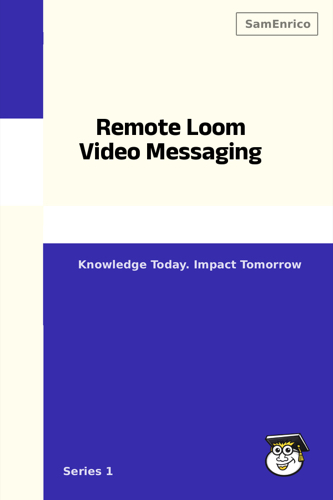
Non-FictionSelf-HelpVideo Messaging
Remote Loom Video Messaging eBook
Record and share screen capture videos for asynchr
Record and share screen capture videos for asynchronous updates and training.
Formats
Free sample
Chapter 1: The 23-Minute Thief--–- The conference room was empty, but the calendar was full. Four back-to-back meetings, three Slack pings per minute, and a looming deadline that somehow felt both urgent and impossible to reach. Sarah, a senior product manager at a growing tech company, had just closed her laptop at 6:47 PM. She had answered 142 messages, attended 6 hours of meetings, and produced exactly 37 minutes of actual work. Her to-do list was longer than when she started.
She was exhausted, anxious, and certain of one thing: something was deeply wrong with how work worked.This is not a story about laziness, poor time management, or a lack of discipline. Sarah was a high performer—promoted twice in three years, praised for her responsiveness, known as someone who "got things done." The problem was not Sarah. The problem was the system. The problem was the assumption, baked into the very fabric of modern knowledge work, that real-time communication is the default, the gold standard, the way things have always been done.The default expectation of synchronous communication—meetings, instant messaging, phone calls, and the constant hum of notification badges—is the single biggest destroyer of deep work, productivity, and sanity in remote and hybrid teams. This chapter names the thief, measures its cost, and offers the first glimpse of a way out.The Sync Default: A Cultural Hangover Every organization operates on unspoken assumptions about how communication should happen.
These assumptions are rarely written in any handbook, but they are enforced relentlessly through social pressure, management expectations, and the architecture of our tools.The most damaging of these assumptions is what I call the Sync Default—the unconscious belief that important communication requires everyone to be present at the same time. If you need an answer, you send a Slack message and expect a reply within minutes. If you need to share information, you schedule a meeting. If you need to make a decision, you gather everyone on a call.This default did not emerge from careful study of productivity or human cognition. It emerged from physical office culture, where tapping someone on the shoulder was faster than writing a memo.
It emerged from legacy management styles that mistook visible busyness for actual contribution. It emerged from the anxiety of leaders who felt they needed to "see" their teams working.But the Sync Default is a hangover, not a strategy. And in the transition to remote and hybrid work, it has become a disaster.Consider the math of a typical day. A 10 AM standup that runs 15 minutes over. A 1 PM design review where seven people watch one person share a screen.
A 3 PM client call that could have been an email. Constant Slack pings arriving at random intervals, each one a tiny guillotine dropping on your focus. Now ask yourself: how many uninterrupted 90-minute blocks of deep work actually exist on your calendar this week?For most knowledge workers, the answer is zero.I have asked this question to over 2,000 professionals in workshops and keynotes. Less than 5 percent can identify a single 90-minute block in the current week. When I ask them to calculate the same for next week, after they have control over their calendar, the number rises slightly—but rarely above one or two blocks.We have built work environments that systematically prevent the very thing that creates value: focused, uninterrupted cognitive effort.The Cost of a Ping To understand the damage, we need to understand how human attention actually works.
The brain is not a computer processor that can switch tasks instantly. It is a biological organ with significant switching costs.Dr. Gloria Mark, a professor at the University of California, Irvine, has spent decades studying attention in the workplace. Her research delivers a staggering finding: after any interruption, it takes an average of 23 minutes to fully refocus on the original task. This is not a measure of distraction—it is a measure of the cognitive tax of context switching.Here is what happens in those 23 minutes.
The interruption arrives—a Slack ping, a meeting notification, a calendar reminder. The brain stops processing the deep work task and shifts to the interruption. Even if you ignore the interruption, the mere awareness of it consumes cognitive resources. If you respond, you enter a new context entirely. When you try to return to the original task, your brain must reconstruct the mental state you were in before the interruption—the variables you were tracking, the problem you were solving, the next step you were planning.
This reconstruction is not instantaneous. It takes, on average, 23 minutes.Now multiply that cost by the number of interruptions in a typical day. A 2022 study by Rescue Time found that the average knowledge worker checks Slack or email every 6 minutes. That is roughly 80 interruptions per day. Even if only half of those require a full context switch, the cumulative cost is staggering: nearly 6 hours of context recovery time daily.Six hours.
Every day. Wasted not on work, but on recovering from interruptions.Meetings: The Most Expensive Interruption Meetings deserve special attention because they are the most culturally entrenched and the most expensive form of synchronous communication. The math is brutal.A 30-minute meeting with 10 attendees consumes 5 person-hours of attention. That is not a meeting—that is a labor cost. If the average salary of those attendees is $80,000 per year (roughly $40 per hour), that single meeting costs the organization $200 in direct labor.
But the true cost is higher because the meeting also creates context switching for every attendee. Each person loses roughly 23 minutes before and after the meeting to refocus. Add another $15 per person, and the meeting now costs $350.Now multiply that by the number of meetings in a typical week. The average manager attends 25 meetings per week. Twenty-five.
That is 12.5 hours of meeting time, 200 person-hours of collective attention, and nearly 10 hours of context switching cost per manager per week.This is not collaboration. This is organizational self-harm.Media Synchronicity Theory: When to Use What To escape the Sync Default, we need a framework for matching communication tools to tasks. Fortunately, such a framework exists. It is called Media Synchronicity Theory (MST), and it was developed by Alan Dennis, Robert Fuller, and Joseph Valacich in the early 2000s.MST argues that communication media exist on a spectrum from synchronous (same time) to asynchronous (different time). Synchronous media include face-to-face conversations, phone calls, video calls, and instant messaging.
Asynchronous media include email, documents, project management tools, and recorded video messages.The critical insight of MST is that each type of media excels at different communication tasks. Synchronous media are superior for conveying ambiguity and building consensus. When you need to interpret tone, negotiate meaning, or resolve misunderstandings, real-time back-and-forth is essential. Asynchronous media are superior for conveying complex, detailed information that requires processing time. When you need to share a report, review a design, or explain a process, asynchronous media allow the receiver to engage at their own pace, re-read or re-watch difficult sections, and respond when they have had time to think.The mistake most teams make is using synchronous media for tasks that require data processing.
They schedule a meeting to review a document that no one has read. They jump on a call to debug…
This is the end of the free sample. Get the eBook to keep going. Buy now
About this book
Details
- Author
- Trujillo Magnolia
- Publisher
- SamEnrico
- Language
- English
- Genre
- Non-Fiction, Self-Help, Video Messaging
- Released
- 2026-06-09
- Pages (approx.)
- 130
- Available as
- eBook, Audiobook

Read better in the ZLOADR app
Your eBooks on your phone or tablet. Sign in with your SamEnrico account and start reading.
More by Trujillo Magnolia
 Menstrual Health Non Binary GuideTrujillo Magnolia$11.99
 Dreams After Witnessing DeathTrujillo Magnolia$11.99
 Sexual Addiction In Clergy Recovery HandbookTrujillo Magnolia$11.99
 Dreams in Political ImprisonmentTrujillo Magnolia$11.99
 The Last Broadcast of AtlantisTrujillo Magnolia$11.99
 The Last Love Letter: The Secret Romance of Eleanor of Aquitaine and SaladinTrujillo Magnolia$11.99
 Graduate ConsultantTrujillo Magnolia$11.99
 Understanding Hemeralopia, Congenital EssentialTrujillo Magnolia$17.99
 How to Become a NeckerTrujillo Magnolia$11.99
 Renewable Energy Standard Contract TermsTrujillo Magnolia$12.99
 Essay Prompt Engineering HandbookTrujillo Magnolia$12.99
You may also like
 Hong Kong Handover 1997Dunn Johnnie$11.99
 Zumba For Postnatal Recovery CourseNeal Christian$11.99
 Zumba for BeginnersLadner Nikia$11.99
 YouTube Comment Mining GuideHumes Pandora$12.99
 Worry Box MeditationCarlin Rudy$11.99
 Workplace Stress MeditationNguyen Lynn$11.99
 Workplace Stress and Sleep RepairHawley Ivory$11.99
 Workplace Perfectionism CureDelaney Jeffry$11.99
 Workplace Injustice Anger GuideWallen Isabelle$11.99
 Work Addiction and Burnout LinkGreenwood Ester$11.99
 Women in Yoga and WellnessBeattie Galina$11.99
 Women in Stand Up ComedyChun Evangeline$11.99