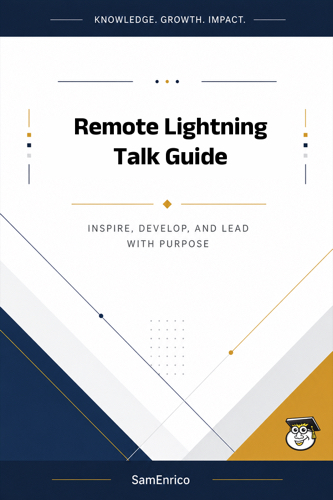
Remote Lightning Talk Guide eBook
Run short, punchy presentations in virtual setting
Run short, punchy presentations in virtual settings.
Formats
Free sample
Chapter 1: The Core Sentence–- Most presenters fail before they say a single word. Not because they are nervous. Not because their slides are ugly. Not because their microphone is cheap. They fail because they have confused a topic with a point.
And that confusion is fatal.Walk into any office—physical or virtual—and you will hear versions of the same mistake. Someone says, “Today I’m going to talk about our Q3 sales numbers.” Another says, “I’d like to share an update on the marketing campaign.” A third announces, “Let me walk you through the new product roadmap.” These are all topics. They are nouns. They describe a subject area. But they do not argue anything.
They do not ask the audience to change their minds, feel something new, or take action. They simply say, “Here is a thing. Listen to me talk about it.”And the audience, being rational, thinks: “Why?”Why should I listen? Why should I care? Why should I give you my limited attention when Slack is pinging, my inbox is overflowing, and my coffee is getting cold?
The presenter has offered no reason. They have offered no point. And so the audience checks out. Not because they are rude. Not because they are lazy.
Because the presenter has not earned their attention.This chapter fixes that. It introduces the single most important concept in this entire book: the Core Sentence. Master this, and everything else—your structure, your slides, your delivery, your Q&A—becomes easier. Ignore this, and nothing else matters.The Difference Between a Topic and a Point Let us start with a clear distinction. A topic is a subject area.
It answers the question “What will you talk about?” A point is an arguable claim. It answers the question “What do you want me to believe, feel, or do after listening?”Here are examples of topics:Our Q3 sales performance The state of the marketing funnel An update on the software release My summer vacation The history of our company Here are examples of points:We need to change our pricing model to hit Q4 targets.The marketing funnel is leaking 30% of leads at the middle stage.The software release should be delayed by two weeks to fix the security flaw.You should visit the Oregon coast because it will change how you think about nature.Our company’s founding story teaches us that risk-taking is our greatest asset.Notice the difference? Topics are safe. Topics are neutral. Topics require nothing from the audience.
Points are dangerous. Points are controversial. Points demand a response. You can agree or disagree with a point. You can feel something about a point.
You can act on a point. A topic just sits there, like a dead fish on a table.Joel Schwartzberg, one of the sharpest thinkers on presentation strategy, puts it this way: “You don’t present a topic. You argue a point.” In his book Get to the Point!, Schwartzberg shows that the single biggest difference between memorable presentations and forgettable ones is whether the presenter has identified their single, arguable point before they open their mouth. Most presenters skip this step. They start with a topic, assume the audience will find it interesting, and then ramble for twenty minutes.
The audience leaves remembering nothing.This chapter exists to make sure you are not one of those presenters.The Core Sentence Defined Your Core Sentence is a single, declarative statement that captures the irreducible argument of your lightning talk. It has five characteristics:One sentence. Not two. Not a paragraph. One.
If you cannot fit your point into a single sentence, you have not found your point yet. You have found a topic area or a collection of ideas. Keep digging.Arguable. A fact is not a point. “The sky is blue” is a fact.
It is true, but no one argues about it. Your Core Sentence should be something that a reasonable person could disagree with. “We should change our pricing model” is arguable. “Our sky is blue” is not. If your sentence does not create at least a little tension, it is not a point.Specific.
Vague sentences are forgettable. “We need to do better” is vague. What does “better” mean? How? By when?
A strong Core Sentence names the action, the target, or the outcome. “We need to reduce customer churn by 10% in Q4 by improving onboarding” is specific. It gives the audience something to grab onto.Memorable. Your Core Sentence should be repeatable. If someone leaves your talk and tells a colleague “She said that we need to change the pricing model,” you have won.
If they leave and say “She talked about Q3 numbers,” you have lost. The test: can you say your Core Sentence to a friend in a loud bar and have them remember it ten minutes later? If not, simplify.Actionable. The Core Sentence should point toward something the audience can do. Not every lightning talk ends with a literal call to action, but every good Core Sentence implies one.
“Our company’s founding story teaches us that risk-taking is our greatest asset” implies that the audience should take more risks. “The marketing funnel is leaking leads” implies that the audience should fix the funnel. If your sentence has no implied action, it is an observation, not an argument.Let us put these five characteristics together. Here is a weak Core Sentence: “I want to talk about our customer support metrics.” That is a topic. It is not arguable, specific, memorable, or actionable.
Here is a strong Core Sentence: “Our customer support team needs to reduce average response time from four hours to one hour by the end of Q2.” That is one sentence, arguable (someone could say “That is too aggressive”), specific (four hours to one hour, end of Q2), memorable (the number shift sticks), and actionable (reduce response time).That is a Core Sentence.The “So What?” Test You think you have a Core Sentence. How do you know? You run it through the “So What?” Test.This is a thirty-second exercise that forces you to find the emotional or logical core of any pitch. Here is how it works. Write down your proposed Core Sentence.
Then ask “So what?” Answer honestly. Then ask “So what?” again. Keep asking until you either arrive at something that makes you wince or you realize you have nothing to say.Let me demonstrate.Starting sentence: “I want to talk about our sales numbers.”So what? “So… sales numbers tell us how we are doing.”So what? “So… if they are good, we are succeeding.
If they are bad, we are failing.”So what? “So… we need to pay attention to them.”So what? “So… if we do not pay attention, we might miss our targets.”So what? “So… we could lose money or miss bonuses.”That final answer—we could lose money or miss bonuses—is getting closer to a real point. But it is still vague.
Let us try again with a different starting sentence.Starting sentence: “We need to change our pricing model.”So what? “So… our current pricing is leaving money on…
This is the end of the free sample. Get the eBook to keep going. Buy now
About this book
Details
- Author
- Pannell Carey
- Publisher
- SamEnrico
- Language
- English
- Genre
- Non-Fiction, Self-Help, Presentations
- Released
- 2026-06-06
- Pages (approx.)
- 130
- Available as
- eBook, Audiobook

Read better in the ZLOADR app
Your eBooks on your phone or tablet. Sign in with your SamEnrico account and start reading.
More by Pannell Carey
 Public Speaking for PastorsPannell Carey$11.99
 Phone Separation AnxietyPannell Carey$11.99
 The Great Central Bank Heist of Ghana: A Crime That Changed a Nation's LawsPannell Carey$11.99
 How to Produce CeilingsPannell Carey$11.99
 Construction Equipment Flood CoveragePannell Carey$12.99
 Patio BuilderPannell Carey$11.99
 How to Start a Project Management Business (Beginners Guide)Pannell Carey$11.99