
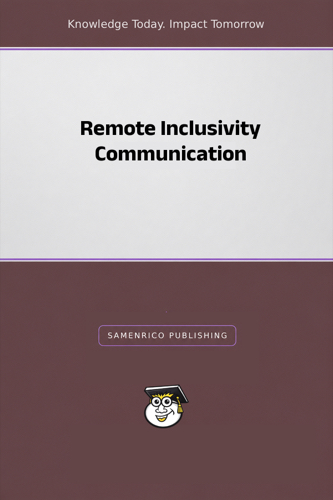
Remote Inclusivity Communication Audiobook
Teaches ensuring all voices are heard in async and
Teaches ensuring all voices are heard in async and sync settings.
Formats
Free sample
Chapter 1: The Invisible Tax--–- The promotion announcement landed in Priya’s inbox at 9:17 AM on a Tuesday. She didn’t need to open it. She already knew. Mike had gotten the role. Again.
For the third time in eighteen months, a promotion had gone to someone who sat closer to the manager’s office than to their own work. Priya’s numbers were better. Her client feedback was stronger. Her project completion rate was fourteen points higher. None of it mattered.
Because Priya worked from Austin, Texas, and Mike worked from the Chicago headquarters, six feet from their manager’s door.This is not a story about meritocracy failing. Meritocracy never existed in the first place. This is a story about proximity bias—the invisible, hardwired, deeply human tendency to trust, favor, and promote the people we see most often. And until leaders understand how this bias operates in remote and hybrid environments, they will continue to make worse decisions, lose better talent, and build teams that mistake visibility for value.This chapter is the foundation of everything that follows in this book. Before you can implement the Predictability Principle, before you can design equitable asynchronous and synchronous conversations, before you can build a listening culture, you must first understand the bias that breaks everything else.
Proximity bias is the original sin of distributed work. And dismantling it is the first non-negotiable step toward remote inclusivity.The Science of Seeing Is Believing Why do humans trust the people they see more often? The answer is not management theory. It is evolutionary biology. For hundreds of thousands of years, human survival depended on immediate, visible threats.
The tiger in the tall grass. The rival tribe over the hill. The weather changing in real time. Our brains are not wired to trust what we cannot see. They are wired to trust what is right in front of us.This worked beautifully for survival.
It works terribly for distributed work.In 2015, researchers at MIT’s Sloan School of Management conducted a study on proximity and performance evaluation. They tracked 2,400 employees across seven organizations, measuring both objective performance metrics and subjective manager ratings. The results were damning. Employees who sat within twenty-five feet of their manager received performance ratings that were fifteen percent higher than employees who sat farther away—even when objective performance metrics were identical. Fifteen percent.
Just for being close.This is not conscious discrimination. No manager wakes up thinking, “I will favor the people near me…
This is the end of the free sample. Get the Audiobook to keep going. Buy now
About this book
Details
- Author
- Thames Sterling
- Publisher
- SamEnrico
- Language
- English
- Genre
- Non-Fiction, Self-Help, Diversity
- Released
- 2026-06-07
- Pages (approx.)
- 153
- Available as
- eBook, Audiobook

Listen in the VoxFlicks app
Audiobooks and audio dramas wherever you go. Sign in with your SamEnrico account and press play.
More by Thames Sterling
 Binge Eating After Weight Loss GuideThames Sterling$11.99
 Anticipatory Grief and GratitudeThames Sterling$11.99
 The Preparation PostureThames Sterling$11.99
 Self Exclusion Success ManualThames Sterling$11.99
 Triangulated Child HealingThames Sterling$11.99
 The Air Force Overdose SurvivorThames Sterling$11.99
 Murdoch AustralianThames Sterling$11.99
 Ketogenic Diet Growth Hormone SurgeThames Sterling$11.99
 The Silent Ward: How a Nurse Became Death’s AllyThames Sterling$11.99
 The Silent Coup: How a Billionaire's Backroom Deal Reshaped an IndustryThames Sterling$11.99
 Bannockburn: The Hammer of Scotland's FreedomThames Sterling$11.99
 The Complete Guide to the Turbocharged DietThames Sterling$11.99
You may also like
 Hong Kong Handover 1997Dunn Johnnie$11.99
 Zumba For Postnatal Recovery CourseNeal Christian$11.99
 Zumba for BeginnersLadner Nikia$11.99
 YouTube Comment Mining GuideHumes Pandora$12.99
 Worry Box MeditationCarlin Rudy$11.99
 Workplace Stress MeditationNguyen Lynn$11.99
 Workplace Stress and Sleep RepairHawley Ivory$11.99
 Workplace Perfectionism CureDelaney Jeffry$11.99
 Workplace Injustice Anger GuideWallen Isabelle$11.99
 Work Addiction and Burnout LinkGreenwood Ester$11.99
 Women in Yoga and WellnessBeattie Galina$11.99
 Women in Stand Up ComedyChun Evangeline$11.99