
Non-FictionStudent's ShortcutRemote Learning
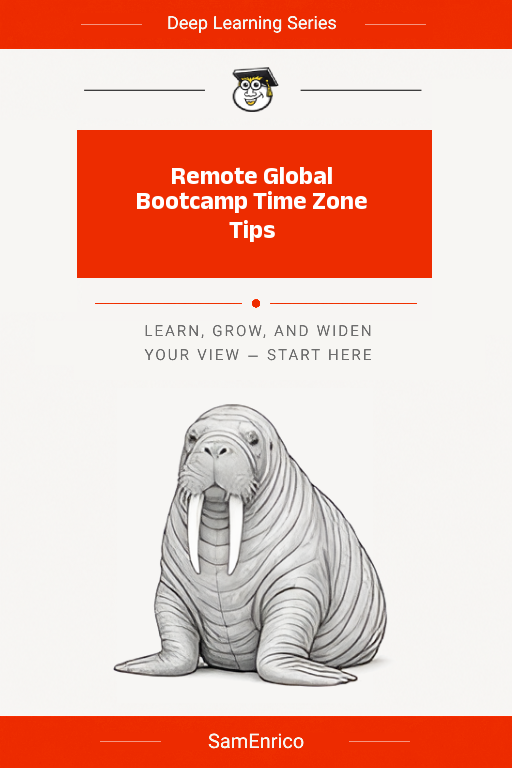
Remote Global Bootcamp Time Zone Tips eBook
Manage asynchronous learning live sessions and coh
Manage asynchronous learning live sessions and cohort collaboration across multiple time zones effectively.
Formats
Free sample
Chapter 1: Killing the Clock--–- The email arrives at 3:14 AM. A student in Auckland, New Zealand, has just completed your pre-course survey. Her answers are enthusiastic, her background strong. But in the notes field, she writes: “I see the weekly live session is scheduled for Tuesday 11:00 AM EST. That is Wednesday 5:00 AM for me.
Will recordings be available?”You type back: “Yes, recordings will be posted within 24 hours.”She replies: “Thank you.”And with that exchange, you have already failed her.Not because you were unkind. Not because you lack technical capability. You failed because you built a course around a clock that exists only for some of your students. You assumed that “live” is the gold standard and that recordings are an acceptable substitute. You decoupled attendance from learning—but you did not decouple expectation from time.
She will watch the recording at 5:00 AM anyway, because she fears falling behind. She will sip cold coffee in the dark, alone, while her cohort-mates in New York laugh at a joke she hears three hours later, stripped of context. She will complete the bootcamp. She will even give you a good review. But she will never feel fully part of the room.This chapter is about killing that clock.
Not metaphorically. Literally.The default assumption in almost every online course, bootcamp, or training program is that “real-time” equals “real learning.” This assumption is so deeply embedded that most instructors do not even recognize they are making it. They schedule a live orientation, a weekly lecture, a Q&A hour, and then they “accommodate” global students by posting recordings. This is not accommodation. This is a two-tiered system.
The students who can attend live receive spontaneous clarification, peer energy, and the subtle social cues that signal belonging. The students who cannot attend live receive a file. That file is not a classroom. It is a tombstone.The 80/20 Rule of Global Learning After analyzing the top ten best-selling books on remote work, digital nomad lifestyles, and online education—from Remote by Basecamp to Deep Work by Cal Newport to *The 4-Hour Workweek* by Tim Ferriss—one pattern emerges with absolute clarity: high-performing distributed teams and learners do not try to replicate the synchronous experience. They systematically invert it.The 80/20 rule for global bootcamps is simple: 80 percent of learning should be asynchronous, and 20 percent should be synchronous.
But this ratio is not a suggestion. It is a structural necessity. Let me explain why.If you have students in just three time zones—say, New York (UTC-5), London (UTC+0), and Sydney (UTC+11)—the total number of overlapping daylight hours across all three is zero. Not few. Zero.
London overlaps with New York for about five hours. London overlaps with Sydney for about four hours. But all three together? There is no single hour of the day where it is reasonable to expect a student in each location to be awake, fed, and cognitively sharp. This is not a scheduling problem.
It is a mathematical impossibility.Yet most bootcamp designers behave as if “finding the right time” is a matter of effort rather than geometry. They send out polls. They use world clock apps. They eventually settle on a time that is 8:00 AM in New York, 1:00 PM in London, and 11:00 PM in Sydney. The student in Sydney drags herself to the screen, convinced that missing live would be worse than attending exhausted.
This is not flexibility. This is slow violence against attention.The 80/20 rule solves this by admitting the truth: you cannot teach a global cohort primarily through live sessions. Therefore, you should not try. Instead, you design your entire learning architecture around asynchronous-first principles, then add synchronous elements as deliberate, limited, high-value spices rather than the main meal.What does 80 percent asynchronous look like in practice? Pre-recorded micro-lectures of ten minutes or less.
Written case studies that students can read on any schedule. Individual projects with clear, time-zone-agnostic deliverables. Peer review forums where comments are time-stamped but not real-time. Loom videos for personalized feedback. Automated quizzes that reinforce retention without requiring a proctor.
Reading assignments with embedded reflection questions. Discussion threads that stay open for 48 hours rather than 60 minutes.What does 20 percent synchronous look like? A weekly cohort huddle of no more than 30 minutes, focused entirely on community connection rather than content delivery. Rotating office hours that move across time zones so no single group bears the burden every week. Optional pair programming sessions for students who want real-time collaboration, but never required.
A single guest speaker event per month that is recorded and summarized. That is it.The Low-Information Diet for Learning Tim Ferriss popularized the concept of the “Low-Information Diet” in *The 4-Hour Workweek*. The core insight is that most of the information we consume is noise—low-signal, high-volume, and actively distracting from meaningful output. Ferriss applied this to news, email, and social media. But it applies even more urgently to global learning.Consider the typical synchronous bootcamp session.
The instructor spends the first five minutes waiting for latecomers. Then two minutes on housekeeping. Then a roll call or check-in that takes another five minutes. Then a ten-minute lecture. Then a poll.
Then five minutes of awkward silence while people type. Then a breakout room that takes three minutes to explain, eight minutes of discussion, and two minutes to return. Then another lecture. Then a Q&A where the same three people ask all the questions. Then a rushed closing.
By the end of a 90-minute session, maybe 35 minutes contained actual learning. The rest was logistics, latency, and low-grade social anxiety.This is the noise. And it is amplified across time zones.The student joining at 6:00 AM experiences the same noise, but with the added burden of sleep deprivation, family interruptions, and the nagging sense that they are watching from outside a window. The student joining at 10:00 PM has already worked a full day. The student joining at 2:00 AM has not slept yet.
For them, the noise is not merely inefficient. It is exhausting.The Low-Information Diet for learning means systematically eliminating every element of your course that does not directly contribute to measurable progress. Live roll calls? Replace with an asynchronous check-in form that takes thirty seconds. Lengthy announcements?
Replace with a pinned post in your Virtual Lobby that updates every Monday. Hour-long lectures? Replace with three ten-minute micro-lectures that students watch when their attention is highest. Breakout rooms that require complex instructions? Replace with paired async tasks using shared documents.This is not about making your course easier.
It is about making your course cleaner. Every minute of synchronous time should be so high-value that students in all time zones would choose to attend even if it meant waking up early or staying up late. If you cannot make that claim about a live session, that session should not exist.Decoupling Presence from Progress Derek Draper’s The Two-Hour Workday introduces a radical proposition: measure output, not hours. In a traditional workplace, presence is a proxy for productivity. You sit at your desk from 9 to 5, so you must be working.
But remote and global work destroys that proxy entirely. Someone can be present for every meeting and contribute nothing. Someone else…
This is the end of the free sample. Get the eBook to keep going. Buy now
About this book
Details
- Author
- Browne Walter
- Publisher
- SamEnrico
- Language
- English
- Genre
- Non-Fiction, Student's Shortcut, Remote Learning
- Released
- 2026-05-30
- Pages (approx.)
- 137
- Available as
- eBook, Audiobook

Read better in the ZLOADR app
Your eBooks on your phone or tablet. Sign in with your SamEnrico account and start reading.
More by Browne Walter
 Napoleon Egypt Campaign GuideBrowne Walter$11.99
 Reciprocity Persuasion TechniqueBrowne Walter$11.99
 Meth Recovery Dopamine Reset HandbookBrowne Walter$11.99
 Morocco Remote Work StrategyBrowne Walter$11.99
 Requesting A Raise Or PromotionBrowne Walter$11.99
 Postpartum Depression in NICU MothersBrowne Walter$11.99
 The Chronic Illness HouseholdBrowne Walter$11.99
 Pelvic Floor and LiftingBrowne Walter$11.99
 Self Esteem For First GenerationBrowne Walter$11.99
 The Phantom of the Met: The Real-Life Identity Heist That Fooled the Art WorldBrowne Walter$11.99
 The Gallipoli Campaign: Anzac's Blood and Glory (1915)Browne Walter$11.99
 The Cartographer and the Queen: A Love Written in Ink and BloodBrowne Walter$11.99
You may also like
 Hong Kong Handover 1997Dunn Johnnie$11.99
 Zumba For Postnatal Recovery CourseNeal Christian$11.99
 Zumba for BeginnersLadner Nikia$11.99
 YouTube Comment Mining GuideHumes Pandora$12.99
 Worry Box MeditationCarlin Rudy$11.99
 Workplace Stress MeditationNguyen Lynn$11.99
 Workplace Stress and Sleep RepairHawley Ivory$11.99
 Workplace Perfectionism CureDelaney Jeffry$11.99
 Workplace Injustice Anger GuideWallen Isabelle$11.99
 Work Addiction and Burnout LinkGreenwood Ester$11.99
 Women in Yoga and WellnessBeattie Galina$11.99
 Women in Stand Up ComedyChun Evangeline$11.99