
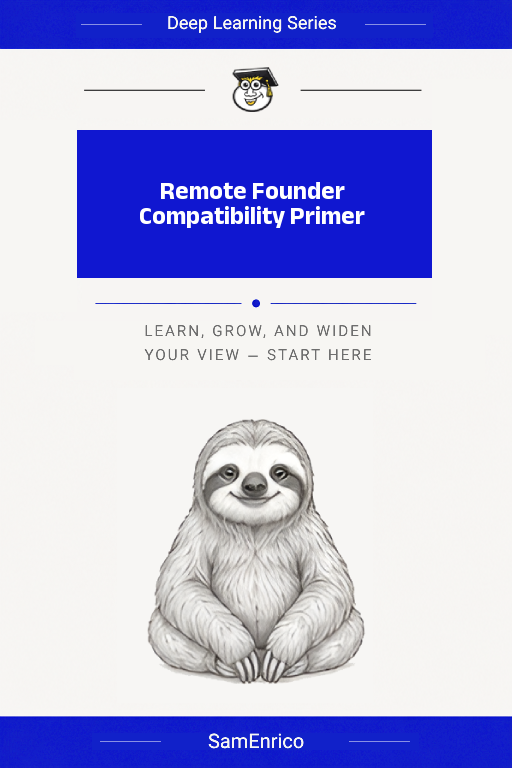
Non-FictionFirst 30 DaysPartnership MatchingCompatibility Guide
Remote Founder Compatibility Primer eBook
Assess time zone overlap, communication styles, an
by Hay Janean
Assess time zone overlap, communication styles, and work ethic before committing. Includes personality assessment guides, conflict resolution scripts, and async collaboration tips.
Formats
Free sample
Chapter 1: The Proximity Lie--–The first time I watched a co-founder partnership implode, I was sitting in a We Work conference room in Austin, Texas, listening to two grown men scream at each other over who had replied to which Slack message and when. They had been best friends for eleven years. They had lived together in college. They had been each other’s best man at their weddings. And now, eight months into their remote-first startup, they could not stand to be in the same Zoom room without a mediator present.The argument that day was about a missed deadline.
But the real fight was about something neither of them could name. The CTO, based in Berlin, had stopped responding to messages after 2 p.m. Central European Time. The CEO, based in Austin, took that as a personal insult. “He used to answer at midnight when we shared an office,” the CEO told me, confused and angry.
“Now he just disappears.” The CTO, on the other end of the call, looked exhausted. “I’m not disappearing,” he said. “I’m sleeping. I have a life. You used to see me work eighteen hours a day because we were in the same room.
You never asked if I wanted to.”That conversation ended the startup. Not a bad market. Not a flawed product. Not a lack of funding. Two people who liked each other enormously discovered that liking was not enough when the only thing connecting them was a screen and a time zone map.This book exists because of that conversation and hundreds like it.Over the past six years, I have advised, invested in, or simply watched more than two hundred remote-first founding teams.
Some succeeded beyond anyone’s expectations. Most failed. And the ones that failed almost never failed for the reasons they thought. They did not fail because of a bad idea. They did not fail because of competition.
They failed because they discovered, six or twelve or eighteen months in, that they were not remotely compatible. The relationship that worked in a coffee shop or a shared office suite did not survive the distance.This chapter is about why that happens. And more importantly, it is about the single most dangerous assumption that remote founders make: that proximity in the past predicts compatibility at a distance.The Friendship Trap Let me name the enemy clearly. It is not conflict. It is not disagreement.
It is not even incompetence. The enemy is the assumption that because you have worked well together in person, you will work well together remotely.I call this the Proximity Lie.The Proximity Lie says: “We know each other. We’ve shared an office. We’ve grabbed drinks after work. We’ve seen each other stressed.
Therefore, we can figure out the remote thing.”This is a lie because physical proximity masks almost every behavior that kills remote partnerships. When you share an office, you see someone working. That visibility creates a powerful but misleading sense of accountability. You assume that because someone is at their desk, they are productive. You assume that because someone nods when you speak, they agree with you.
You assume that because someone laughs at your joke, they respect you.Remote work strips away all of those visual cues. And what remains is the truth about how someone actually operates when no one is watching.I have seen the Proximity Lie destroy partnerships that looked perfect on paper. Two founders who had built a successful agency together for five years in a shared office. Two childhood friends who had started three side projects before finally launching a real company. Two former colleagues who had won awards at a Fortune 500 company and decided to strike out on their own.In every case, they made the same mistake.
They assumed that social compatibility — the ease they felt in each other’s presence, the history they shared, the laughter and the late nights — would translate into structural compatibility: the ability to coordinate, communicate, and execute across distance without the crutch of physical co-location.It did not.Structural vs. Social Compatibility: The Crucial Distinction Let me define these two terms carefully because the entire framework of this book rests on them.Social compatibility is the degree to which you enjoy being around another person. It includes shared humor, similar values, mutual respect, and the kind of easy rapport that makes conversations feel effortless. Social compatibility is what most people mean when they say “we get along.” It is valuable. It is not useless.
But it is not sufficient for remote work.Structural compatibility is the degree to which your working systems, habits, and preferences align when the physical context is removed. It includes how you document decisions, how quickly you respond to messages, how you handle ambiguity, how you prioritize tasks, and how you communicate urgency. Structural compatibility is not about liking each other. It is about functioning together.Here is the hard truth that the Proximity Lie hides: high social compatibility can actually mask low structural compatibility. When you are in the same room, you compensate for each other’s structural weaknesses with social grace.
You laugh off a missed deadline. You forgive a vague email because you can walk over and clarify. You tolerate poor documentation because you can just ask.Remote work removes that compensation mechanism. And when it does, low structural compatibility reveals itself not as a minor annoyance but as a fatal flaw.Consider the difference in practice. A socially compatible pair might spend an hour on a video call laughing and catching up, but if they have no shared system for tracking decisions, that hour produces nothing actionable.
A structurally compatible pair might never share a personal joke, but their shared documentation, response time agreements, and decision protocols allow them to execute flawlessly across twelve time zones.Which pair would you rather start a company with?The answer should be obvious, and yet almost every founder I have met prioritizes social compatibility first. They interview potential co-founders for likability. They do reference checks on character. They ask, “Do I want to spend ten hours a day with this person?” They rarely ask, “Does this person write decisions down? Do they respond to Slack within an hour?
Do they need daily video calls to feel connected?”This book is designed to help you ask — and answer — those second questions.A Brief Failure Story: The Indiegogo Campaign That Destroyed a Friendship Let me ground this in a real example. I have changed the names and some details, but the shape of the story is true.Marcus and Elena had been friends since graduate school. They had worked on three research projects together, co-authored two papers, and shared an office for two years. When they decided to launch a hardware startup, they did not even consider working with anyone else. They were the dream team.Their product was a smart gardening sensor.
They ran a successful Indiegogo campaign, raising $340,000. They had six months to deliver.Marcus moved to Shenzhen to manage manufacturing. Elena stayed in San Francisco to handle software development and customer support. They had a five-hour…
This is the end of the free sample. Get the eBook to keep going. Buy now
About this book
Details
- Author
- Hay Janean
- Publisher
- SamEnrico
- Language
- English
- Genre
- Non-Fiction, First 30 Days, Partnership Matching, Compatibility Guide
- Released
- 2026-06-01
- Pages (approx.)
- 154
- Available as
- eBook, Audiobook

Read better in the ZLOADR app
Your eBooks on your phone or tablet. Sign in with your SamEnrico account and start reading.
More by Hay Janean
 Energy Management TechnologyHay Janean$11.99
 Last Mile Real Time Tracking Implementation HandbookHay Janean$11.99
 Self Esteem Physical Intimacy GuideHay Janean$11.99
 Payment Models For Poor ClientsHay Janean$11.99
 The Clockwork Dreamer: How a 12-Year-Old Invented the First Wind-Up ToyHay Janean$11.99
 Quetzalcoatl's Serpent Song: The Feathered Serpent's Divine MelodyHay Janean$11.99
 Understanding Herpes Viridae DiseaseHay Janean$17.99
 Cloud DevOps Outlook 2026Hay Janean$12.99
 How to Start a Mount Cutting Business (Beginners Guide)Hay Janean$11.99
 Customer Support ManagerHay Janean$11.99
You may also like
 Hong Kong Handover 1997Dunn Johnnie$11.99
 Zumba For Postnatal Recovery CourseNeal Christian$11.99
 Zumba for BeginnersLadner Nikia$11.99
 YouTube Comment Mining GuideHumes Pandora$12.99
 Worry Box MeditationCarlin Rudy$11.99
 Workplace Stress MeditationNguyen Lynn$11.99
 Workplace Stress and Sleep RepairHawley Ivory$11.99
 Workplace Perfectionism CureDelaney Jeffry$11.99
 Workplace Injustice Anger GuideWallen Isabelle$11.99
 Work Addiction and Burnout LinkGreenwood Ester$11.99
 Women in Yoga and WellnessBeattie Galina$11.99
 Women in Stand Up ComedyChun Evangeline$11.99