
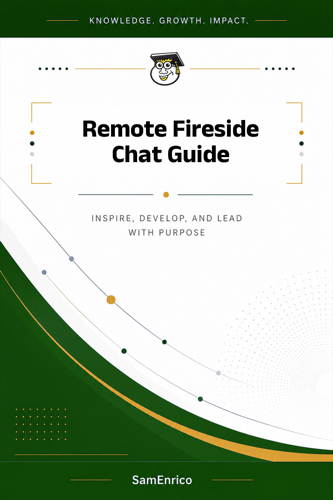
Remote Fireside Chat Guide eBook
Run intimate leader conversations in virtual town
Run intimate leader conversations in virtual town halls.
Formats
Free sample
Chapter 1: The Attendance Illusion--–- It was 2:47 PM on a Wednesday when Sarah, a seasoned vice president of product, clicked “End Meeting” on her quarterly all-hands. Two hundred and fourteen employees had attended. The chat log showed eleven thumbs-up emojis. Three people had asked questions, two of which were about vacation policy. Sarah leaned back in her chair, exhausted, and told her chief of staff, “That went fine.
Good attendance.” What she didn’t know—what she could not see from her perch behind the virtual podium—was that across nine time zones, her best engineer had spent forty minutes muting and unmuting himself, trying to find the courage to ask why the company’s strategy had changed, before finally closing his laptop and crying in frustration. Her most loyal manager had typed a thoughtful question about burnout, then deleted it three times, afraid of seeming negative. And her newest hire, a brilliant introverted designer, had checked out entirely at minute twelve, switching to email while Sarah read slide fourteen of thirty-two.This is not a story about bad leadership. It is a story about a broken format. And until leaders like Sarah recognize that “good attendance” is not the same as “real alignment,” they will continue to mistake silent rectangles for engaged teams.The Quiet Catastrophe of the Virtual Town Hall The virtual all-hands meeting has become the most dangerous ritual in modern management.
Dangerous not because it is malicious, but because it is deceptive. It produces the appearance of connection while systematically eroding the substance of trust. Leaders walk away feeling they have done their job—they showed up, they shared information, they opened the floor for questions. Employees walk away feeling more isolated, more confused, and less likely to speak than before the meeting began.Let me name what many of you have felt but perhaps not articulated: the traditional virtual town hall, as currently practiced, is actively damaging your organizational culture. It is not merely ineffective.
It is counterproductive. It trains people to be passive, to hide, and to disassociate from the collective mission.How did we get here? When the world shifted abruptly to remote work, leaders did what humans always do in a crisis: they replicated what they knew. The physical town hall—that once-a-quarter gathering in a conference room or auditorium—became the Zoom all-hands. Same agenda.
Same slides. Same monologue. Only now, instead of a room of bodies with subtle cues of boredom or engagement, leaders faced a grid of rectangles, most of them silent, most of them with cameras off, all of them impossible to read.The problem was never the technology. The problem was the assumption that a format designed for passive consumption in a physical space would translate to active connection in a virtual one.Three Failures That Fool Almost Every Leader Let me be specific about what breaks when you try to run a traditional town hall for more than fifty people in a virtual environment. These are not opinions.
They are structural failures baked into the format itself.Failure One: Diffusion of Responsibility In a room of two hundred people, no single person feels personally responsible for the success of the conversation. This is not a character flaw; it is a well-documented psychological phenomenon. When responsibility is distributed across a crowd, individual accountability evaporates. In a physical meeting, the weight of the room—the proximity of bodies, the visibility of faces, the social pressure of being seen—creates a baseline level of engagement. You might not ask a question, but you feel expected to pay attention.
In a virtual meeting, that social scaffolding disappears. You are alone in your home, surrounded by distractions that feel more urgent than a distant leader on a screen.The result is what I call the “someone else will ask” fallacy. Every participant assumes that someone else will ask the hard question, surface the uncomfortable truth, or admit confusion. And because everyone assumes someone else will act, no one acts. The leader finishes the meeting believing there were no concerns.
The employees leave believing the leader doesn't care. Both are wrong, and both are trapped by diffusion of responsibility.Failure Two: The Performance Trap Something peculiar happens to leaders when they see two hundred names on a screen. They stop talking to people and start performing for an audience. Their voice rises slightly. Their posture stiffens.
They begin reading from notes or slides rather than speaking from memory or instinct. This is the performance trap—an unconscious shift from conversation mode to presentation mode that signals safety for the leader but distance for everyone else.The tragedy is that leaders fall into this trap because they care. They want to be clear. They want to be professional. They want to respect everyone’s time by being efficient.
But efficiency is not the same as connection. A perfectly delivered, tightly scripted, slide-driven monologue communicates competence, yes—but it does not communicate warmth, vulnerability, or approachability. And in a virtual environment, where physical cues are muted, warmth is the primary currency of trust.When a leader stands behind a virtual podium (which is to say, when they lecture from slides for more than ten minutes), they send an implicit message: I am here to inform you, not to hear you. Even if they open the floor for questions at the end, the tone has been set. The performance has established a power gradient that makes authentic dialogue nearly impossible.Failure Three: The Vanity of Attendance Perhaps the most deceptive failure is the simplest one: leaders mistake attendance for alignment.
They look at the participation number—180 out of 200 attended, 90 percent!—and conclude that the meeting was a success. But attendance measures only one thing: whether someone clicked a link. It does not measure whether they listened, understood, agreed, or cared.I have watched employees attend mandatory all-hands while simultaneously answering email, making dinner, or scrolling social media. I have watched them keep their cameras off and their microphones muted for an entire hour, contributing nothing, learning nothing, and resenting the obligation. Attendance numbers tell you nothing about attention, and attention is the only thing that matters.The data bears this out.
In my research and across dozens of organizations, I have found that active participation—defined as asking a question, typing a substantive chat comment, or reacting to content—drops by more than seventy percent when the group size exceeds fifty people. By the time you reach two hundred participants, meaningful participation is statistically negligible. You are not running a conversation. You are broadcasting a podcast that people are forced to attend.The Silent Majority: Your Best Thinkers Are Not Speaking There is a deeper problem beneath these three failures, one that most leaders never see because the format actively hides it from view. Let me introduce you to a concept that will appear throughout this book: the Silent Majority.In any large virtual gathering, roughly eighty percent of participants will never speak.
They will never ask a question, never type a substantive comment, never raise a virtual hand. They will sit in silence for the duration of the meeting, contributing nothing audible or visible…
This is the end of the free sample. Get the eBook to keep going. Buy now
About this book
Details
- Author
- Rayburn Lucinda
- Publisher
- SamEnrico
- Language
- English
- Genre
- Non-Fiction, Self-Help, Leadership
- Released
- 2026-06-10
- Pages (approx.)
- 141
- Available as
- eBook, Audiobook

Read better in the ZLOADR app
Your eBooks on your phone or tablet. Sign in with your SamEnrico account and start reading.
More by Rayburn Lucinda
 Venture Debt DepreciationRayburn Lucinda$11.99
 Grayscale Phone InterventionRayburn Lucinda$11.99
 The Sumo Swindle: How a Japanese Wrestler Fooled Renaissance SpainRayburn Lucinda$11.99
 Wind Farm Business Interruption GuideRayburn Lucinda$12.99
 How to Start a Programmer for Textile Machinery Business (Beginners Guide)Rayburn Lucinda$11.99
 How to Produce Celery RootsRayburn Lucinda$11.99
 Payroll and Benefits SpecialistRayburn Lucinda$11.99
You may also like
 Managerial Stress Reduction WorkbookHolden Heike$11.99
 Emotional Regulation For LeadersWolf Chantel$11.99
 CEO Flow StatesFinnegan Jonah$11.99
 Validation for LeadersLackey Debi$11.99
 The Calm Leader GuideStrand Alverta$11.99
 The Assertiveness for New ManagersThomson Margit$11.99
 Pomodoro for Managers GuideLoftin Page$11.99
 Nonverbal Cues In Leadership CourseTRUE Betsey$11.99
 Navigating Workplace ConflictNoyes Sherly$11.99
 Legacy for LeadersSadler Rusty$11.99
 Improv for LeadershipSkaggs Lura$11.99
 Fear Of Failure In LeadershipHendrickson Lavern$11.99