
Non-FictionSelf-HelpEmail Skills
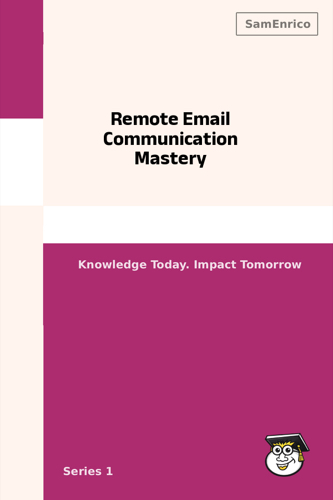
Remote Email Communication Mastery eBook
Write clear, actionable emails that reduce back an
Write clear, actionable emails that reduce back and forth and misunderstandings.
Formats
Free sample
Chapter 1: The 3-Hour Tax--If you are reading this sentence, you have likely just checked your email within the last sixty seconds. You might have done it without thinking—a reflexive flick of the thumb on your phone, a habitual click on a browser tab that has not been closed in four years, a nervous glance at a notification badge that glows red like an accusation. You are not alone. According to data from the global remote work analysis conducted by the email productivity firm Rescue Time, the average remote worker checks their email seventy-seven times per day. That is once every twelve minutes during a standard eight-hour workday.
And here is the detail that should terrify you: most of those checks are completely unnecessary.The problem is not email. Email, as a technology, is neutral. It is a protocol, a set of rules that allow messages to travel from one server to another. The problem is not even the volume of email, although volume is certainly a contributing factor. The problem is what happens inside your brain each time you switch from the work you intend to be doing to the work your inbox is demanding you pay attention to.
That switching cost—the cognitive friction of stopping one task, orienting to another, and then trying to find your way back to the original task—is the single largest unacknowledged tax on knowledge workers in the remote era. This book calls that tax the 3-Hour Tax, and the opening chapter of this book is dedicated to making you feel its weight, understand its mechanisms, and commit to a fundamental shift in how you relate to your inbox.The Anatomy of Cognitive Fragmentation To understand the 3-Hour Tax, you must first understand a concept that neuroscientists call "attention residue." When you are working on Task A—say, writing a quarterly report, analyzing a spreadsheet, or planning a product launch—your brain builds what is known as an attentional set. This is a temporary neural framework that holds the context, rules, goals, and relevant data for that specific activity. Your working memory loads up the relevant facts. Your procedural memory activates the sequences of actions you need to take.
Your inhibitory control suppresses distractions that might pull you away. This is a state of flow, or something close to it.Then you check your email.Even if you look away for only thirty seconds, even if you do not reply, even if the email is spam, the act of switching attention fragments the attentional set you had built. Your brain must now suppress Task A's framework and activate a new framework for Task B (email triage). When you return to Task A, your brain does not simply snap back to where it left off. It must reload the context, reconstruct the mental model, and reorient to the specific point of progress.
The residue of Task B lingers. And the research on this is unforgiving.In a landmark study conducted at the University of California, Irvine, researcher Gloria Mark and her team followed knowledge workers in their natural environments. They found that after an interruption—any interruption, including an email check—it took an average of twenty-three minutes and fifteen seconds for a worker to return to the original task with the same level of focus and cognitive depth. That is not twenty-three minutes to notice the interruption and click back to the report. That is twenty-three minutes to achieve the same depth of concentration as before the interruption.
For twenty-three minutes, you are working in a shallow, distracted, partial state—what Mark calls "working while interrupted."Now multiply that by seventy-seven daily email checks. Even if only half of those checks occur during deep work (a conservative estimate), you are losing roughly forty-three minutes per check to the combination of the interruption itself plus the recovery time. That is more than three hours of lost cognitive capacity every single day. That is the 3-Hour Tax.Urgency Versus Importance: The Remote Distortion Field The 3-Hour Tax would be justifiable if every email check prevented a catastrophe. But the vast majority of emails are not urgent.
They are not even important. They are, to use a technical term, noise. However, remote work has distorted our ability to distinguish urgency from importance for three specific reasons.First, remote work removes physical context. In an office, you can look across the room and see whether a colleague is in a deep work state (headphones on, staring at a screen, not making eye contact) or available for interruption (leaning back in a chair, walking to the coffee machine, making small talk). That visual data allows you to calibrate your own responsiveness.
You do not interrupt someone who is clearly focused unless the building is on fire. But in remote work, every colleague exists in the same flat digital plane. A request from your boss arrives in the same format as a shipping notification from Amazon. Without the physical cues, urgency becomes a matter of sender anxiety rather than actual importance.Second, remote work has collapsed the distinction between synchronous and asynchronous communication. When you work in the same physical space, you naturally use different tools for different timelines.
You tap someone on the shoulder for an immediate answer (synchronous). You send an email for something that can wait hours or days (asynchronous). But remote work has blurred these boundaries. People send emails expecting instant replies because they cannot tap a shoulder. They send Slack messages expecting asynchronous responses because they do not want to schedule a call.
The result is a permanent state of low-grade urgency where every channel demands immediate attention.Third, remote work amplifies the "availability bias"—the tendency to assume that because someone is online (green dot on Slack, active status on Teams, recently sent an email), they are available to respond. This is a dangerous fallacy. Being online means your computer is on. It does not mean you are not in deep work. It does not mean you are not on a call.
It does not mean you are not eating lunch with your family. But the green dot creates an expectation of responsiveness that did not exist in the physical office, where a closed door was a clear signal. In remote work, there is no closed door. There is only the expectation, and the guilt that follows when you disappoint it.The Reactor Versus the Strategist: A Self-Assessment Before we go any further, you need to know where you currently stand. The remainder of this chapter presents a self-assessment that will classify you as either a Reactor or a Strategist.
There is no moral judgment here. The remote work environment has been deliberately designed to turn all of us into Reactors. Notifications are engineered to be addictive. The green dot is designed to create social pressure. The inbox is designed to look like a to-do list that never empties.
Becoming a Strategist requires conscious effort and a willingness to swim against the current of how email software wants you to behave.Answer each of the following questions honestly. Do not answer how you wish you behaved. Answer how you actually behaved in the…
This is the end of the free sample. Get the eBook to keep going. Buy now
About this book
Details
- Author
- Ramsay Annita
- Publisher
- SamEnrico
- Language
- English
- Genre
- Non-Fiction, Self-Help, Email Skills
- Released
- 2026-06-10
- Pages (approx.)
- 134
- Available as
- eBook, Audiobook

Read better in the ZLOADR app
Your eBooks on your phone or tablet. Sign in with your SamEnrico account and start reading.
More by Ramsay Annita
 Cultural Dream Processing TraditionsRamsay Annita$11.99
 IUD And Period Changes GuideRamsay Annita$11.99
 Sexual Integrity Restoration WorkbookRamsay Annita$11.99
 Dream Processing After SurgeryRamsay Annita$11.99
 The Sound of a Thousand Stars: How a Silent Film Revolutionized HollywoodRamsay Annita$11.99
 Maui's Fishing Line: The Hook That Bent the SkyRamsay Annita$11.99
 Corporate Renewable Procurement OutlookRamsay Annita$12.99
 Grad School Research Proposal WorkbookRamsay Annita$12.99
 Understanding Heart Defects Limb ShorteningRamsay Annita$17.99
 How to Start a Caviar Substitute Business (Beginners Guide)Ramsay Annita$11.99
 Conscious Sedation MonitoringRamsay Annita$11.99
You may also like
 Hong Kong Handover 1997Dunn Johnnie$11.99
 Zumba For Postnatal Recovery CourseNeal Christian$11.99
 Zumba for BeginnersLadner Nikia$11.99
 YouTube Comment Mining GuideHumes Pandora$12.99
 Worry Box MeditationCarlin Rudy$11.99
 Workplace Stress MeditationNguyen Lynn$11.99
 Workplace Stress and Sleep RepairHawley Ivory$11.99
 Workplace Perfectionism CureDelaney Jeffry$11.99
 Workplace Injustice Anger GuideWallen Isabelle$11.99
 Work Addiction and Burnout LinkGreenwood Ester$11.99
 Women in Yoga and WellnessBeattie Galina$11.99
 Women in Stand Up ComedyChun Evangeline$11.99