
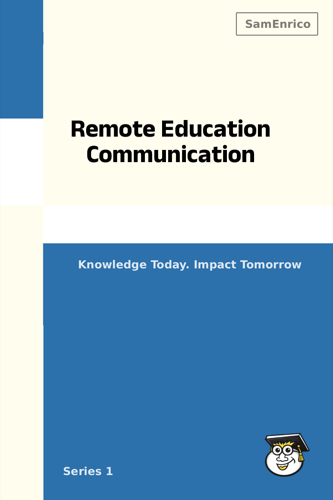
Remote Education Communication eBook
Engages students in virtual classrooms.
by Dunlap Oma
Engages students in virtual classrooms.
Formats
Free sample
Chapter 1: The Digital Threshold...--The first time Ms. Elena Vasquez closed her laptop after a full day of remote teaching, she cried. Not from sadness, exactly, but from a profound sense of failure. She had done everything right by the old standards: she had logged in on time, delivered her carefully prepared slides, asked questions, and waited for answers. But thirty students had been reduced to thirty black rectangles with names in gray type.
Three students spoke. The rest were ghosts. She had taught, but had anyone learned? That question—the one that keeps educators awake at night—is the central problem of remote education communication. You can deliver instruction, but without engagement, you have not taught.
You have merely broadcasted.This chapter solves that problem. It moves you from the exhausting cycle of broadcasting to empty grids toward the intentional design of genuine virtual presence. You will learn why traditional teaching presence fails online, what "communicative resilience" means in practice, and how to transform the first five minutes of any virtual session from awkward silence into a ritual of belonging. By the end of this chapter, you will have a concrete playbook for turning lurkers into participants, attendance into engagement, and anxiety into anticipation.The Failure of Physical Habits in Digital Spaces Every teacher who has struggled with remote instruction has made the same mistake: they imported their physical classroom habits directly into the virtual environment. This is not a failure of effort; it is a failure of translation.
The physical classroom operates on rules that simply do not exist on a screen.In a physical room, presence is automatic. When you stand at the front of a classroom, students see you in their peripheral vision. Your movement, your proximity, your very physicality exerts a gentle pressure toward attention. If a student begins to drift, you can walk toward their desk. Without a word, the behavior corrects.
This is what communication theorists call ambient authority—the unspoken power of shared physical space.In a virtual classroom, ambient authority evaporates. You are one rectangle among many. Your students can resize you, mute you, or tile you next to a cat video. The physical cues that signaled "pay attention" in a real room—your raised eyebrow, your shifted weight, your movement toward a whiteboard—are either invisible or comically compressed into a two-inch thumbnail.Worse, the screen introduces new cognitive burdens that physical classrooms do not have. The phenomenon of mirror anxiety—the stress of seeing your own face during a conversation—does not exist when you sit in a desk.
But on Zoom, your own expression stares back at you, triggering self-evaluation networks in the brain. Your students are not just watching you; they are watching themselves watch you. This dual awareness exhausts the brain and drives disengagement.The research from NSF-funded Hy Flex studies confirms what teachers feel instinctively: the traditional lecture, already inefficient in person, becomes nearly useless online. Comprehension drops by forty percent when students toggle between slides, chat, video, and notes. The brain simply cannot parallel-process these inputs.
Yet most remote teaching continues to replicate the lecture format, adding more slides and more tools, making the problem worse.This is the first and most important shift you must make: stop trying to replicate the physical classroom. Start designing for the digital threshold.Communicative Resilience: The Core Competency The skill that separates successful remote educators from struggling ones is what this book calls communicative resilience. Defined formally, communicative resilience is the ability to maintain learning momentum despite the inevitable breakdowns of virtual instruction—technical glitches, muted mics, delayed responses, environmental distractions, and the complete absence of physical feedback loops.Communicative resilience has four components, each of which will be developed throughout this chapter and the book.The first component is redundancy. In a physical classroom, you say something once, and the room carries the message. In a virtual classroom, you must say it, type it in chat, put it on a slide, and then say it again.
This is not over-teaching; it is the minimum necessary bandwidth for digital communication.The second component is patience. Virtual response times are longer. Lag, processing, and the cognitive load of screen participation mean that a five-second wait in person becomes a fifteen-second wait online. Communicative resilience means not filling silence with more words but allowing the space for processing.The third component is flexibility. When a planned activity fails—and it will fail—you need backup structures.
Polls when discussion stalls. Chat when voices freeze. Asynchronous when synchronous crashes. The resilient instructor has multiple pathways to the same learning goal.The fourth component is self-regulation. Your frustration is visible on your face, and your face is two inches from your students' eyes.
Communicative resilience requires managing your own emotional responses so that a technical failure does not become a relational failure.Developing communicative resilience is not optional. It is the fundamental competency upon which all other virtual teaching skills are built. Without it, every tool, strategy, and technique in this book will fail because you will abandon them at the first sign of trouble. With it, you can teach effectively through nearly any disruption.Why Students Lurk: The Psychology of Screen Participation Before you can move students from attendance to engagement, you must understand why they disengage. The term lurking describes the behavior of students who are logged in and technically present but contribute nothing cognitively or communicatively.
Lurking is not laziness. It is a rational response to the psychological conditions of the virtual classroom.The first cause of lurking is camera anxiety. Many students experience the video grid as a panopticon—a space where they are constantly watched but can never see who is watching them. They worry about their appearance, their background, their facial expressions, their children or siblings wandering into frame. This anxiety is not trivial.
Research on mirror anxiety shows that seeing one's own face during conversation activates the same neural networks as social evaluation. Students who are already self-conscious in person become paralyzed online.The second cause is interruption fear. In a physical classroom, turn-taking is managed by subtle physical cues: a slight lean forward, a raised hand, eye contact. On a video call, these cues disappear. Lag means that two people often begin speaking at the same time, followed by the awkward "you go first" dance.
Students learn that speaking is unpredictable and sometimes embarrassing, so they stop trying.The third cause is self-view distraction. Nearly every video platform shows you your own face by default. Looking at yourself while trying to learn divides attention between content and self-monitoring. Students may spend the entire session checking their own expressions rather than processing instruction. This is not vanity; it is a design flaw.The fourth cause is past negative experience.
Many students have been called on when unprepared, mocked for their background noise, or interrupted mid-sentence. These experiences create conditioned avoidance. The virtual classroom becomes a space of potential humiliation, so they hide behind the gray rectangle.The fifth cause is simply cognitive overload. Trying to watch slides, read chat, listen to the instructor, monitor your own face, and ignore your phone is exhausting. Lurking is…
This is the end of the free sample. Get the eBook to keep going. Buy now
About this book
Details
- Author
- Dunlap Oma
- Publisher
- SamEnrico
- Language
- English
- Genre
- Non-Fiction, Self-Help, Education
- Released
- 2026-06-05
- Pages (approx.)
- 147
- Available as
- eBook, Audiobook

Read better in the ZLOADR app
Your eBooks on your phone or tablet. Sign in with your SamEnrico account and start reading.
More by Dunlap Oma
 Lighthouse Evening RelaxationDunlap Oma$11.99
 Flow in Flow Art PracticesDunlap Oma$11.99
 Canva Brand Folder SetupDunlap Oma$11.99
 Senior Medication ManagementDunlap Oma$11.99
 Self Hypnosis for Rotator Cuff PainDunlap Oma$11.99
 Phobia Support Groups GuideDunlap Oma$11.99
 Daily Affirmations HandbookDunlap Oma$11.99
 The Shadow of the Rising Sun: Yamato's War for the Land of the GodsDunlap Oma$11.99
 The Nightingales of the Western Front: Florence Nightingale and the Birth of Modern NursingDunlap Oma$11.99
 A Collector's Handbook to the Wolseley 85Dunlap Oma$11.99
 Tigers: Big Cat GuideDunlap Oma$11.99
 How to Produce Automatic DetergentDunlap Oma$11.99
You may also like
 Hong Kong Handover 1997Dunn Johnnie$11.99
 Zumba For Postnatal Recovery CourseNeal Christian$11.99
 Zumba for BeginnersLadner Nikia$11.99
 YouTube Comment Mining GuideHumes Pandora$12.99
 Worry Box MeditationCarlin Rudy$11.99
 Workplace Stress MeditationNguyen Lynn$11.99
 Workplace Stress and Sleep RepairHawley Ivory$11.99
 Workplace Perfectionism CureDelaney Jeffry$11.99
 Workplace Injustice Anger GuideWallen Isabelle$11.99
 Work Addiction and Burnout LinkGreenwood Ester$11.99
 Women in Yoga and WellnessBeattie Galina$11.99
 Women in Stand Up ComedyChun Evangeline$11.99