
Non-FictionSelf-HelpDocument Management
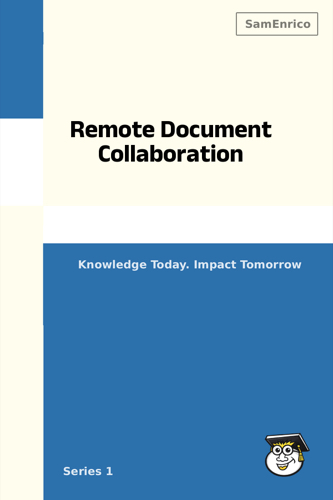
Remote Document Collaboration eBook
Comment, suggest edits, and track changes in share
by Holley Ling
Comment, suggest edits, and track changes in shared files without confusion.
Formats
Free sample
Chapter 1: The Attachment Graveyard--–- It begins, as these things always do, with an email. Not a dramatic email, not a hostile one, but an email that lands in your inbox at 4:47 PM on a Friday, just as you were about to close your laptop. The subject line reads: "Urgent: Final edits on the proposal." The body contains a single sentence: "Here are my comments – please incorporate by EOD." And attached is a file named Proposal_FINAL_v3_Jane_edits.docx.The problem, of course, is that you already have three other versions of this same proposal. You have Proposal_FINAL_v2.docx from your manager, sent Tuesday. You have Proposal_FINAL_v3_John_comments.docx from your colleague in legal, sent Thursday.
And you have Proposal_FINAL_v4_really_final.docx that you created yourself yesterday after a panicked late-night session. Now Jane has sent you a fifth version, and you have no idea which document she started from, whether her "edits" are on top of John's comments or in competition with them, or whether the version she used even includes the changes you made at 11 PM last night.You open the attachment. Jane has turned on Track Changes, thank goodness. But she has also added fifteen comments in bright red balloons, three of which say only "This doesn't work" with no further explanation. She has deleted an entire paragraph that you know your manager specifically requested.
And she has written "???" in the margin next to a section that you thought was perfectly clear. You sigh. You open your messaging app to ask Jane for clarification. She is already offline for the weekend. You look at the clock.
It is now 5:03 PM. You have twenty-seven minutes to reverse-engineer Jane's intentions, reconcile her changes with John's changes, produce a coherent draft, and send it back. Your weekend, which you had planned to spend away from your laptop, disappears like a breath on a mirror.This scenario is not an edge case. It is not a rare failure of process. It is, for millions of knowledge workers, the default mode of collaboration.
We have accepted chaos as inevitable. We have normalized the 4:47 PM panic. We have built entire careers around the ability to manually merge conflicting versions of the same document, to decipher cryptic comments, to chase down stakeholders across four different communication channels just to answer the question: "What did you actually mean here?"And we have done all of this while surrounded by tools that were explicitly designed to prevent exactly this kind of confusion. The problem is not that the technology is inadequate. The problem is that we have never learned to use it as a system.The Hidden Cost of Version Chaos Before we can fix the problem, we have to measure it.
And the true cost of document collaboration chaos is almost never captured on any balance sheet.Let us start with the most obvious cost: time. A 2022 study by the collaboration software company Miro found that the average knowledge worker spends 2.5 hours per week simply searching for information—including the correct version of a document. That is more than two full work weeks per year, per employee. For a team of ten, that is twenty weeks of lost productivity annually. For a company of one thousand, that is four hundred thousand hours of labor that could have been spent on actual work, but instead was spent on the administrative task of finding the right file.But time is only the beginning.
The second cost is cognitive load. Every time you open a document named FINAL_v2 and then discover a newer file named FINAL_v3_real, your brain must perform a series of exhausting mental gymnastics: Which version is actually the most recent? Who created each version? What changes are in this file that are not in the other? Did the person who sent me this file see the changes my manager made last week?
This constant context-switching and uncertainty drains mental energy that should be reserved for creative problem-solving and strategic thinking. By the time you finally locate the correct document, you are already mentally fatigued.The third cost is errors. When teams work from inconsistent versions, mistakes multiply. A change made in one file never makes it into the "master" version. A comment from a stakeholder is accidentally deleted because the reviewer was working from an older draft.
A legal approval is granted on a version that does not include the final edits from the compliance team. These errors are not the result of carelessness. They are the inevitable outcome of a broken system. And in regulated industries—healthcare, finance, law—these errors can carry legal and financial consequences that dwarf the lost time.The fourth cost is relationships. Nothing erodes trust between colleagues faster than the experience of having your work overwritten, ignored, or misinterpreted because of version confusion.
When Sarah spends three hours editing a document, sends it to David, and David then makes changes to an older version that does not include Sarah's work, Sarah feels disrespected. David feels frustrated. Both feel that the other is incompetent. Neither is correct. The system failed them both.
But the relationship suffers anyway.Finally, there is the cost of burnout. The 4:47 PM Friday email is not just an inconvenience. It is a slow-acting poison. It teaches employees that their time is not their own, that the boundary between work and life is illusory, and that no matter how organized they try to be, chaos will always find them. Over months and years, this erodes morale, increases turnover, and drives talented people to leave for organizations that have figured out a better way.The Myth of the Careless Colleague When version chaos erupts, our first instinct is to blame the people involved.
"Jane should have used the correct file naming convention." "David should have checked the shared drive before starting his edits." "The team should have communicated better." These statements are not wrong, but they are incomplete. They focus on individual behavior while ignoring the system that shapes that behavior.In his classic book The Goal, Eliyahu Goldratt introduced the concept of the "hero" and the "system." A hero is someone who succeeds despite a broken system. The system is the environment, the rules, the tools, and the incentives that determine how work actually gets done. When a team relies on heroes—the person who remembers where every file is stored, the one who manually reconciles conflicting versions, the one who stays late to fix everyone else's mistakes—the organization becomes fragile. The heroes burn out.
And when they leave, the chaos they were holding at bay floods back in.The solution is not to train everyone to be a hero. The solution is to build a system that makes heroics unnecessary. A system where the correct version of a document is always obvious, where comments are always clear and actionable, where changes are never lost, and where the 4:47 PM Friday email simply cannot happen because the underlying process prevents it.This book is the blueprint for that system.The Single Source of Truth: Your New Religion Every functional collaboration system rests on a single, non-negotiable…
This is the end of the free sample. Get the eBook to keep going. Buy now
About this book
Details
- Author
- Holley Ling
- Publisher
- SamEnrico
- Language
- English
- Genre
- Non-Fiction, Self-Help, Document Management
- Released
- 2026-06-11
- Pages (approx.)
- 154
- Available as
- eBook, Audiobook

Read better in the ZLOADR app
Your eBooks on your phone or tablet. Sign in with your SamEnrico account and start reading.
More by Holley Ling
 Sex Addiction Withdrawal Timeline CourseHolley Ling$11.99
 DIM For Estrogen DominanceHolley Ling$11.99
 Dreams in Torture Survivor RecoveryHolley Ling$11.99
 The MBSR for Tinnitus GuideHolley Ling$11.99
 The Celestial Clockmakers of Samarkand: Ulugh Beg and the Rise of Medieval AstronomyHolley Ling$11.99
 Excalibur’s Shadow: The Knight Who Forgot His NameHolley Ling$11.99
 Understanding Hemangiomatosis, Familial Pulmonary CapillaryHolley Ling$17.99
 Renewable Energy Trading OutlookHolley Ling$12.99
 AI Prompt Workbook For StudentsHolley Ling$12.99
 How to Become a Distillation OperatorHolley Ling$11.99
 Flexographic Printing Press OperatorHolley Ling$11.99
You may also like
 Hong Kong Handover 1997Dunn Johnnie$11.99
 Zumba For Postnatal Recovery CourseNeal Christian$11.99
 Zumba for BeginnersLadner Nikia$11.99
 YouTube Comment Mining GuideHumes Pandora$12.99
 Worry Box MeditationCarlin Rudy$11.99
 Workplace Stress MeditationNguyen Lynn$11.99
 Workplace Stress and Sleep RepairHawley Ivory$11.99
 Workplace Perfectionism CureDelaney Jeffry$11.99
 Workplace Injustice Anger GuideWallen Isabelle$11.99
 Work Addiction and Burnout LinkGreenwood Ester$11.99
 Women in Yoga and WellnessBeattie Galina$11.99
 Women in Stand Up ComedyChun Evangeline$11.99