
Non-FictionSelf-HelpDecision Making
Remote Decision Making Guide eBook
Makes team choices without face to face.
by Tennant Ola
Makes team choices without face to face.
Formats
Free sample
Chapter 1: The Visibility Trap--–- On a Tuesday afternoon in March 2021, a product manager named Elena watched her $1.2 million project collapse in real time. Not because of a market shift, a competitor, or a technical failure. Because of a Slack thread.The thread had started innocently enough. A senior engineer asked, "Should we refactor the authentication module before the Q2 launch?" Within four hours, eleven people had weighed in. Two were in favor.
Three were opposed. The rest offered variations of "good point" or "has anyone considered…" No one made a decision. The thread ended with the engineer typing, "I guess we'll figure it out in the meeting tomorrow."That meeting never happened. The following day brought three more urgent threads. The authentication question drifted into the digital graveyard of "later." Six weeks later, the team discovered that two developers had made opposite assumptions about the module – one had refactored it, the other had built on top of the old version.
The resulting integration work cost $1.2 million in delayed revenue and burned out two engineers, one of whom quit within a month.Elena's story is not unusual. It is not even remarkable. Across thousands of remote and hybrid teams, the same pattern plays out daily: decisions are discussed in fragmented channels, made by accidental consensus, documented nowhere, and regretted by everyone. The problem is not bad people or low effort. The problem is that most teams are trying to make decisions using a system designed for a different era.The face-to-face meeting, for all its flaws, provided an invisible architecture for choice.
When people gathered in a room, certain rules – unspoken but powerful – governed how decisions got made. The person who spoke first often shaped the framing. The executive in the corner commanded attention through proximity. The raised eyebrow, the nod, the glance around the table – these small signals told everyone when a decision had been reached, even when no vote was taken. And when the meeting ended, the shared experience of having been in the room created a collective memory, however imperfect, of what had been agreed upon.Remove the room, and the architecture disappears.
The signals vanish. The shared memory fragments into individual recollections, each slightly different. What remains is a mess of Slack threads, calendar invites, and a gnawing feeling that something important was missed.This book exists because that feeling is correct. Something important has been missed. But the solution is not to replicate the conference room on Zoom.
The solution is to build a better system entirely – one that turns the weaknesses of remote work into strengths. This chapter lays the groundwork for that system by exposing the hidden costs of the "quick huddle," reframing how we think about decision quality, and introducing the core distinction that will guide everything that follows.The Great Unlearning Before we can build a new system, we must unlearn the habits that served us in the office but sabotage us at a distance. The most destructive of these habits is the addiction to synchronous, face-to-face decision-making – what managers call "quick huddles" and researchers call "the default to real-time."Consider a simple experiment. Ask any manager in a traditional office how they made their last three decisions. The answers will almost always include the phrase "I pulled the team together" or "We grabbed a conference room" or "I ran it by a few people in the hallway." These responses reveal an implicit assumption: that the natural unit of organizational choice is the synchronous gathering.
The meeting is not a tool among tools. It is the default.Now ask those same managers how much time they spend in meetings. The average knowledge worker, according to research from Harvard Business Review, spends nearly 23 hours per week in meetings – a number that has increased, not decreased, in the remote era. Yet when asked to rate the quality of those meetings, the same workers give an average score of 5.2 out of 10. The default assumption is producing enormous overhead for mediocre returns.The pandemic should have broken this assumption.
When every meeting became a Zoom call, the costs of synchronous coordination became suddenly, painfully visible. The back-to-back calls. The Zoom fatigue. The realization that a thirty-minute meeting actually consumed ninety minutes of cognitive recovery time. For a brief period, many teams reduced meetings, replaced calls with Loom videos, and experimented with asynchronous workflows.Then the old habits crept back.
Leaders missed the feeling of control that came from seeing their teams in a room. Teams missed the social connection, however shallow, of the shared calendar invite. By 2022, meeting volumes had returned to pre-pandemic levels, with one crucial difference: now those meetings were worse. The hallway conversations that used to resolve pre-meeting confusion no longer existed. The side conversations that clarified ambiguous points were gone.
The result was meetings that took longer, accomplished less, and left participants more exhausted than ever.This is the trap. Remote work has made synchronous meetings more costly and less effective, yet teams are holding just as many of them. The system is broken, but the default assumption remains unexamined.Collaborative Overhead vs. Decision Quality To understand why the default is failing, we need a more precise vocabulary. Let me introduce two concepts that will appear throughout this book: Collaborative Overhead and Decision Quality.Collaborative Overhead is the total cost – in time, energy, cognitive load, and emotional friction – required to coordinate people toward a choice.
Every time you schedule a meeting, write a message, wait for a response, or clarify a misunderstanding, you are incurring Collaborative Overhead. This overhead is not inherently bad; coordination is necessary. But like any cost, it must be justified by the value it produces.Decision Quality is the actual value of the choice made, measured against the available information and the stakes involved. A high-quality decision is one that maximizes desired outcomes given the constraints of time, information, and team capability. A low-quality decision is one that ignores relevant information, fails to consider alternatives, or gets made by the wrong people.Here is the critical insight: in face-to-face settings, Collaborative Overhead and Decision Quality are only loosely correlated.
A room full of charismatic people can make a terrible decision very efficiently. The meeting feels productive – people talked, someone decided, everyone nodded – but the outcome is poor. Conversely, a quiet, introverted analyst might need significant coordination time to share their insights, but those insights could save the team millions.In remote settings, however, the relationship between overhead and quality becomes even more tenuous. The absence of non-verbal cues increases the overhead required to reach consensus. The lag in communication means misunderstandings take longer to resolve.
The lack of shared context means more time spent recapping and less time spent deciding. Teams can burn enormous Collaborative Overhead and still produce low-quality decisions – or, worse, no decision at all.Elena's authentication thread illustrates this perfectly. The team incurred significant overhead: eleven people reading and writing messages, the cognitive load of tracking the conversation, the emotional friction of unanswered questions. Yet the Decision Quality was zero – no decision was made at all. The overhead produced nothing.The Charisma Bias Why do teams keep defaulting to synchronous meetings despite these costs?
The answer lies in a cognitive bias that most managers don't even know they have: the Charisma Bias.In a face-to-face…
This is the end of the free sample. Get the eBook to keep going. Buy now
About this book
Details
- Author
- Tennant Ola
- Publisher
- SamEnrico
- Language
- English
- Genre
- Non-Fiction, Self-Help, Decision Making
- Released
- 2026-06-06
- Pages (approx.)
- 147
- Available as
- eBook, Audiobook

Read better in the ZLOADR app
Your eBooks on your phone or tablet. Sign in with your SamEnrico account and start reading.
More by Tennant Ola
 Self Hypnosis for Gallbladder PainTennant Ola$11.99
 Flyer Design CanvaTennant Ola$11.99
 Quarterback Hypnosis CourseTennant Ola$11.99
 Lake Serenity VisualizationTennant Ola$11.99
 Senior Hair Changes GuideTennant Ola$11.99
 Nyctophobia Dark FearTennant Ola$11.99
 Acupuncture for Breech BabyTennant Ola$11.99
 Nefertiti's Vanished Sun: The Curse of the Lost QueenTennant Ola$11.99
 Operation Midnight Sun: The Untold Arctic Espionage WarTennant Ola$11.99
 A Collector's Handbook to the Wolseley 18Tennant Ola$11.99
 How to Produce Pipe Adapters and BushingsTennant Ola$11.99
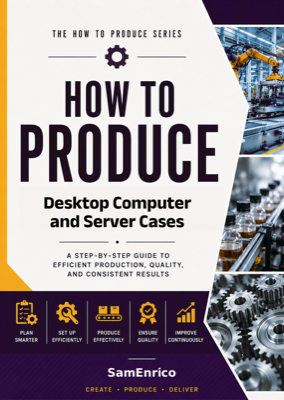 How to Produce Desktop Computer and Server CasesTennant Ola$11.99
You may also like
 Hong Kong Handover 1997Dunn Johnnie$11.99
 Zumba For Postnatal Recovery CourseNeal Christian$11.99
 Zumba for BeginnersLadner Nikia$11.99
 YouTube Comment Mining GuideHumes Pandora$12.99
 Worry Box MeditationCarlin Rudy$11.99
 Workplace Stress MeditationNguyen Lynn$11.99
 Workplace Stress and Sleep RepairHawley Ivory$11.99
 Workplace Perfectionism CureDelaney Jeffry$11.99
 Workplace Injustice Anger GuideWallen Isabelle$11.99
 Work Addiction and Burnout LinkGreenwood Ester$11.99
 Women in Yoga and WellnessBeattie Galina$11.99
 Women in Stand Up ComedyChun Evangeline$11.99